


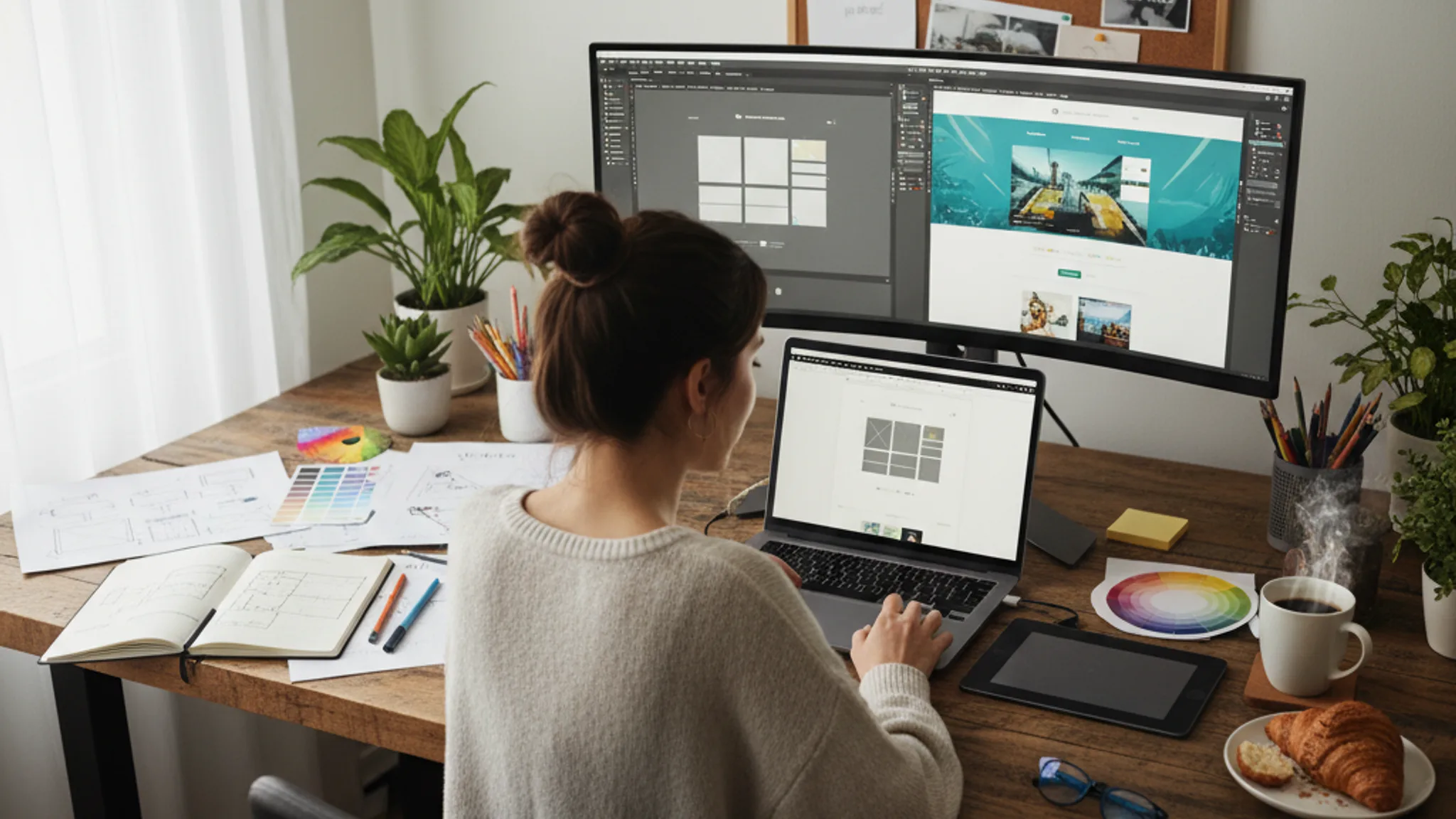
A freelance web designer is a self-employed professional who plans, designs, and often builds websites for clients on a project-by-project basis. They typically handle everything from visual design and layout to basic front-end development, content loading, and on-page SEO, working directly with you instead of through layers of account managers.
If you have searched "what does a freelance web designer do," you have probably noticed that most results are portfolio pages telling you to hire someone. Very few actually explain the role itself. This post fills that gap. It covers what services freelancers typically include, what they typically do not include, how the project process works from start to finish, and when hiring a freelancer makes more sense than hiring an agency.
Everything here is based on how we actually work at TerrisDigital, where Terris personally handles every project from consultation to launch. No theory, just how it works in practice.
What services does a freelance web designer provide?
Freelance web designer services typically cover the full journey from blank page to live website. The exact scope varies by designer, but here is what most experienced freelancers include as standard.
Visual design and layout
This is the core of the role. Visual design is the process of deciding how your website looks and feels: the colour palette, typography, spacing, imagery, button styles, and overall page structure. A freelance web designer creates unique layouts for each page of your site, making sure the design reflects your brand and guides visitors toward taking action (calling you, filling in a form, making a purchase).
At TerrisDigital, every project starts with custom design mockups in Figma. You see exactly what your site will look like before any code gets written.
Front-end development
Front-end development is the process of turning a visual design into a working website using HTML, CSS, and JavaScript. Many freelance web designers handle this themselves, which means you get a single person responsible for both how the site looks and how it functions. This eliminates the "lost in translation" problem that happens when a designer hands static mockups to a separate developer.
Mobile-responsive design
Responsive design is the practice of building a website so it adapts automatically to different screen sizes, from large desktop monitors to tablets and mobile phones. In 2026, over 60% of web traffic comes from mobile devices. Any freelance designer worth hiring builds mobile-first as standard, not as an add-on.
Content loading and formatting
Most freelancers will take the text, images, and other content you provide and place it into the website with proper formatting: headings, paragraphs, image captions, alt text, and internal links. You provide the raw materials; they structure it properly on the page.
Basic on-page SEO
On-page SEO is the practice of optimising individual web pages so they rank higher in search engine results. Freelance web designers typically handle the foundational elements: meta titles, meta descriptions, heading hierarchy (H1, H2, H3), clean URL structures, image alt text, and proper HTML semantics. This gives your site a solid starting point for search visibility without needing a separate SEO specialist.
Domain and hosting setup
Many freelancers will help you register a domain name (your website address), set up hosting (where your site files live), and configure DNS records so everything connects properly. Some include this in their project fee; others charge it separately.
CMS setup and training
A content management system (CMS) is software that lets you edit your own website content without touching code. If your site is built on WordPress, Webflow, or a similar platform, most freelancers will set up the CMS and walk you through how to make basic updates yourself: editing text, swapping images, adding blog posts.
What do freelance web designers NOT include?
This is where expectations often go wrong. Knowing what falls outside a freelance web designer's typical scope is just as important as knowing what is included.
Ongoing digital marketing
A freelance web designer builds your website. They do not typically manage your Google Ads campaigns, run your social media accounts, or execute an ongoing SEO strategy after launch. Some designers (including TerrisDigital) offer these as separate services, but they are not part of a standard web design project.
Professional photography
Designers work with the images you provide. They may source stock photography, resize and optimise images, and suggest what photos you need, but they will not show up at your office with a camera. If you need professional photos of your team, premises, or products, hire a photographer separately before the web project begins.
Large-scale copywriting
Copywriting is the craft of writing persuasive text for marketing purposes. Most freelance web designers expect you to provide the bulk of your website's written content. They will format it, suggest edits, and write short pieces like button labels or taglines, but writing 10 pages of service descriptions from scratch is copywriting, not web design. Some designers offer copywriting as an add-on service, and it is worth asking about upfront. For tips on getting your content ready, read our guide on how to prepare content for your new website.
Complex back-end development
Custom web applications, membership portals with complex user roles, payment gateway integrations, API connections to third-party systems, and database-heavy features typically require a web developer or full-stack developer rather than a web designer. Some freelancers can handle basic integrations (contact forms, booking widgets, simple e-commerce), but complex back-end work usually falls outside their scope.
Ongoing maintenance and updates
Once your site launches, it needs regular maintenance: software updates, security patches, backups, and content changes. Many solo freelancers hand over the finished site and move on to the next project. Others (like TerrisDigital) offer maintenance packages. Either way, make sure you clarify post-launch support before signing a contract.
The clearest way to avoid surprises is to ask for a written scope of work before the project starts. A good freelancer will spell out exactly what is included and what is not.
Web designer vs web developer: what is the difference?
These two titles get used interchangeably, but they describe different skill sets.
A web designer is a professional who focuses on the visual appearance, layout, and user experience of a website. They decide how pages look, how users move through the site, and how the design supports the business's goals. Their primary tools are design software like Figma, Adobe XD, or Sketch.
A web developer is a professional who writes the code that makes a website function. They build the technical structure, handle server-side logic, connect databases, and ensure everything works correctly across browsers and devices. Their primary tools are code editors and programming languages like HTML, CSS, JavaScript, PHP, or Python.
Think of it this way: the designer creates the blueprint; the developer builds the house.
| Aspect | Web Designer | Web Developer |
|---|---|---|
| Focus | Visual design, UX, brand alignment | Code, functionality, technical systems |
| Primary tools | Figma, Adobe XD, Sketch | VS Code, Git, terminal |
| Output | Mockups, wireframes, design systems | Working code, databases, APIs |
| Languages | HTML, CSS (often basic JS) | JavaScript, PHP, Python, SQL |
| Typical deliverable | A complete website design | A functioning web application |
In practice, many freelancers in 2026 are both. The traditional split between "designer" and "developer" has blurred significantly, especially among freelancers who handle entire projects solo. At TerrisDigital, Terris handles both the design and the full front-end and back-end development, which means there is no handoff between two different people and no gap between the design vision and the final product.
When you are hiring, the important question is not "are you a designer or a developer?" but "can you deliver a complete, working website that looks great and functions properly?" If the answer is yes, the title matters less than the result.
What does the freelance web design process look like?
A typical freelance web design project follows six phases: discovery, wireframing, visual design, development, testing, and launch. The entire process takes 3 to 8 weeks for most business websites, depending on the number of pages, complexity of features, and how quickly you provide content and feedback.
Here is how each phase works in practice, using TerrisDigital's actual process as an example.
Phase 1: Discovery (2 to 5 days)
Discovery is the research and planning phase where the designer learns about your business, your goals, your competitors, and your target audience. This happens through a consultation call or meeting where you discuss what your website needs to achieve, who it is for, and what you like (and dislike) about other sites in your industry.
At TerrisDigital, this is a direct conversation with Terris. No sales reps, no questionnaires passed through three departments. We discuss your business, review competitor sites together, and agree on a clear project scope. You receive a written proposal with a fixed price and defined deliverables before any work begins.
Phase 2: Wireframing (3 to 5 days)
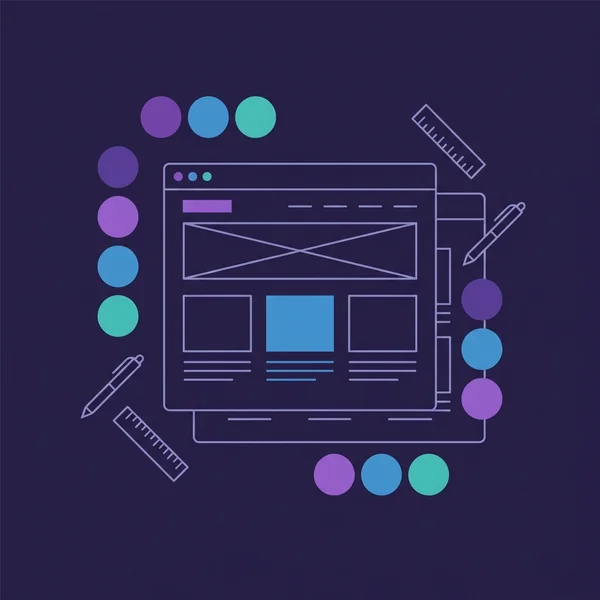
A wireframe is a simplified, black-and-white layout that shows the structure of each page: where headings, text, images, buttons, and navigation go, without any colours, fonts, or visual styling. Think of it as the skeleton of your website.
Wireframes let you approve the page structure and content hierarchy before the designer spends time on visual details. It is much easier (and cheaper) to move a section around at the wireframe stage than after the full design is complete.
Phase 3: Visual design (5 to 10 days)
This is where your brand comes to life on screen. The designer applies your colour palette, typography, imagery, and visual style to the wireframes, creating high-fidelity mockups that show exactly what the finished site will look like. You typically see desktop and mobile versions of each key page.
For TerrisDigital projects, we design in Figma and share interactive prototypes you can click through. You give feedback directly on the design file, we revise, and you approve before we move to code.
Phase 4: Development (1 to 3 weeks)
The approved designs get built into a real, working website. This involves writing HTML, CSS, and JavaScript (or building within a CMS like WordPress), making the site responsive across all screen sizes, loading your content, and connecting any forms or integrations.
Because Terris handles both design and development at TerrisDigital, there is no translation gap between the mockup and the live site. What you approved in the design phase is what you get in the browser.
Phase 5: Testing (2 to 4 days)
Before launch, the designer tests the site across multiple browsers (Chrome, Safari, Firefox, Edge), screen sizes (desktop, tablet, mobile), and operating systems. They check that all links work, forms submit correctly, images display properly, and the site loads quickly. This is also when you review the live site and request any final adjustments.
Phase 6: Launch (1 to 2 days)
The site goes live on your domain. This involves connecting your domain name, configuring SSL certificates (the padlock icon in your browser), setting up analytics tracking, submitting your sitemap to Google Search Console, and running a final round of checks to confirm everything is working in production.
For a detailed breakdown of how long each phase takes by project type, see our guide on how long it takes to build a website.
Recommended reads
What does "custom design" actually mean?
A custom website design is a website built from scratch specifically for your business, with unique layouts, styling, and structure that do not come from a pre-built template or theme.
This distinction matters because the term "custom" gets thrown around loosely in the web design industry. Here is the difference in plain terms.
Template-based design
A template-based website starts with a pre-built design that the designer customises with your logo, colours, images, and content. The underlying layout, section structure, and page patterns come from the template. Think of it like buying a suit off the rack and having it tailored to fit.
Template-based sites are faster and cheaper to produce. They work well for businesses that need a professional online presence without a large budget. The trade-off is that your site may look similar to thousands of others using the same template, and you are limited by the template's structure.
Fully custom design
A fully custom website starts with a blank canvas. The designer creates every page layout, every component, and every interaction specifically for your business goals and brand identity. Think of it like having a suit made to measure from scratch.
Custom sites take longer and cost more, but they give you complete control over the user experience, better performance (no unused template code), and a design that genuinely differentiates your business. For a breakdown of how pricing compares, see freelance web designer costs in Singapore.
The middle ground
Many freelancers (including TerrisDigital) work in a middle ground: starting with a flexible framework or component library, then custom-designing the visual layer and page layouts from scratch. You get the efficiency of proven code foundations with fully original design on top. This is how most modern custom websites get built in 2026, and it is the approach that gives clients the best balance of quality, speed, and cost.
When a freelancer tells you the design is "custom," ask specifically: are you designing the layouts from scratch, or customising a template? Both are valid approaches, but you should know which one you are paying for.
How does hiring a freelancer differ from hiring an agency?
The core difference is structure. A freelance web designer is typically one person (or a very small team) who handles your project directly. A web design agency is a company with multiple staff members, where your project passes through different people for different tasks.
Here is how that plays out in practice.
| Factor | Freelancer | Agency |
|---|---|---|
| Communication | Direct with the person building your site | Through an account manager who relays to the team |
| Cost | Generally 30 to 50% less than agencies | Higher due to office, staff, and overhead costs |
| Speed | Faster feedback loops, fewer approval layers | Longer timelines due to internal coordination |
| Scope | Best for websites and small web applications | Better for large projects needing multiple specialists |
| Consistency | Same person from start to finish | Different staff may rotate on/off your project |
| Risk | Single point of failure if unavailable | Team redundancy, but less personal attention |
The biggest advantage of a freelancer is direct communication. When you message your freelancer, the person who reads that message is the same person writing the code and pushing the pixels. There is no game of telephone between you, an account manager, a project manager, and the actual designer.
The biggest advantage of an agency is breadth of resources. If your project needs a dedicated UX researcher, a motion designer, a back-end engineer, and a copywriter all working in parallel, an agency can staff that. A freelancer typically cannot.
TerrisDigital sits in between. You get the direct communication and personal attention of a freelancer, with the professional processes, reliability, and breadth of skills that people expect from an agency. For most Singapore SMEs building a 5 to 20 page business website, this is the best of both worlds.
When should you hire a freelance web designer vs a full team?
The right choice depends on what you are building, your budget, and how much involvement you want in the process.
Hire a freelance web designer when:
- You need a business website (1 to 20 pages). Brochure sites, service-based websites, portfolio sites, and simple e-commerce stores are squarely within a freelancer's sweet spot. This covers the vast majority of Singapore SMEs.
- You want direct communication. If you prefer speaking directly to the person building your site rather than going through account managers, a freelancer gives you that.
- Your budget is SGD 2,000 to SGD 10,000. This is the typical range for freelance web design in Singapore. If your budget is under SGD 2,000, a DIY website builder may be more appropriate. If it is over SGD 15,000, you may benefit from an agency's larger team.
- You need it done in 3 to 8 weeks. Freelancers typically deliver faster than agencies because there are fewer internal processes and approvals.
- You value a single point of accountability. One person owns your project from start to finish. No finger-pointing between departments.
Hire an agency or full team when:
- You need a complex web application. Membership portals, SaaS platforms, marketplace sites, or anything requiring significant back-end development benefits from a multi-person team.
- You need integrated marketing services. If the website is part of a larger engagement that includes SEO, content marketing, paid advertising, and social media management, an agency can coordinate all of it.
- Your project involves more than 50 pages. Large-scale sites with hundreds of product pages, multiple content types, and complex taxonomy structures need more hands on deck.
- You need ongoing staffing. If you want dedicated people working on your site full-time for months, an agency or in-house hire is a better fit than a freelancer.
For most small and medium businesses in Singapore looking for a professional website, a freelance web designer is the most cost-effective and practical choice. You can always scale up to an agency later as your needs grow.
What should you look for when hiring a freelance web designer?
Not all freelancers deliver the same quality. Here are the things that separate a reliable professional from a risky hire.
A strong portfolio with real projects
Look for finished, live websites you can actually visit and click through. Concept designs and mockups are nice, but they do not prove the designer can deliver a working site. Pay attention to whether the portfolio sites load quickly, look good on mobile, and feel easy to use.
Clear communication from the first conversation
How a freelancer communicates during the sales process is how they will communicate during your project. If they are slow to respond, vague about timelines, or unclear about pricing before you have signed, that will not improve after you have paid a deposit.
A written contract with defined scope
A proper freelancer provides a written agreement that lists exactly what is included: number of pages, number of revision rounds, timeline, payment schedule, and what happens if the scope changes. If someone wants to start work without a contract, walk away.
Verified reviews or testimonials
Google reviews, Clutch profiles, and LinkedIn recommendations are harder to fake than testimonials on a personal website. Look for specific feedback that mentions the quality of the work, communication, and reliability, not just generic praise.
Post-launch support
Ask what happens after the site goes live. Does the designer offer a warranty period for bug fixes? Do they provide ongoing maintenance? Can they make changes next year if you need them? The best freelancers build long-term relationships, not one-off transactions.
Full ownership of your site
Make sure your contract states that you own the website, domain, hosting account, and all content. Some designers use proprietary systems or keep hosting access to themselves, which locks you in. You should be able to take your site and move it anywhere at any time.
For a complete list of questions to ask before signing, read our guide on questions to ask a web designer.
What should you prepare before hiring a freelance web designer?
Coming prepared makes your project faster, cheaper, and better. Here is what to have ready before your first meeting.
- Your logo and brand assets. If you have a logo, brand colours, and fonts, share them. If you do not have these yet, mention it upfront so the designer can advise or include branding as part of the project.
- Examples of websites you like. Collect 2 to 3 links to websites whose design or functionality appeals to you. Be specific about what you like: "I like the clean layout on this site" is more useful than "I like this site."
- A rough sitemap. List the pages you think you need: Home, About, Services (which services?), Portfolio, Contact, Blog, etc. Your designer will refine this, but having a starting point saves time.
- Your written content. This is the single biggest factor in project speed. If you can provide your page text, team bios, service descriptions, and FAQs before the project starts, you will shave weeks off the timeline. For a full content preparation checklist, read how to prepare content for your new website.
- High-quality images. Photos of your team, premises, products, or completed work. Professional photography is ideal, but well-lit smartphone photos work for many businesses. Avoid stock photos wherever possible.
- Access credentials. If you already have a domain name, hosting account, or existing website, make sure you have the login details ready. Surprisingly often, clients cannot access their own hosting when the project starts.
- A clear budget range. You do not need an exact number, but telling your designer "we are thinking around SGD 3,000 to 5,000" helps them propose a realistic scope instead of guessing.
For a thorough brief template you can fill out and send to your designer, see our guide on how to write a website brief.
A real-world example: how a TerrisDigital project works
To make this concrete, here is a walkthrough of a typical project for a Singapore SME at TerrisDigital. This is a real workflow, not a theoretical framework.
Day 1 to 3: Discovery call and proposal. You reach out through our website or WhatsApp. We schedule a 30 to 45 minute consultation (video call or in person) where we discuss your business, goals, target audience, competitors, and budget. Within 48 hours, you receive a written proposal with a fixed price, detailed scope, and estimated timeline.
Day 4 to 8: Content gathering and wireframes. While you prepare your text and images, we start on wireframes for the key pages. We share these via Figma for your feedback. Changes at this stage are fast and free, which is why we do not skip it.
Day 9 to 18: Visual design. We design the full visual look of your site: homepage plus 2 to 3 inner page templates. You see desktop and mobile versions, click through an interactive prototype, and provide feedback. Most clients need 1 to 2 rounds of revisions before approving.
Day 19 to 32: Development and content loading. We build the live site, make it responsive, load all your content, set up forms and analytics, and implement on-page SEO. You receive a staging link to review the site in progress.
Day 33 to 37: Testing and revisions. We test across browsers and devices, run performance audits, check all links and forms, and make your final revision requests. We also validate structured data markup and submit a sitemap to Google Search Console.
Day 38: Launch. We connect your domain, enable SSL, do a final check, and push the site live. You get a handover document with all login details, a walkthrough video for your CMS, and our contact details for ongoing support.
Total timeline: roughly 5 to 6 weeks for a standard business website. This matches what we delivered for clients like Perfect Style Salon (4 weeks) and Arcade Rental Singapore (6 weeks). The biggest variable is always content: projects where clients have their text and images ready from the start finish significantly faster.
For a deeper look at what features your website should include, read our guide on the essential features every business website needs.
Frequently asked questions about freelance web designers
How much does a freelance web designer charge?
In Singapore, freelance web designers typically charge SGD 2,000 to SGD 10,000 per project for a business website. A simple 5-page site starts around SGD 2,500 to SGD 4,000. More complex sites with custom features, e-commerce, or booking systems range from SGD 5,000 to SGD 10,000 or more. Most freelancers quote fixed project fees rather than hourly rates.
How long does it take a freelance web designer to build a website?
A standard business website takes 3 to 8 weeks from kickoff to launch. Simple sites can be done in 2 to 3 weeks. Complex sites with custom features or large amounts of content may take 8 to 12 weeks. The biggest factor is how quickly you provide content and feedback.
Do I need a web designer or a web developer?
If you need a website that looks professional and works well, a web designer who also codes (which most freelancers do in 2026) will handle the entire job. You only need a dedicated web developer if your project involves complex back-end functionality like custom web applications, complex database integrations, or advanced API work.
Can a freelance web designer help with SEO?
Most freelance web designers include basic on-page SEO: meta titles, descriptions, heading structure, image alt text, and clean URLs. For ongoing SEO strategy, keyword research, link building, and content marketing, you will need a separate SEO service. Many freelancers (including TerrisDigital) offer both.
Will I be able to edit the website myself after launch?
Yes, if the site is built on a CMS like WordPress, Webflow, or Shopify. Your freelancer should set up the CMS and provide basic training so you can update text, add images, and publish blog posts without needing to touch code. Always confirm this is included before the project starts.
What if my freelance web designer disappears mid-project?
This is a real risk with unverified freelancers. Protect yourself by checking Google reviews and portfolio references, signing a contract with milestone-based payments (never pay 100% upfront), ensuring you own the domain and hosting independently, and choosing a freelancer with a verifiable business presence. At TerrisDigital, we are a registered Singapore business with a public portfolio and reviews you can verify.
A freelance web designer does much more than "make a website look nice." They research your business, plan your site structure, design the visual experience, build the front-end (and sometimes back-end), load your content, optimise for search engines, and launch a finished product. The best ones also handle post-launch support and act as long-term partners for your business's online presence.
The key takeaways: freelancers typically include visual design, responsive development, content loading, and basic SEO. They typically do not include ongoing marketing, professional photography, large-scale copywriting, or complex back-end development. Custom design means built from scratch for your business, not customised from a template. And for most Singapore SMEs with budgets of SGD 2,000 to SGD 10,000, a freelancer delivers better value than an agency.
If you want to see how this works in practice, visit our freelance web design service page or get in touch for a free consultation. Every project at TerrisDigital starts with a no-obligation conversation where we discuss your needs and give you a clear, honest recommendation, even if that recommendation is to go elsewhere.

Written by
Terris
Founder & Lead Strategist
Terris is a freelance web designer and founder of TerrisDigital in Singapore. He has personally designed and built over 100 websites for SMEs, startups, and professional services firms, handling every project from first consultation to post-launch support.
Want to see these strategies in action? Browse our portfolio or get in touch to discuss your project.