



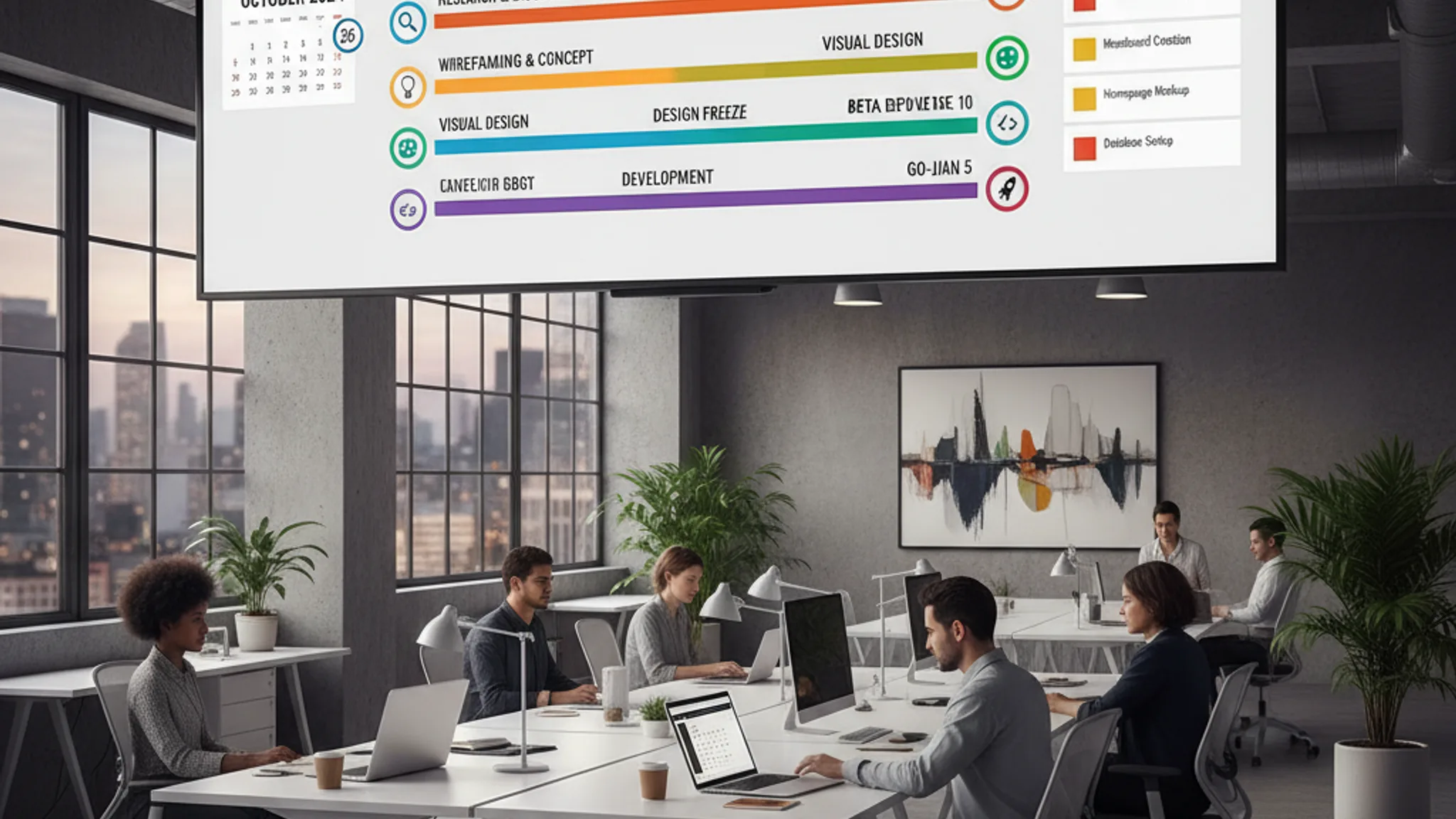
A typical business website in Singapore takes 4 to 8 weeks to build from start to launch. A simple brochure site can be done in 2 to 3 weeks. A full e-commerce store takes 6 to 10 weeks. A custom web application with complex features can stretch to 12 to 16 weeks or longer.
Those are the real numbers. Not the "it depends" answer you get from most agencies, and not the "build a website in a day" promises from DIY platforms that leave you with something that looks like it was built in a day.
We have delivered over 100 websites for Singapore businesses at TerrisDigital, and every project has reinforced the same lesson: the timeline depends on three things. The type of website, the approach you choose, and how prepared you are before the project starts.
Here is a quick reference table, followed by a detailed breakdown of every factor that affects your website development timeline.
Quick answer: website timelines by type
This table summarises realistic timelines for the most common types of websites Singapore businesses need in 2026.
| Website Type | Pages | Timeline | Best For |
|---|---|---|---|
| Landing page | 1-3 | 1-2 weeks | Ad campaigns, product launches |
| Brochure site | 3-5 | 2-3 weeks | New businesses, simple services |
| Business website | 8-15 | 4-6 weeks | SMEs, professional services |
| E-commerce store | 20-50+ | 6-10 weeks | Online retail, F&B delivery |
| Custom web app | Varies | 8-16 weeks | Portals, booking systems, SaaS |
| Website redesign | Varies | 4-8 weeks | Existing businesses refreshing their site |
These timelines assume a professional agency or experienced freelancer handling the build. They include discovery, design, development, content, testing, and launch. DIY website builders can be faster for simple sites but come with significant trade-offs (more on that below).
Now let's break down each website type in detail.
Website timeline by type: detailed breakdown
Every website project is different, but after building over 100 of them, we see clear patterns. Here is what to expect for each type of site.
Landing page (1 to 2 weeks)
A landing page is a single focused page designed to convert visitors from a specific campaign. Think Google Ads landing pages, product launch pages, or event registration pages. With one to three pages and a clear objective, these are the fastest projects to complete.
- Week 1: Strategy, design, content, and initial development
- Week 2: Refinements, testing, and launch
Many landing pages can be completed in under a week if the content and brand assets are ready. We have turned around Google Ads landing pages in as little as five business days.
Brochure site (2 to 3 weeks)
A brochure website is the digital equivalent of a business card. It covers the basics: who you are, what you do, and how to get in touch. Typically three to five pages (Home, About, Services, Contact, and maybe a Portfolio or Testimonials page).
- Week 1: Discovery call, wireframes, design mockup
- Week 2: Development, content integration, mobile optimisation
- Week 3: Revisions, testing, SEO setup, launch
Brochure sites are ideal for new businesses that need an online presence quickly. The cost is typically between $1,500 and $3,500 in Singapore.
Business website (4 to 6 weeks)
This is the most common type of website we build for Singapore SMEs. A business website typically has 8 to 15 pages covering multiple services, case studies, team profiles, blog, and detailed contact or enquiry forms. It often includes performance optimisation, SEO foundations, and integrations like Google Analytics and CRM tools.
- Week 1: Discovery, competitor research, sitemap planning
- Week 2: Wireframes and homepage design
- Week 3: Inner page designs, content finalisation
- Week 4-5: Full development, responsive testing
- Week 6: QA, SEO setup, launch prep, go live
The biggest variable here is content. If you have your website copy, images, and brand assets ready before the project starts, we can often shave a full week off the timeline.
E-commerce store (6 to 10 weeks)
E-commerce websites are more complex because they involve product catalogues, payment gateways (Stripe, PayNow, GrabPay), shipping logic, inventory management, and security considerations. A typical Singapore e-commerce site has 20 to 50+ pages once you factor in product pages, category pages, checkout flow, and account management.
- Week 1-2: Discovery, platform selection, product taxonomy
- Week 3-4: UI/UX design for storefront and checkout
- Week 5-7: Development, payment integration, product upload
- Week 8-9: Testing (payments, shipping, mobile, edge cases)
- Week 10: Soft launch, monitoring, go live
Payment gateway integration alone can add one to two weeks, especially if you need multiple Singapore-specific options like PayNow QR or GrabPay. Factor in time for product photography and descriptions if you do not already have them.
Custom web application (8 to 16 weeks)
Custom web apps include booking portals, membership platforms, internal dashboards, SaaS products, and anything that requires user authentication, database operations, or complex business logic. These projects require detailed technical planning before a single line of code is written.
- Week 1-2: Requirements gathering, technical architecture
- Week 3-4: UI/UX design, prototype
- Week 5-10: Iterative development (sprints)
- Week 11-14: Integration testing, user acceptance testing
- Week 15-16: Beta launch, bug fixes, production deployment
Complex web apps can take longer than 16 weeks. If your project involves third-party API integrations, real-time features, or regulatory compliance (for example, PDPA data handling), add buffer time. We recommend building an MVP first, then iterating based on user feedback.
Website redesign (4 to 8 weeks)
A website redesign can be faster than building from scratch because the content and site structure already exist. However, it is not always quicker. If the redesign includes new content, a restructured sitemap, migration from an old platform, or significant SEO changes, it can take just as long as a new build.
- Week 1: Audit existing site, analytics review, strategy
- Week 2-3: New design concepts, content updates
- Week 4-5: Development on new platform
- Week 6-7: Content migration, redirect mapping, testing
- Week 8: SEO migration checks, launch
The critical step most people skip during a redesign is redirect mapping. If your old URLs change (and they usually do), you need 301 redirects for every page. Skip this and you lose your Google rankings overnight.
DIY vs freelancer vs agency: how the approach affects timeline
Who builds your website matters almost as much as what you are building. Here is how the three most common approaches compare on timeline.
DIY website builders (1 to 7 days for basic sites)
Platforms like Wix, Squarespace, and WordPress.com let you build a basic website in a matter of days. If all you need is a simple online presence with a few pages, this is the fastest option.
The catch: "fast to build" does not mean "ready for business." DIY sites often suffer from poor SEO, slow load times, limited customisation, and generic designs that do not differentiate your brand. You also spend your own time learning the platform, choosing templates, writing content, and troubleshooting issues. Most business owners we talk to who tried DIY first spent 20 to 40+ hours and still were not happy with the result.
DIY works for: personal projects, hobby sites, or businesses that genuinely only need a basic online presence with no growth ambitions.
Freelancer (2 to 8 weeks)
A skilled freelance web designer can match agency quality at a lower price point. Timelines are similar to agencies for straightforward projects. The main risk is availability: freelancers juggle multiple clients, and if they get sick or overloaded, your project timeline stretches.
Freelancers also typically specialise in either design or development, rarely both. You may end up coordinating between a designer and a separate developer, which adds communication overhead and can extend the timeline by one to two weeks.
Freelancers work best for: small to medium projects with flexible deadlines and a client who can provide clear direction.
Agency (2 to 16 weeks depending on scope)
A web design agency brings a team: strategist, designer, developer, copywriter, project manager. This means multiple workstreams can happen in parallel. While the designer finalises inner pages, the developer can start building the homepage. While development is underway, the copywriter can refine content for later pages.
Agencies also have established processes, quality checklists, and testing protocols that reduce the chance of post-launch surprises. The trade-off is cost (agencies charge more) and the fact that you are one of several clients being managed simultaneously.
Agencies work best for: business-critical websites, e-commerce stores, and projects where quality, SEO, and performance are non-negotiable.
| Approach | Timeline | Cost Range (SGD) | Best For |
|---|---|---|---|
| DIY builder | 1-7 days | $0-$500/year | Personal, hobby sites |
| Freelancer | 2-8 weeks | $1,500-$6,000 | Small-medium projects |
| Agency | 2-16 weeks | $3,000-$30,000+ | Business-critical sites |
Recommended reads
The web design process timeline: phase by phase
Understanding what happens at each phase helps you plan your time and resources. Here is the standard web development process broken down by phase, with typical durations for a mid-size business website.
Phase 1: Discovery and strategy (3 to 5 days)
This is where we learn about your business, goals, target audience, and competitors. We review your existing website (if you have one), analyse competitor sites, and define the project scope. Deliverables include a project brief, sitemap, and timeline.
This phase is short but critical. Skipping discovery is the number one reason websites go over timeline and over budget. Every hour spent here saves three to five hours later.
Phase 2: Design (1 to 2 weeks)
We create wireframes (layout blueprints without visual styling) followed by full design mockups. Most projects start with the homepage design, then move to key inner pages once the homepage direction is approved.
Design timelines depend heavily on the revision process. We include two rounds of revisions in our standard scope. Each additional round adds two to three business days. This is why we recommend being decisive during the design phase (more on that in the "how to speed things up" section).
Phase 3: Development (2 to 4 weeks)
The approved designs are translated into a functioning website. This includes front-end development (what visitors see), back-end setup (CMS, forms, databases), responsive optimisation for mobile and tablet, and integration of third-party tools like analytics, CRM, and marketing platforms.
Development is usually the longest phase, but it is also the most predictable. A competent developer can estimate build time accurately once the designs are finalised. Surprises during development almost always trace back to scope changes or unclear requirements from the discovery phase.
Phase 4: Content integration (1 to 2 weeks, often in parallel)
This is where your text, images, videos, and other content are placed into the built pages. If content is ready before development starts, this phase overlaps with Phase 3 and adds no extra time. If content is still being written or gathered during development, it becomes the bottleneck.
We always recommend having at least 80% of your content ready before development begins. Need help? Read our guide on writing website copy that converts.
Phase 5: Testing and QA (3 to 5 days)
Every page is tested across browsers (Chrome, Safari, Firefox, Edge), devices (desktop, tablet, mobile), and screen sizes. We check for broken links, form functionality, load speed, accessibility, and SEO basics. Any bugs are fixed, and the client does a final review.
Phase 6: Launch (1 to 2 days)
DNS propagation, SSL certificate setup, analytics verification, final redirect checks, and the moment you have been waiting for: going live. We monitor the site closely for the first 48 hours to catch any issues that only appear in production.
Total timeline for a standard business website: 4 to 6 weeks when everything runs smoothly.
What slows website projects down
In our experience, the build itself rarely causes delays. It is everything around the build that pushes timelines out. Here are the five most common culprits.
1. Content delays
This is the single biggest cause of delayed website launches. The design is done, the development is done, but the client has not provided their team bios, product descriptions, or case study content. We have seen projects where development was completed in three weeks but the site did not launch for three months because the content was not ready.
Content includes: page copy, product descriptions, team photos, testimonials, case studies, legal pages (privacy policy, terms and conditions), and any downloadable resources. Start gathering this the moment you decide to build a website, not when the developer asks for it.
2. Scope creep
"Can we also add a blog?" "What about a members-only section?" "Actually, we need the site in three languages." Each of these requests is perfectly reasonable. But when they come mid-project, they add weeks to the timeline and complexity to the build.
We strongly recommend finalising your full scope during the discovery phase. If new requirements surface later, we scope them as a Phase 2 addition rather than disrupting the current build.
3. Too many revision rounds
Two to three rounds of design revisions is normal. Six rounds is a red flag. Usually, excessive revisions happen when too many stakeholders are involved without a single decision-maker, or when feedback is vague ("make it pop," "it needs to feel more premium") rather than specific ("change the heading font size to 36px," "use the darker shade of blue from our brand guide").
4. Decision-making bottlenecks
The agency sends a design for approval on Monday. The client's managing director is travelling and does not review it until the following Monday. That is one week lost, just for a single approval. Multiply this across design approvals, content sign-offs, and development check-ins, and a six-week project easily becomes ten weeks.
The fix is simple: appoint one person with the authority to approve designs and content, and commit to 48-hour turnaround on feedback.
5. Third-party integrations
Connecting your website to external systems (payment gateways, ERP software, booking platforms, CRM tools) introduces dependencies outside anyone's direct control. Payment gateway approval in Singapore can take one to three weeks. API documentation from third-party vendors is sometimes outdated or incomplete. Always account for integration time separately from core development.
How to speed up your website project
We have seen clients launch in half the expected timeline simply by being well-prepared. Here are six practical ways to keep your project on track.
1. Prepare your content early
Start writing (or commissioning) your website content the moment you engage a web designer. Do not wait for the design to be done. At minimum, have your homepage copy, service descriptions, company story, and team bios ready before development starts. If writing is not your strength, we can handle copywriting as part of the project, but this needs to be scoped upfront.
2. Appoint one decision-maker
One person should have final say on design and content. Gathering feedback from five directors who all have different opinions is a recipe for delays and design-by-committee. Collect internal feedback before sending consolidated direction to the agency.
3. Set a clear scope from day one
Define exactly what your website needs to do before the project begins. How many pages? What features? What integrations? What languages? Document everything in the project brief and resist the temptation to add "just one more thing" mid-project.
4. Use existing brand assets
If you already have a logo, brand colours, fonts, and photography, provide them at the start. If you need branding services, factor that into the timeline (add one to two weeks before the web design phase begins).
5. Respond to requests within 48 hours
Every day a design approval or content request sits in your inbox is a day added to the project timeline. Set a personal rule: respond to your web agency within two business days, even if it is just to say "I need until Friday."
6. Trust the process
A good agency has built dozens (or hundreds) of websites. Their process exists for a reason. Micromanaging every pixel or requesting changes before seeing the full picture slows everything down. Give feedback at the designated review points, not continuously during development.
Singapore-specific timeline considerations
Building a website in Singapore comes with a few unique factors that can affect your timeline. Ignore these at your peril.
Public holidays and festive seasons
Singapore has 11 gazetted public holidays per year, and they cluster in certain months. Chinese New Year (January/February), Hari Raya (dates vary), and the December holiday season can each remove one to two weeks of productive time from your project. If you need a website launched by Chinese New Year, start the project no later than early November.
Year-end rush
Every year, we see a surge of "we need the website done before January" requests starting in October. Agencies get fully booked, freelancers raise their rates, and everything takes longer because everyone is competing for the same limited resources. Plan ahead. If you want a Q1 launch, start the project in September or October, not December.
GST and compliance requirements
If your website involves e-commerce, you need to factor in GST compliance (currently 9% in Singapore), PDPA-compliant data collection forms, and potentially payment gateway approvals that require ACRA registration documents. These administrative steps can add one to three weeks to your timeline, and they cannot be rushed.
Bilingual or multilingual content
Many Singapore businesses need their website in English and Chinese (Simplified). Some also require Malay or Tamil. Multilingual websites take 30% to 50% longer than single-language sites because every page needs to be translated, reviewed, and tested in each language. Translation quality matters: machine translation is fast but often produces awkward results that undermine your credibility. Budget one to two extra weeks for professional translation and review.
.sg domain registration
If you are registering a .com.sg or .sg domain, the process requires SGNIC verification and typically takes one to three business days. This is faster than it used to be, but do not leave it to the day before launch. Register your domain as soon as you finalise your business name.
Frequently asked questions
Can a website be built in one day?
A basic single-page website using a template can technically be set up in one day. However, a professional business website that is custom-designed, SEO-optimised, mobile-responsive, and conversion-focused takes a minimum of two weeks. Anything claiming a quality business website in one day is cutting serious corners.
How long does a WordPress website take to build?
A WordPress website with a premium theme takes 2 to 4 weeks for a standard business site. A fully custom WordPress theme takes 4 to 8 weeks. WordPress is faster to set up than fully custom-coded sites, but it requires ongoing maintenance, security updates, and plugin management that adds long-term time investment.
What is the fastest way to get a website in Singapore?
The fastest professional option is a landing page or brochure site built by an experienced freelancer or agency. With content ready upfront and quick approval turnarounds, a 3 to 5 page site can launch in 7 to 10 business days. At TerrisDigital, our fastest project went from kickoff to live in 5 business days for a single-page site.
Why do some agencies quote 2 weeks and others quote 3 months for the same project?
The difference usually comes down to what is included. A two-week quote might cover design and development only, with the client providing all content, images, and copy. A three-month quote might include brand strategy, professional copywriting, custom photography, SEO setup, and post-launch support. Always compare scope, not just timelines.
Does website size affect the timeline?
Yes. Each additional page adds roughly half a day to one day of development time, depending on complexity. A 5-page site takes significantly less time than a 30-page site. However, pages using the same template (like blog posts or product pages) are faster to produce than unique, custom-designed pages.
How long does it take to redesign an existing website?
A website redesign typically takes 4 to 8 weeks, similar to a new build. The main difference is that existing content can often be reused (saving content creation time), but you gain additional steps like SEO migration, redirect mapping, and platform migration. Read our detailed guide on website redesigns in 2026 for the full breakdown.
Building a website is not an overnight task, but it does not need to be a six-month ordeal either. A well-scoped business website with prepared content, decisive stakeholders, and an experienced team behind it can go from concept to launch in four to six weeks.
The single most important thing you can do to keep your project on schedule? Have your content ready before development starts. Content delays account for over 60% of the project overruns we see. Everything else (design revisions, development, testing) follows a predictable timeline when the scope is clear and the content is flowing.
If you are planning a new website or redesign for your Singapore business, we are happy to give you a realistic timeline based on your specific requirements. No fluff, no "it depends" answers, just honest numbers based on 100+ completed projects. Get in touch for a free consultation, or explore our web design services and website design packages to see what we can build for you.

Written by
Terris
Founder & Lead Strategist
Terris has delivered over 100 website projects for Singapore businesses, from two-week landing pages to three-month enterprise builds. He shares realistic timelines based on hands-on experience, not guesswork.
Want to see these strategies in action? Browse our portfolio or get in touch to discuss your project.