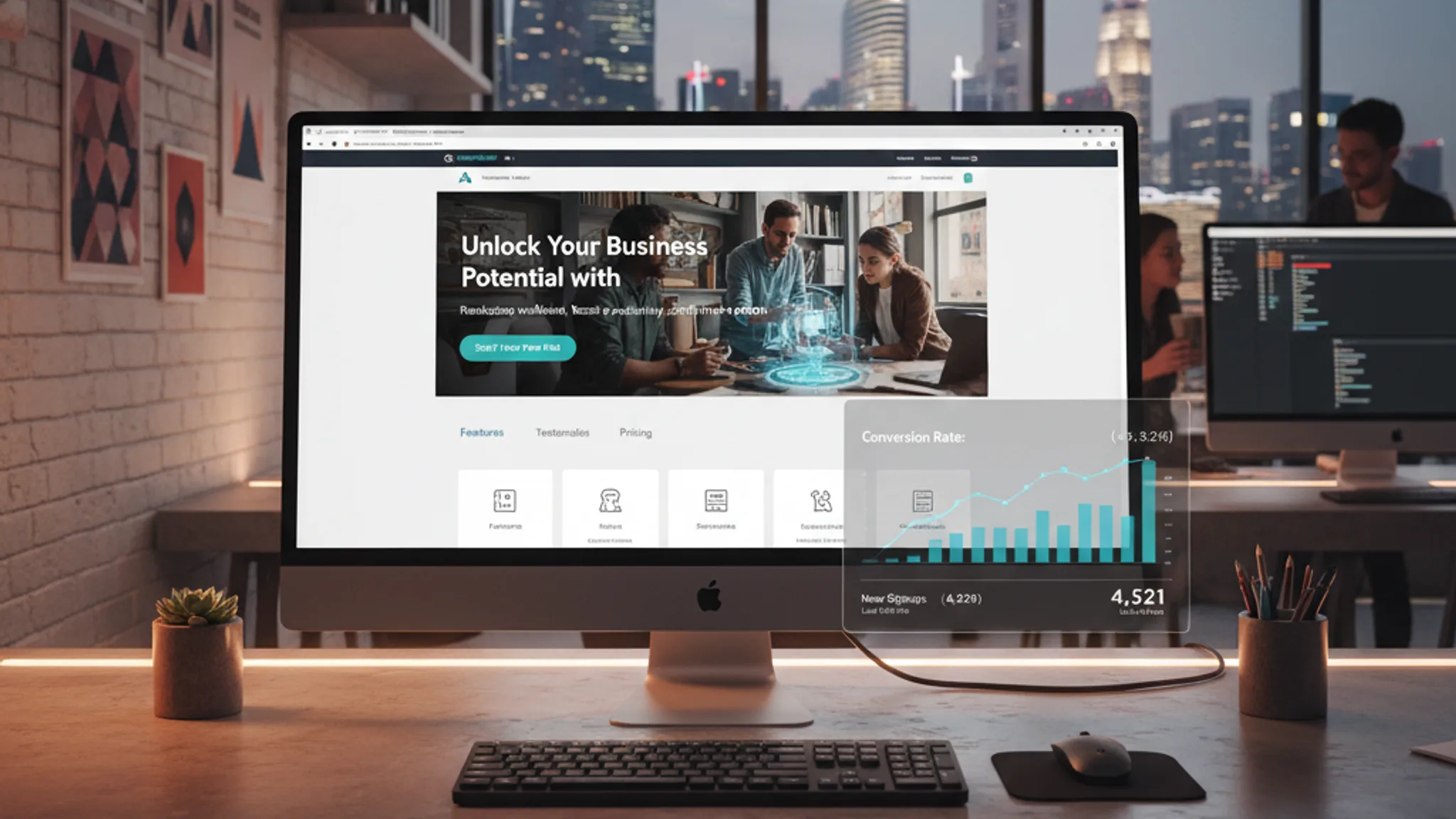







Your website gets traffic. People land on your pages, scroll for a few seconds, and then leave. No enquiry, no sale, no WhatsApp message. The design looks fine, the loading speed is decent, and the SEO is doing its job. So what's the problem?
Nine times out of ten, it's the copy.
We've rewritten website copy for over 100 Singapore businesses at Terris, and the pattern is consistent. Most websites talk about themselves instead of talking to the visitor. They list features instead of outcomes. They bury the call to action under paragraphs of text nobody reads. And then the business owner wonders why the site isn't generating leads.
Good website copywriting isn't about fancy words or clever taglines. It's about understanding what your visitor wants, addressing their concerns, and making the next step obvious. It's the difference between a website that looks good and a website that actually works.
Here are 11 website copywriting tips that we use every day to build pages that convert, backed by real results from Singapore businesses we've worked with.
1. Write headlines that hook (not headlines that bore)
Your headline is the first thing visitors read. According to research from the Nielsen Norman Group, roughly 80% of people will read your headline, but only 20% will read the rest of your page. That means your headline is doing 80% of the work. If it doesn't grab attention immediately, everything below it is wasted effort.
So what makes a headline that hooks? Three things.
- Be specific with numbers and outcomes. "We Build Websites" says nothing. "Websites That Generate 3x More Enquiries" gives the visitor a reason to keep reading.
- Address a pain point directly. "Tired of a Website That Doesn't Bring in Leads?" immediately resonates with a business owner who's frustrated with their current site.
- Lead with the benefit, not the process. Nobody cares that you use "cutting-edge technology." They care that their website will load in under 2 seconds and rank on Google.
A formula we use often: [Outcome] + [Specificity] + [Relevance]. For example, "Web Design That Helped 50+ Singapore SMEs Double Their Online Enquiries." It's specific, outcome-focused, and locally relevant.
One more thing: avoid clever wordplay in headlines. Puns and double meanings might make you smile, but they force the visitor to think. And thinking creates friction. Clarity always beats cleverness on a commercial website.
2. Lead with benefits, not features
This is the single most common copywriting mistake we see on Singapore business websites. The homepage reads like a product spec sheet: "We use WordPress CMS," "Our team has 15 years of experience," "We offer responsive design." These are features. Your visitor doesn't care about features. They care about what those features mean for them.
Every feature can be translated into a benefit. Here's how:
- Feature: Responsive design. Benefit: Your website looks perfect on every device, so you never lose a customer because the page looked broken on their phone.
- Feature: SEO-optimised structure. Benefit: You show up when potential customers in Singapore search for what you sell.
- Feature: Fast loading speed. Benefit: Visitors stay on your site instead of bouncing to a competitor while your page is still loading.
The trick is to keep asking "so what?" after every statement. "We use premium hosting." So what? "Your site loads faster." So what? "Visitors don't leave out of frustration." So what? "You get more enquiries and sales." That final answer is your benefit, and that's what should be on the page.
We restructured the homepage copy for a Singapore accounting firm using this approach. They went from listing their certifications and software tools to leading with outcomes: "Spend less time on bookkeeping and more time growing your business." Enquiries from the homepage increased by 40% in the first month.
If you're building or redesigning your site, our web design service always starts with benefit-focused copy before a single pixel is designed.
3. Write for scanners first, readers second
Nobody reads your website word by word. They scan. Eyes jump from headline to headline, catch bolded phrases, skim bullet points, and glance at images. Research consistently shows that users read only about 20 to 28% of the text on a page. If your key message is buried in the middle of a dense paragraph, most visitors will never see it.
Writing for scanners means structuring your copy so the important bits stand out even when someone is scrolling at full speed. Here's what that looks like in practice:
- Keep paragraphs short. Two to three sentences maximum. A wall of text is a wall visitors won't climb.
- Use descriptive subheadings. Not "Our Approach" (vague), but "How We Build Sites That Rank on Google" (specific and benefit-driven).
- Bold your key phrases. When someone scans a paragraph, their eyes catch bold text first. Use it to highlight the one thing you want them to take away from each section.
- Break up lists with bullet points. If you're listing three or more items, bullets are always easier to scan than a comma-separated sentence.
- One idea per paragraph. If a paragraph covers two topics, split it into two paragraphs.
Think of your web copy like a newspaper article. The headline gives you the main story. The subheadings give you the key points. The body text fills in the details. A scanner should be able to understand your value proposition just from the headlines and bold text alone.
This approach isn't just good for users. It's good for SEO too. Search engines use heading structure and content hierarchy to understand what your page is about. Well-structured, scannable copy tends to rank better because it signals topical clarity.
4. Use social proof strategically
People trust other people more than they trust businesses. That's not cynicism; it's psychology. Social proof (testimonials, reviews, case studies, client logos, and numbers) is one of the most powerful tools in website copy that converts.
But there's a right way and a wrong way to use it.
The wrong way: a generic "Testimonials" page with 20 quotes that all say "Great service, highly recommended!" Nobody reads that page. Nobody trusts those quotes.
The right way: placing specific, relevant social proof right next to the point where a visitor might hesitate. For example:
- Next to your pricing section: "We were hesitant about the investment, but our website paid for itself within 3 months through new client enquiries." This addresses the price objection at exactly the right moment.
- On your service pages: a brief case study snippet showing measurable results. "We redesigned their site and organic traffic increased 150% in 6 months." Numbers are more convincing than adjectives.
- Below your headline: client logos or a trust bar. "Trusted by 100+ Singapore businesses" with recognisable brand logos immediately establishes credibility before the visitor reads a single sentence of copy.
- Near your CTA: a short testimonial that reinforces the action you want them to take. "I filled in the contact form and got a response within an hour." This reduces the perceived risk of taking that next step.
The key principle: social proof works best when it's contextual, not collected. Don't dump all your testimonials in one place. Distribute them across your site where they'll address specific doubts at specific moments.
Want to see this in action? Look at how we use social proof on our landing pages guide and on the CRO strategies post.
Recommended reads
5. Craft CTAs that actually get clicked
A call to action is not a button that says "Submit." That's a command, not an invitation. And yet, we still see "Submit" on contact forms across Singapore. Along with "Click Here," "Learn More," and the ever-inspiring "Send."
Your CTA is the most important piece of copy on the page. It's the moment of conversion. Every word matters. Here's how to write CTAs that people actually click:
- Use action verbs that describe the outcome. "Get Your Free Quote" is better than "Submit." "See Our Portfolio" is better than "Click Here." "Start Growing Your Business" is better than "Learn More."
- Add urgency when it's genuine. "Book Your Free Consultation (Limited Slots)" works because it's believable. "BUY NOW BEFORE IT'S GONE!!!" does not.
- Reduce friction with reassurance. "Get a Quote (No Obligation)" removes the fear of commitment. "Takes 30 Seconds" tells visitors the form won't eat their entire lunch break.
- Match the CTA to the stage of the journey. A first-time visitor isn't ready to "Buy Now." They're ready to "See How It Works" or "View Our Work." Save the hard sell for visitors who've already shown intent.
Placement matters just as much as wording. Your primary CTA should appear above the fold (visible without scrolling), after key selling points, and at the bottom of the page. On longer pages, repeat the CTA two to three times in different contexts. Don't make the visitor scroll back up to take action.
We A/B tested CTA copy on a Singapore logistics company's landing page. Changing "Contact Us" to "Get a Free Shipping Quote" increased click-through by 34%. Same page, same design, same traffic. The only difference was four words.
6. Address objections before they arise
Every visitor to your website has doubts. "Is this too expensive?" "Are they actually good?" "What if it doesn't work?" "Can I trust this company?" These objections sit quietly in the back of their mind, and if your copy doesn't address them, the visitor leaves with their doubts intact.
Smart copywriting anticipates and neutralises objections before the visitor even consciously forms them. Here's how:
- FAQ sections on key pages. Not just a generic FAQ page buried in the footer. Put relevant FAQs on your service pages, pricing pages, and landing pages. Answer the real questions people ask, not the ones you wish they'd ask.
- Guarantees and risk reversals. "100% satisfaction guarantee," "Full refund within 14 days," or "We'll revise until you're happy" all reduce the perceived risk of making a purchase or signing up.
- Trust signals throughout the site. SSL certificates, payment security badges, industry certifications, and association memberships. These don't need to be prominent, but they should be visible, especially near forms and checkout pages.
- Pricing transparency. In Singapore, hiding your prices is one of the fastest ways to lose a potential customer. People want to know if they can afford you before they invest time in an enquiry. Even a starting price or price range is better than "Contact us for a quote" with no context.
When we write copy for client websites, we start by listing every possible objection a visitor might have. Then we make sure each one is addressed somewhere on the page, ideally right before the point where that objection would cause someone to leave. This is a core part of conversion rate optimisation.
Think of it this way: your website copy should answer every question a good salesperson would handle in a face-to-face meeting. The visitor just can't ask out loud, so you need to anticipate.
7. Write like you talk (but edit like a pro)
Corporate jargon kills conversions. "Leveraging synergies to deliver holistic solutions" means absolutely nothing to a small business owner in Singapore looking for a web designer. It sounds like it was generated by a committee, and it creates distance between you and your reader.
The best website copy sounds like a conversation with a knowledgeable friend. It's clear, direct, and warm without being unprofessional. Here's the approach:
- Read your copy out loud. If it sounds awkward or overly formal when spoken, rewrite it. Your website copy should flow like natural speech.
- Use "you" more than "we." Count the pronouns on your homepage. If "we" and "our" outnumber "you" and "your," you're talking about yourself instead of talking to the visitor.
- Cut the buzzwords. "End-to-end solutions," "best-in-class," "cutting-edge," "state-of-the-art." These words have been used so many times they've lost all meaning. Replace them with plain language that describes what you actually do.
- Use contractions. "We'll help you" is warmer than "We will help you." "You're in good hands" flows better than "You are in good hands." Contractions signal conversational tone.
A note on language for Singapore audiences: Singapore is multilingual, and your audience likely switches between English, Mandarin, Malay, and Tamil daily. For website copy, Standard Singapore English works best for most businesses. Light Singlish can work for casual, lifestyle brands (think "shiok" or "confirm plus chop"), but use it sparingly and intentionally. For B2B or professional services, stick to clean, jargon-free English. The goal is to sound approachable and local without alienating any segment of your audience.
The "write like you talk" rule has one important caveat: edit ruthlessly. Conversational doesn't mean sloppy. Write the first draft like you're explaining to a friend. Then go back and tighten every sentence. Cut unnecessary words. Sharpen vague phrases. Make every line earn its place on the page.
8. Keep it short and punchy
The biggest favour you can do for your website visitors is respect their time. Nobody visits a business website to read an essay. They want answers, and they want them fast.
Here's what "short and punchy" looks like in practice:
- Cut the fluff words. "In order to" becomes "to." "Due to the fact that" becomes "because." "At this point in time" becomes "now." Every unnecessary word is friction.
- One idea per paragraph. If you catch yourself writing "Additionally" or "Furthermore," that's a sign you're cramming two ideas into one block. Split them.
- Delete your first paragraph. Seriously. Most web pages start with a warm-up paragraph that adds nothing. "Welcome to our website. We are a leading provider of..." Delete it. Start with the value.
- Use the 50% rule. Write your first draft, then cut it by half. You'll be surprised how much you can remove without losing meaning. The tighter version is almost always the better version.
Short copy doesn't mean thin content. A 2,000-word service page is fine if every sentence adds value. The problem isn't length; it's padding. A 500-word page stuffed with fluff is worse than a 2,000-word page packed with useful information.
Here's a practical test: go through each sentence on your page and ask, "If I delete this, does the reader lose anything important?" If the answer is no, delete it. Your visitors will thank you by staying longer and converting more.
This principle directly impacts user experience and conversions. The less effort required to understand your offer, the more likely someone is to take action.
9. Optimise for SEO without sounding robotic
There's a persistent myth that SEO-friendly copy has to sound unnatural. You've seen the results: "If you're looking for web design Singapore, our web design Singapore team offers the best web design Singapore services." That's not SEO. That's spam, and Google is smart enough to penalise it.
Modern web copywriting balances search visibility with readability. Here's how to do both:
- Use your target keyword naturally. Include it in your H1, your opening paragraph, and one or two subheadings. After that, let it appear organically. If you have to force it into a sentence, the sentence needs rewriting.
- Lean on semantic keywords. Google understands context. If your page is about "website copywriting tips," you don't need to repeat that exact phrase 15 times. Related terms like "web copy," "conversion-focused writing," "page content," and "landing page text" all signal the same topic to search engines.
- Write for featured snippets. Structure answers to common questions in clear, concise formats. Bullet lists, numbered steps, and short paragraph definitions are all snippet-friendly. This is especially valuable for long-tail keyword searches.
- Prioritise readability. Use tools like Hemingway Editor to check your copy's reading level. Aim for Grade 6 to 8 reading level, which isn't dumbing it down; it's making it accessible. The easier your content is to read, the longer people stay, and dwell time is a positive ranking signal.
Internal linking is another important piece. Naturally linking to related pages on your site helps search engines understand your content structure and distributes authority across your pages. For example, this post links to our SEO guide for Singapore small businesses because the topics are genuinely related, not because we're trying to game the algorithm.
The golden rule: write for humans first, then optimise for search engines. If your copy sounds great when read aloud and includes your keywords naturally, you're doing it right.
10. Test and iterate (your first draft is never the best)
Here's the uncomfortable truth about website copywriting: you won't get it right on the first try. Nobody does. The highest-converting websites are the ones that treat copy as an ongoing experiment, not a one-time task.
Testing doesn't have to be complicated. Start with these high-impact areas:
- A/B test your headlines. Your H1 is the single highest-leverage piece of copy on any page. Test two versions and measure which one leads to lower bounce rates and higher engagement. Even small changes (swapping "Get" for "Discover," adding a number, or rephrasing the benefit) can move the needle significantly.
- Test your CTA copy. We mentioned the logistics company earlier. A simple CTA wording change drove a 34% improvement. Test different verbs, different value propositions, and different levels of urgency.
- Review heatmap data. Tools like Hotjar and Microsoft Clarity show you exactly where visitors click, how far they scroll, and which sections they skip. If nobody is scrolling past your third section, the copy there might be boring, irrelevant, or poorly structured.
- Track form completion rates. If visitors are clicking your CTA but not completing the form, the problem is in the form itself. Maybe there are too many fields. Maybe the form copy is intimidating. Maybe the button says "Submit" instead of something inviting.
- Analyse exit pages. In Google Analytics, check which pages have the highest exit rates. Those pages are where your copy is failing to keep visitors engaged or move them to the next step.
Set a quarterly review cycle for your key pages: homepage, main service pages, and top landing pages. Look at the data, identify underperformers, rewrite, and test again. This iterative approach is the foundation of effective conversion rate optimisation.
The best part? Copywriting changes are free to implement. You don't need a developer. You don't need a redesign. You just need better words.
11. Singapore-specific copywriting tips
Everything above applies globally, but if you're writing for a Singapore audience, there are specific nuances that can make or break your copy. Singapore is a unique market: highly educated, multilingual, digitally savvy, and famously pragmatic. Generic, one-size-fits-all copy doesn't work here.
Here's what we've learned from writing website copy for Singapore businesses over the years:
- Lead with value and proof, not promises. Singapore consumers are sceptical by nature. "We're the best" means nothing without evidence. "We've helped 100+ Singapore SMEs increase their online leads by an average of 45%" is far more compelling. Quantifiable results, named clients, and verifiable claims build trust faster than adjectives.
- Consider multilingual search intent. Many Singaporeans search in English but may use Mandarin, Malay, or Tamil terms for specific services. If your business serves a specific language community, consider including relevant terms naturally in your copy. This isn't about keyword stuffing; it's about matching the way real people search.
- Reference local context. Mentioning MRT stations, neighbourhoods, local events, or government schemes (like IMDA's SMEs Go Digital programme) signals that you're a real Singapore business, not a generic offshore provider. Local references build credibility.
- Price in SGD and be transparent. Always display prices in Singapore Dollars. Include GST information (especially with the 9% GST rate). Pricing ambiguity is a conversion killer in Singapore, where comparison shopping is practically a national sport.
- Mobile-first copy for a mobile-first country. With smartphone penetration above 97%, your copy needs to work on small screens. That means shorter paragraphs, less scrolling to reach the point, and CTAs that are easy to tap with a thumb.
- Trust signals that matter locally. ACRA registration, SG government grants eligibility, local office address, Singapore phone number (+65), and featured mentions in local media (Straits Times, CNA, Business Times) carry more weight than generic "Trusted Worldwide" claims.
One thing to avoid: writing copy that talks down to your audience. Singapore has one of the highest literacy rates in the world. Your audience doesn't need oversimplified language; they need clear, direct, and respectful communication that gets to the point quickly.
For a deeper look at common website mistakes in Singapore, including copy-related issues, check out our detailed breakdown.
Good website copywriting is not a one-time task. It's an ongoing discipline that combines empathy (understanding your visitor), strategy (structuring your message for conversions), and craft (choosing the right words). The 11 tips in this guide cover the fundamentals that separate websites that convert from websites that just exist.
To recap the essentials: write headlines that hook, lead with benefits over features, structure for scanners, use social proof strategically, craft CTAs that people actually want to click, address objections proactively, write conversationally, keep it tight, balance SEO with readability, test relentlessly, and tailor everything for your Singapore audience.
If your website looks great but isn't generating enquiries, the copy is almost certainly the weak link. And unlike a full redesign, improving your copy is one of the fastest, cheapest, and highest-ROI changes you can make.
We've helped over 100 Singapore businesses rewrite their website copy for better conversions. Whether you need a full copywriting overhaul or just a fresh pair of eyes on your landing pages, explore our web design services or get in touch for a free consultation.
Sources & References (5)
- https://www.nngroup.com/articles/how-users-read-on-the-web/
- https://www.wordstream.com/blog/ws/2021/07/19/website-copywriting
- https://blog.hubspot.com/marketing/copywriting-tips
- https://unbounce.com/conversion-rate-optimization/the-beginners-guide-to-conversion-rate-optimization/
- https://www.imda.gov.sg/about-imda/research-and-statistics

Written by
Terris
Founder & Lead Strategist
Terris has written and directed website copy for over 100 Singapore businesses, from startup landing pages to enterprise websites. He combines conversion-focused copywriting with SEO best practices to create pages that rank and sell.
Want to see these strategies in action? Browse our portfolio or get in touch to discuss your project.