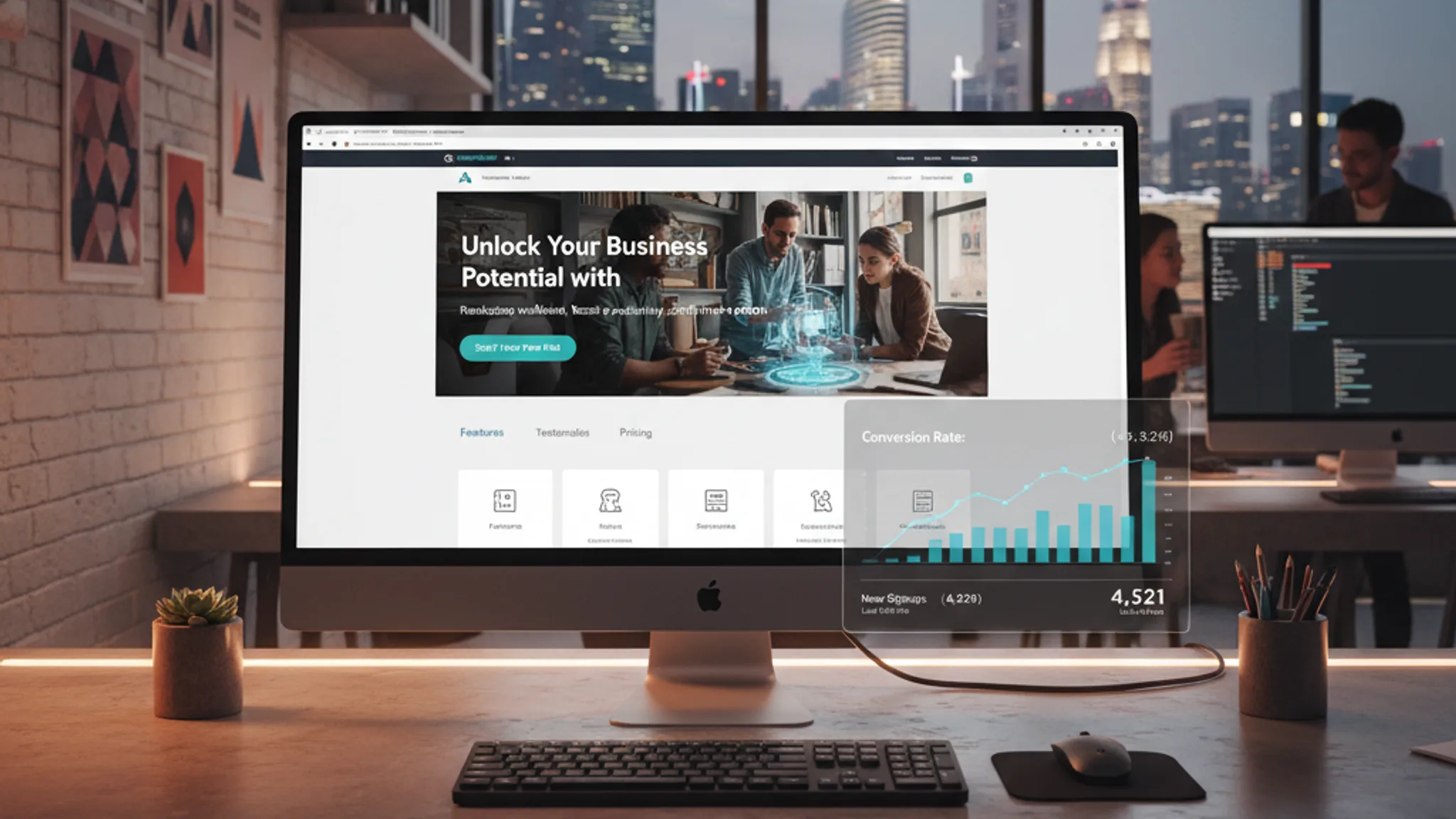




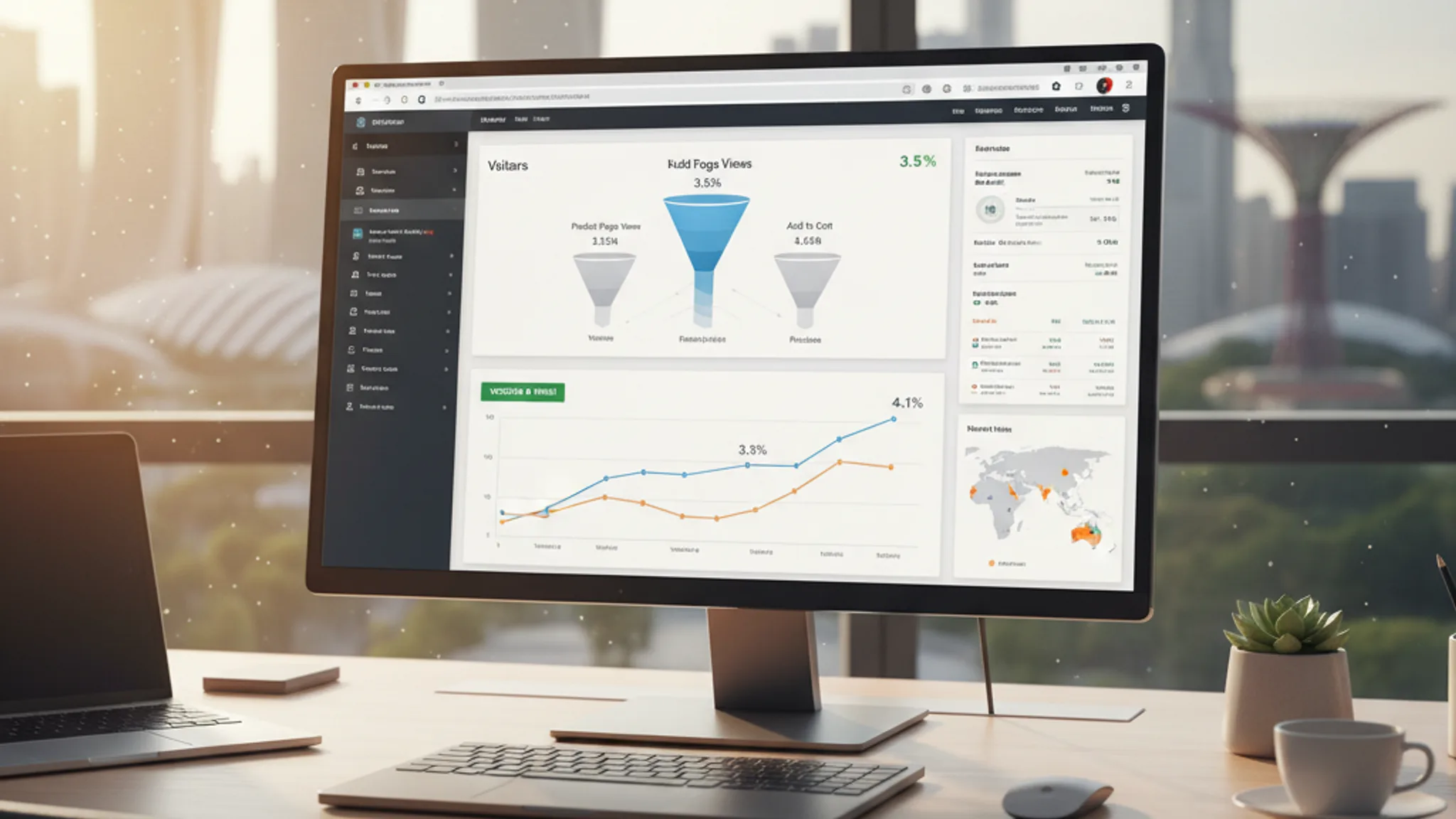
Here's something that bothers me about how most Singapore SMEs spend their marketing budget: they pour money into getting more traffic (more Google Ads, more SEO, more social media posts) while their website quietly wastes half the visitors who show up. Conversion rate optimisation in Singapore is the fix most businesses skip, and it's the one that actually moves the needle.
Think about it this way. If your website converts 2% of visitors into enquiries and you're spending $3,000 a month on ads to get 5,000 visitors, you're getting 100 leads. Double the conversion rate to 4%, and you get 200 leads. Same spend, same traffic, twice the result. Zero extra ad dollars.
We proved this with Perfect Style Salon. After a full CRO-focused redesign, their online enquiries jumped 180%. We didn't triple their ad budget. We fixed the website that was letting good traffic slip away.
This guide breaks down where Singapore websites typically leak conversions and what you can do about it, with real benchmarks, specific tactics, and the exact audit process we use with our own clients.
What Is Conversion Rate Optimisation (And Why It Beats More Traffic)
Conversion rate optimisation is the process of increasing the percentage of website visitors who take a desired action: filling out a form, booking a consultation, making a purchase. If 1,000 people visit your site and 20 enquire, your conversion rate is 2%. CRO pushes that number up through deliberate changes to design, copy, layout, and user experience.
Why does this matter more than getting more traffic? Because traffic costs money. Every Google Ads click has a price tag. Every SEO campaign requires ongoing investment. But improving your conversion rate multiplies the return on all those channels simultaneously.
Running ads at $2 per click with a 2% conversion rate? Each lead costs you $100. Push conversions to 4% and that lead costs $50. You've halved your acquisition cost without spending an extra dollar on ads. That's why CRO is often the highest-ROI marketing activity a Singapore business can invest in, and why we bake it into every web design project we take on. To see how conversion rate improvements affect your bottom line, try our free Google Ads ROI calculator. Adjust the conversion rate and watch the projected returns change.
Conversion Rate Optimisation Benchmarks for Singapore Websites
Before you optimise anything, you need to know what "good" looks like. Here are the benchmarks we reference when auditing website conversion rates for Singapore businesses, based on 2026–2026 industry data.
Overall averages: B2C websites sit at 3.9%, B2B at 3.6%, and ecommerce ranges from 2.5–4.3% depending on category.
By industry:
- Legal services: 4.2%
- Healthcare: 3.5%
- Financial services: 2.9%
- Real estate: 2.6%
- SaaS / software: 1.7%
By traffic source: Direct traffic converts highest at 3.3%, followed by email (2.8%), SEO (2.3%), organic social (1.8%), and PPC (1.5%).
If you're below these numbers, there's almost certainly low-hanging fruit. The top 10% of websites convert at 11% or higher. That gap between average and excellent is where the money is.
Recommended reads
The CRO Audit: Where to Start
Every CRO project we run starts with an audit. You can't fix what you haven't measured.
1. Page speed. Pages loading in one second convert 2.5–3x better than those loading in five. Run your site through Google's Core Web Vitals. If your Largest Contentful Paint exceeds 2.5 seconds, that's fix number one.
2. Mobile experience. Desktop converts up to 2x better than mobile, and mobile cart abandonment exceeds 80%. Open your site on a phone and try to complete the primary action. Be honest about whether it's frustrating.
3. Form length. 68% of users abandon forms before completing them. If you're asking for anything beyond name, phone, and a brief message, you're probably asking too much.
4. CTA placement. Personalised CTAs convert 202% better than generic ones. Is yours visible above the fold? Can a visitor understand what to do within 3 seconds?
5. Trust signals. Five or more reviews increase purchase likelihood by up to 270%. Display Google reviews, client logos, and case studies where they matter, near the point of decision, not buried on a separate page.
This audit alone usually uncovers three to five quick wins. For a deeper look, see our guide on UX principles that drive conversions.
High-Impact CRO Tactics for Singapore Businesses
Not all optimisations are equal. These produce the biggest lifts for Singapore websites specifically.
WhatsApp CTAs. Across every service business we've worked with (salons, clinics, tuition centres, renovation firms), WhatsApp buttons outperform traditional contact forms by 30–50%. Singapore consumers prefer messaging over filling out forms. Add a WhatsApp button alongside your form, not instead of it.
SGD pricing display. "Starting from SGD 1,500" converts dramatically better than "Contact us for pricing." Singapore consumers compare multiple providers before reaching out. If your site won't give them a ballpark figure, they'll go to the competitor who will. You don't need to publish every rate; a starting price or tiered packages work fine.
Social proof near the decision point. Reviews can boost conversions by up to 370%: but only if people see them. Place your Google rating and testimonials next to your contact form or pricing table, not buried on a separate page.
Simplified forms. For a service enquiry, name + phone number + one optional field is enough. Qualify leads on the phone. The form's only job is to start the conversation.
Mobile-first design. Over 60% of Singapore web traffic is mobile. Your conversion path needs to work flawlessly on a 6-inch screen: thumb-friendly buttons, readable text, short forms. We cover this in detail in our common website mistakes article.
Speed. One second faster = 7% more conversions. 53% of mobile users abandon sites taking longer than 3 seconds. Compress images to WebP, lazy-load below-the-fold content, and host on Asia-Pacific servers.
A/B Testing: How to Know What Actually Works
Opinions are nice. Data is better. A/B testing compares two versions of a page element and measures which converts more visitors.
What to test first. Headlines, CTA buttons (text, colour, placement), form layout, and hero sections. These four areas account for the bulk of conversion movement. Don't start with footer links or font sizes.
Minimum traffic. You need roughly 1,000 visitors per variation to reach statistical significance. If your site gets fewer than 5,000 monthly visitors, focus on structural changes first and save element-level testing for later.
Tools worth using:
- Microsoft Clarity: free heatmaps and session recordings. Shows where people click, scroll, and rage-click.
- Hotjar: similar heatmaps with a generous free tier.
- VWO: full A/B testing with a visual editor, no developer needed.
- Google Analytics 4: the free baseline for tracking conversion events.
77% of companies run A/B tests, and 71% of active testers run two or more per month. CRO is a discipline, not a one-off campaign.
Common Conversion Killers on Singapore Websites
After auditing hundreds of Singapore business websites, the same problems come up again and again.
Slow loading. We regularly see SME sites taking 5–8 seconds to load: unoptimised images, cheap US hosting, fifteen tracking scripts. This is the number one killer.
Responsive but not mobile-optimised. Responsive means the layout adjusts to screen size. Optimised means the entire journey (reading, deciding, acting) is designed for someone holding a phone on the MRT. Tap targets sized for thumbs, content concise enough for a small screen, forms short enough to fill out one-handed. There's a meaningful difference.
Hidden pricing. "Call for a quote" gets skipped when competitors show starting prices. Even a range ("SGD 2,000–5,000 depending on scope") is better than nothing.
Cluttered navigation. Mega menus with 40 links and three-level dropdowns. For service businesses, guide visitors toward four paths: services, proof, pricing, contact. Everything else is noise.
Zero trust signals. No Google reviews displayed, no client logos, no case studies, no UEN, no physical address. When someone finds you through Google, they have zero reason to trust you yet. Trust signals do the heavy lifting that copy alone cannot.
Generic CTAs. "Submit" and "Send" convert far less than "Get My Free Audit" or "WhatsApp Us Now." Tell visitors exactly what happens when they click.
If these sound familiar, our guide on landing pages that convert covers how to fix every one.
Measuring CRO Success: The Metrics That Matter
You've made changes. How do you know they're working? Track these in GA4 monthly:
- Conversion rate by page: a site-wide number masks the fact that one page converts at 8% while another sits at 0.5%.
- Conversion rate by traffic source: if PPC converts at 1% while organic converts at 4%, the problem may be your ad targeting, not your site.
- Bounce rate on key pages: high bounce = mismatch between visitor expectation and page content.
- Form abandonment: if people start your form but don't finish, it's too long or too intrusive.
- Visits to conversion: if people need four or five visits before enquiring, you need stronger first-visit trust signals or retargeting.
CRO isn't a project with an end date. It's an ongoing practice: measure, change, test, repeat.
The businesses that win online in Singapore aren't always the ones spending the most on marketing. They're the ones making the most of every visitor who shows up. Conversion rate optimisation is how you turn your existing traffic into more enquiries, more sales, and more revenue, without increasing your ad spend by a single dollar.
Start with the audit. Check your page speed, your mobile experience, your forms, your CTAs, and your trust signals. Fix the obvious problems first: slow load times, missing social proof, vague pricing. Then move into testing and iterating.
If you want help identifying where your Singapore website is leaking conversions, or you're ready for a redesign built around CRO from the ground up, have a look at our web design services or reach out directly. We've done this for salons, clinics, engineering firms, real estate agencies, and dozens of other Singapore businesses. We'd be happy to show you what's possible.

Written by
Terris
Founder & Lead Strategist
Terris has over 8 years of experience designing high-converting websites for Singapore businesses. From luxury brands to SMEs, he combines aesthetic design with strategic thinking to deliver websites that drive real business growth.
Want to see these strategies in action? Browse our portfolio or get in touch to discuss your project.