




Singapore has more than 800 law practices and over 5,800 practising lawyers competing for clients in one of the most digitally connected markets in the world. Over 85% of Singaporeans search for legal services online, and 77% of potential clients research law firms on the web before ever picking up the phone. If your firm's website looks like it was built in 2018, or worse, if you do not have one at all, you are invisible to the majority of people looking for legal help.
But website design for law firms in Singapore is not the same as building a website for a restaurant or an e-commerce shop. The Law Society of Singapore enforces strict publicity rules under the Legal Profession (Publicity) Rules. Your website content, testimonials, and claims all need to be compliant from day one. Get it wrong and you risk disciplinary proceedings.
We have built websites for professional service firms across Singapore where regulatory compliance and trust are non-negotiable. This guide covers everything you need to know: the must-have features, compliance rules, SEO strategy, costs, and common mistakes we see law firm websites making in 2026.
Why law firms in Singapore need a professional website
The legal industry in Singapore has shifted. Referrals and word-of-mouth are still valuable, but they are no longer enough. When someone needs a lawyer for a divorce, a commercial dispute, or estate planning, the first thing they do is search online. They compare firms, read about practice areas, check credentials, and form an opinion about your professionalism before they send a single enquiry.
Here is what the numbers tell us:
- 85% of Singaporeans search for legal services online, whether through Google, social media, or legal directories
- 77% of potential clients research law firms online before making contact, comparing multiple firms before deciding
- Over 800 law practices operate in Singapore, with more than 5,800 practising lawyers. The competition for visibility is intense
- First impressions are formed in under 5 seconds. A dated, slow, or cluttered website makes visitors question your competence, even if your legal work is exceptional
Your website is your digital reception area. It sets the tone for the entire client relationship. A clean, professional, fast-loading website signals that your firm is credible, modern, and serious about serving clients well. A poor website signals the opposite.
Beyond first impressions, a well-built website works around the clock. It ranks in search results for practice area keywords, answers common legal questions through blog content, and captures enquiries at 11pm when your office is closed. For firms still relying solely on referrals, that is a significant amount of potential business being left on the table.
What makes a great law firm website
Law firm websites need to balance professionalism with approachability. Visitors are often dealing with stressful situations (disputes, family matters, regulatory issues) and they need to feel confident that your firm can help, without feeling intimidated by the website itself.
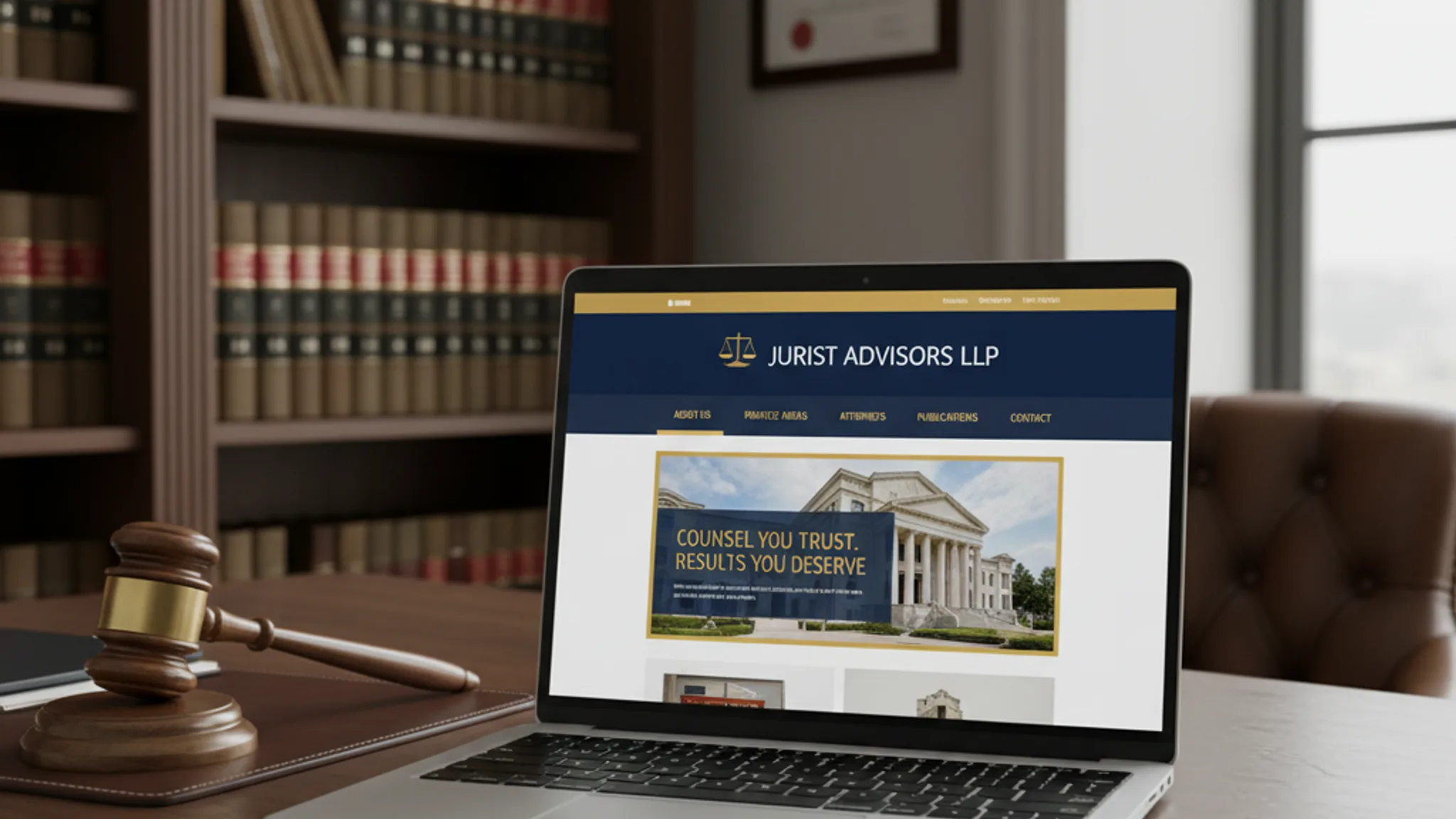
Clean, authoritative design. This means generous whitespace, a restrained colour palette (navy, charcoal, deep grey with selective accent colours), and typography that conveys authority. Avoid flashy animations, excessive gradients, or anything that looks more like a tech startup than a professional services firm. The design should feel serious but not cold.
Trust signals everywhere. Credentials, awards, professional memberships, years of experience, and notable matters handled should be visible throughout the site, not buried on a single "About" page. Display your Law Society registration details, any specialist accreditations, and professional affiliations prominently.
Mobile-first is essential. The majority of legal searches in Singapore happen on mobile devices. Someone searching for "divorce lawyer Singapore" at 10pm is almost certainly on their phone. Your site must load quickly, be easy to navigate with a thumb, and make it simple to call or send an enquiry from any page.
Fast load times. Every second of delay costs you potential clients. Aim for a Largest Contentful Paint (LCP) under 2.5 seconds. Use modern image formats like WebP, minimise JavaScript, and choose a hosting setup optimised for Singapore. We have seen law firm websites that take 6 to 8 seconds to load because of uncompressed images and bloated WordPress themes. That is unacceptable in 2026.
Clear navigation. Visitors should find what they need within two clicks. A straightforward navigation structure with Practice Areas, Our Lawyers, About, Resources, and Contact is all most firms need. Avoid vague labels like "Our Solutions" or overly nested dropdown menus. People under stress want clarity, not a treasure hunt.
For more on design principles that drive conversions, read our UX design principles guide.
Essential pages and features for a law firm website
Every law firm website needs a core set of pages. These are not optional; they are what potential clients expect to find when they visit your site.
Homepage. Your homepage is the front door. It should immediately communicate who you are, what areas of law you practise, and why a potential client should choose your firm. Include a strong headline, a brief overview of your key practice areas, and a clear call to action (typically "Contact Us" or "Schedule a Consultation"). Avoid lengthy paragraphs about your firm's history here; save that for the About page.
Practice area pages. Each practice area deserves its own dedicated page. A single "Services" page listing everything in bullet points is a missed opportunity. Individual pages for family law, corporate law, litigation, conveyancing, employment law, and so on allow you to explain your approach, highlight relevant experience, and target specific keywords for SEO. Each page should answer: what this area covers, common situations where clients need help, your firm's approach, and how to get started.
Lawyer profile pages. This is where trust is built or lost. Each lawyer should have a dedicated profile page with their full name, qualifications, areas of expertise, professional memberships, years of experience, and a professional headshot. People hire lawyers, not firms. Potential clients want to know who will be handling their matter, and a strong profile page makes that connection personal.
About page. Your firm's story, values, and approach. This page should communicate your firm's culture and what makes your approach different. Include your firm's history, notable achievements (within compliance rules), and team culture. Real photography of your office and team is far more effective than stock images.
Client testimonials and case results. Social proof is powerful, but it must be handled carefully due to the Legal Profession (Publicity) Rules. We will cover the compliance requirements in the next section. When done properly, testimonials and matter summaries build credibility significantly.
Blog and resources section. A blog serves two purposes: it demonstrates your expertise and it drives organic search traffic. Articles like "What to expect in a Singapore divorce" or "Understanding commercial lease disputes" answer the exact questions your potential clients are searching for. This positions your firm as a trusted authority while bringing qualified traffic to your site.
Contact page with multiple options. Make it easy to reach you. Include a contact form, phone number (click-to-call on mobile), email address, office address with an embedded map, and operating hours. Some firms add a WhatsApp option, which works well for initial enquiries in Singapore's messaging-first culture.
FAQ page. Address common questions about fees, the legal process, what to expect at a first consultation, and how to prepare documents. FAQs reduce barriers to contact and are excellent for SEO, particularly when marked up with FAQPage schema for featured snippet visibility.
Recommended reads
Law Society compliance and advertising rules
This is where law firm websites differ from every other industry. The Legal Profession (Publicity) Rules, issued under the Legal Profession Act, govern what law practices can and cannot say in their marketing materials, and your website is considered a form of publicity.
Ignoring these rules is not just a branding risk. It can result in disciplinary proceedings by the Law Society of Singapore, which can lead to fines, suspension, or striking off the rolls in serious cases. Many web designers are completely unaware these rules exist, which is why we see so many non-compliant law firm websites in Singapore.
What the rules restrict:
- Superlative or comparative claims: you cannot describe your firm as "the best," "leading," "top," "premier," or "number one." Avoid any language that implies superiority over other firms
- Claims about success rates: you cannot state or imply guaranteed outcomes, win rates, or settlement amounts without proper context and disclaimers
- Testimonials must be genuine: client testimonials are permitted, but they must be factual and not misleading. You cannot fabricate or embellish reviews, and you should not selectively curate only positive feedback in a way that creates a misleading impression
- Fee comparisons: you cannot advertise that your fees are the "lowest" or "most competitive" or make direct comparisons with other firms' pricing
- Solicitation restrictions: content should not amount to direct solicitation of clients, particularly through aggressive pop-ups, countdown timers, or high-pressure sales tactics
What you can include:
- Factual information about your firm, its history, and areas of practice
- Lawyer qualifications, professional memberships, and areas of expertise
- Descriptions of your practice areas and the types of matters you handle
- Office locations, contact details, and operating hours
- Educational articles and legal updates (clearly marked as general information, not legal advice)
- Fee structures and indicative pricing (factual, not comparative)
- Genuine client testimonials (factual, not misleading)
Disclaimers matter. Every law firm website should include a disclaimer stating that the website content is for general information purposes and does not constitute legal advice. Blog articles should include a similar note. Any case results or matter descriptions should be anonymised appropriately and not presented in a way that guarantees similar outcomes.
For guidance on broader data protection requirements for your website, see our PDPA website compliance guide. Under the Personal Data Protection Act, every form on your website collecting personal data (contact forms, newsletter sign-ups, consultation requests) needs a clear consent statement and a link to your privacy policy.
SEO for law firm websites in Singapore
A beautiful website that nobody finds is a waste of money. Search engine optimisation is what turns your website from a digital brochure into a client acquisition machine. For law firms, SEO is particularly valuable because legal searches have high intent: someone searching "employment lawyer Singapore" is actively looking for help.
Local SEO is critical. Most legal searches include location modifiers ("lawyer Singapore," "conveyancing lawyer Raffles Place," "family law firm Tanjong Pagar"). Optimise every practice area page for location-specific keywords. If your firm has multiple offices, create dedicated pages for each location.
Practice area keywords drive qualified traffic. Each practice area page should target specific search terms:
- "Divorce lawyer Singapore" (high volume, high competition)
- "Commercial lease dispute lawyer Singapore" (lower volume, higher intent)
- "Employment contract review Singapore" (specific, highly qualified)
- "Will and estate planning lawyer Singapore" (consistent demand)
The strategy is to rank for both broad terms and long-tail keywords. Your practice area pages target the broad terms, while your blog content targets the long-tail questions people ask before they are ready to hire a lawyer.
Google Business Profile. This is arguably more important than your website for local search visibility. It powers the map pack (the three results with a map that appear at the top of local searches). Claim your profile, verify your address, add all practice areas as services, upload real photos of your office, respond to reviews professionally, and keep your hours current. For a complete local SEO strategy, see our local SEO Singapore guide.
Schema markup. Implement LegalService and LocalBusiness schema for your firm's name, address, phone, practice areas, and operating hours. Add FAQPage schema on pages with frequently asked questions, and Person schema for individual lawyer profiles. Most law firm websites have no structured data at all, so adding it gives you a genuine advantage in search results. Our schema markup guide covers implementation in detail.
Content marketing through a legal blog. Publish articles that answer the questions your potential clients are asking. Topics like "How long does a divorce take in Singapore," "What happens if a tenant breaks a commercial lease," or "Do I need a lawyer for an employment dispute" drive significant organic traffic. Each article positions your firm as a knowledgeable authority and creates an entry point for people who may eventually become clients.
For a broader SEO strategy, our SEO guide for Singapore small businesses covers the fundamentals that apply to every industry, including legal.
How much does a law firm website cost in Singapore?
Law firm websites in Singapore typically cost between S$6,000 and S$18,000 for a professionally designed and developed site. The range is wide because costs depend on several factors, and understanding these factors helps you budget appropriately.
What affects pricing:
- Number of pages: a solo practitioner with 5 to 8 pages will pay significantly less than a mid-sized firm needing 30+ pages covering multiple practice areas, lawyer profiles, and a resource library
- Custom design vs templates: a fully custom design tailored to your firm's brand and positioning costs more than adapting a pre-built template. For law firms, custom design is usually worth the investment because it differentiates you from competitors using the same generic WordPress themes
- Content creation: if the agency writes your website copy (which is recommended for SEO and compliance), this adds to the cost. Legal website copy requires more care than most industries due to the publicity rules
- Integrations: appointment booking systems, client portals, live chat, newsletter platforms, and CRM integrations all add complexity and cost
- Photography: professional headshots and office photography are a worthwhile investment. Budget S$500 to S$1,500 separately for a professional shoot
- Ongoing maintenance: hosting, security updates, content updates, and SEO services typically run S$200 to S$800 per month depending on the scope
DIY vs professional. Website builders like Wix or Squarespace can produce a basic site for under S$500 per year. But for law firms, we recommend against the DIY route for several reasons: compliance risks (no one is reviewing your content for publicity rule violations), limited SEO capability, generic design that fails to differentiate you, and the opportunity cost of your time. A lawyer's billable hour is worth far more than the hourly cost of a professional web designer.
For a detailed breakdown of website costs in Singapore across industries, read our website cost guide.
Common mistakes law firm websites make
We review law firm websites regularly, and the same problems come up again and again. Avoiding these mistakes puts your firm ahead of the majority.
- Generic stock photography. The "business people shaking hands in a conference room" image is on every second law firm website in Singapore. Potential clients recognise stock photos instantly, and they erode trust. Invest in real photography of your office, your team, and your working environment. It does not need to be expensive, but it needs to be authentic.
- No clear call to action. Many law firm websites present information but never tell the visitor what to do next. Every page should have a clear, visible CTA: "Schedule a Consultation," "Contact Us," or "Call Now." If someone reads your entire practice area page and cannot figure out how to reach you without scrolling back to the top, your site has a conversion problem.
- Poor mobile experience. Tiny text, horizontal scrolling, forms that are impossible to fill on a phone, navigation menus that do not work properly on touchscreens. If the majority of your visitors are on mobile (and they are), a broken mobile experience means a broken business pipeline.
- Ignoring SEO entirely. Many law firm websites are built with zero consideration for search engine optimisation. No keyword research, no meta titles, no structured data, no blog content. The site looks presentable but generates zero organic traffic because Google has no reason to rank it.
- Non-compliant claims and content. "Best divorce lawyer in Singapore," "100% success rate," or fabricated testimonials. Often the law firm owner did not write these claims; their web designer or copywriter did, without understanding the Legal Profession (Publicity) Rules. The responsibility, however, rests with the firm.
- Slow load times. Uncompressed images, heavy WordPress themes with dozens of unused plugins, and cheap shared hosting. Run your firm's website through Google PageSpeed Insights and check the score. Anything below 70 needs attention.
- No blog or resource section. A law firm website without content is a missed opportunity for SEO and thought leadership. Even publishing two to three well-researched articles per month on topics your clients search for can dramatically improve your organic visibility over time.
Choosing a web design agency for your law firm
Not every web designer can build a compliant, effective law firm website. The legal industry has specific requirements that most generalist agencies overlook. When evaluating potential partners, here is what to look for.
Ask about compliance awareness. Does the agency know about the Legal Profession (Publicity) Rules? Can they explain what your website can and cannot say? If they give you a blank stare, move on. A designer who does not know the rules will build a site that violates them, and you will be the one facing disciplinary action.
Look at their portfolio for professional services. Experience with law firms specifically is ideal, but experience with other professional services (accounting firms, consulting firms, medical practices) is also valuable. These industries share similar requirements around trust, compliance, and conversion. A designer who has built effective websites for professional service firms understands the nuances.
Insist on SEO from day one. SEO should not be an afterthought or an "add-on package." Every page should be built with proper heading hierarchy, meta data, structured data, fast load times, and mobile optimisation from the start. Ask how they approach keyword research for practice area pages.
Check their approach to content. Will they write the copy, or do you need to provide everything? Good legal website copy requires understanding both the practice areas and the compliance boundaries. If you are writing your own content, ensure the agency at least reviews it for compliance red flags.
Understand the ongoing relationship. A website is not a one-time project. It needs regular updates, security patches, content additions, and performance monitoring. Ask about maintenance packages and what is included. A good agency relationship is a partnership, not a transaction.
For a comprehensive framework on evaluating agencies, read our guide on how to choose a web design agency in Singapore.
Frequently asked questions
How long does it take to build a law firm website?
A professional law firm website typically takes 6 to 10 weeks from kickoff to launch. This includes discovery and strategy (1 to 2 weeks), design (2 to 3 weeks), development (2 to 3 weeks), and content population and testing (1 to 2 weeks). Firms with more pages, custom features, or complex integrations may take longer. The most common cause of delays is content: if your team takes weeks to approve copy or provide lawyer bios, the timeline stretches accordingly.
Can I use client testimonials on my law firm website?
Yes, but with important caveats. The Legal Profession (Publicity) Rules require that testimonials be genuine and not misleading. You cannot fabricate reviews, and you should not present testimonials in a way that implies guaranteed outcomes. Always get written consent from the client, anonymise where appropriate, and ensure the testimonial reflects their actual experience factually. When in doubt, have your compliance team or a colleague review the testimonial before publishing.
Should I use WordPress for my law firm website?
WordPress is a viable option, but it comes with trade-offs. It is the most popular CMS globally and has a large ecosystem of themes and plugins. However, WordPress sites require regular maintenance (security updates, plugin updates, database optimisation) and can become slow if not managed properly. For law firms that want a hands-off, high-performance website, modern static site generators or managed platforms often deliver better results with lower maintenance overhead. The right choice depends on your budget, in-house technical capability, and how often you plan to update content.
Do I need a blog on my law firm website?
Strongly recommended. A blog is one of the most effective ways to drive organic search traffic and demonstrate expertise. Articles answering common legal questions (such as "How is property divided in a Singapore divorce" or "What are my rights if my employer terminates me") attract potential clients who are actively researching their situation. These visitors are highly qualified leads. Even publishing two to three articles per month can significantly improve your search visibility over 6 to 12 months.
How do I ensure my law firm website complies with PDPA?
Every form on your website that collects personal data (contact forms, newsletter sign-ups, consultation request forms) must include a clear consent statement explaining what data you collect, why you collect it, and how it will be used. You also need a published privacy policy linked from every form and accessible from your footer. If your forms collect sensitive information (such as details about legal matters), additional safeguards apply. Ensure your website uses HTTPS, and store form submissions securely. Read our PDPA compliance guide for a complete checklist.
What is the ROI of a professional law firm website?
The return varies based on your practice areas and fee structure, but consider this: if your average client matter is worth S$5,000 to S$20,000, and a well-optimised website generates even two to three additional enquiries per month that convert, the website pays for itself within the first few months. Add compounding SEO benefits (organic traffic grows over time, not overnight) and the long-term ROI is substantial. Firms that invest in SEO alongside their website typically see the strongest returns because they are not just building a site but building a consistent source of qualified leads.
A law firm website in Singapore must accomplish three things: comply with the Legal Profession (Publicity) Rules, build trust with potential clients, and convert visitors into enquiries. Miss any one of these, and your website is either a compliance risk, a missed opportunity, or both.
The compliance dimension is what makes law firm web design different from other industries. You cannot simply hire any web designer and hope they understand the boundaries. The publicity rules are specific, the penalties for violations are real, and "our web designer did not know" is not a defence the Law Society accepts.
When done right, your website becomes your hardest-working business development tool. It ranks for practice area keywords that your potential clients are searching, it answers their questions through educational content, it builds trust through professional design and genuine credentials, and it captures enquiries 24 hours a day.
If you are planning a new website for your law firm, or if you suspect your current site has compliance or performance issues, see our law firm website design service or get in touch for a free consultation. We understand the requirements, we build within the boundaries, and we deliver websites that actually generate business.
Sources & References (5)
- https://www.lawsociety.org.sg/for-lawyers/running-your-practice/publicity-rules/
- https://sso.agc.gov.sg/Act/LPA1966
- https://www.pdpc.gov.sg/overview-of-pdpa/the-legislation/personal-data-protection-act
- https://www.mlaw.gov.sg/about-us/our-work/
- https://www.statista.com/statistics/975069/internet-usage-rate-singapore/

Written by
Terris
Founder & Lead Strategist
Terris has designed websites for professional service firms across Singapore, combining clean visual design with conversion-focused UX. He understands the unique compliance and trust requirements that law firms face in their digital presence.
Want to see these strategies in action? Browse our portfolio or get in touch to discuss your project.