




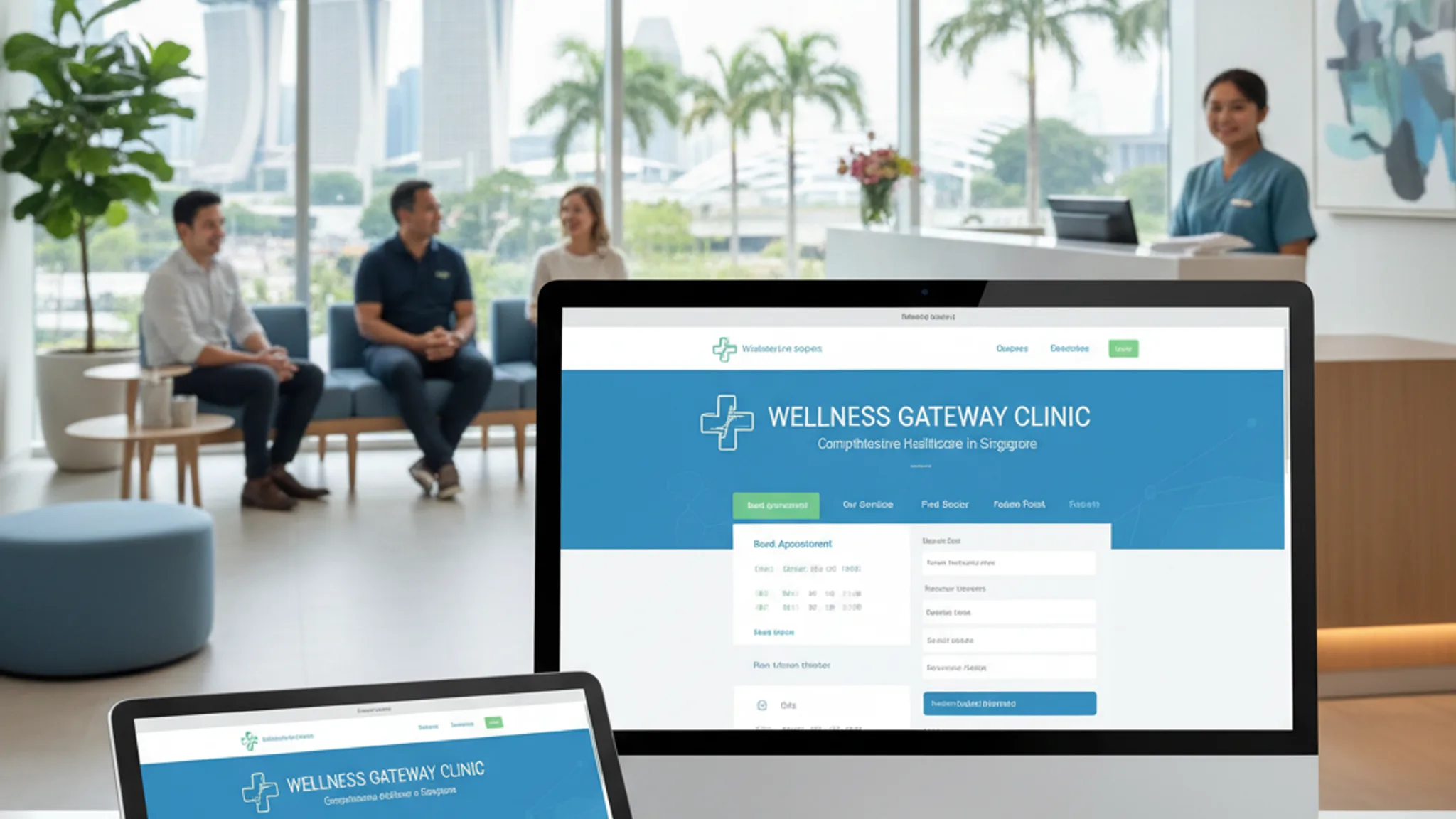
A healthcare clinic website in Singapore is not a regular business website with a stethoscope icon slapped on. The Ministry of Health enforces strict advertising guidelines through the Healthcare Services Act 2020 and subsidiary regulations. The Singapore Medical Council adds another layer with its Ethical Code. Getting those rules wrong means fines, licence conditions, or disciplinary proceedings against your doctors.
But website design for a healthcare clinic in Singapore, done properly, becomes your strongest patient acquisition tool. Patients compare clinics online, check credentials, and look for proof your practice is legitimate, all before they ever call. A well-designed clinic website answers those questions compliantly and turns searches into booked appointments.
We have built websites for service-based businesses across Singapore, including practices where regulatory compliance is non-negotiable. This guide covers the regulations, the must-have features, and the design decisions that separate clinics that attract patients from those that repel them.
Why healthcare websites need a different approach
When someone searches for a clinic, they are making a decision that affects their health. Your website has 3–5 seconds to answer three questions: Is this clinic legitimate? Are the doctors qualified? Can I trust them?
What patients actually look for:
- Doctor credentials: degrees, specialisations, professional memberships
- Treatment information: clear, jargon-free service descriptions
- Pricing transparency: at least indicative fees or consultation costs
- Location and accessibility: MRT proximity, parking, a map
- Online appointment booking: a way to book without calling
Then there is the regulatory layer. Singapore's healthcare advertising rules are among the strictest in the region. Content that is perfectly normal on a clinic website in Australia could violate MOH guidelines here. Your copy, images, and reviews section all need compliance built in from day one, not patched after launch.
MOH advertising guidelines: what your clinic website can and cannot say
This is where most clinic websites get into trouble. The regulations span multiple documents, and many web designers do not know they exist. If it is on your website, it is your responsibility.
The primary legislation is the Healthcare Services Act 2020 (HSA), which replaced the older PHMC Act. The SMC Ethical Code and Ethical Guidelines (2016 Edition) adds further restrictions on how registered medical practitioners can advertise online.
What is prohibited:
- Before-and-after patient photographs: the most commonly violated rule, especially by aesthetic clinics (SMC Ethical Code, Section D, Guideline D3)
- Patient testimonials as advertising: you cannot feature curated reviews or testimonials to promote services
- Guaranteed outcomes: no "100% success rate" or similar claims
- Superlative claims: no "best doctor," "top clinic," "leading," "premier," or "number one"
- Unsubstantiated claims: every factual claim must be verifiable
- Inducements: promotional discounts and free consultations are restricted
What you can include: factual clinic information, doctor qualifications and SMC registration numbers, MOH licence numbers, treatment descriptions (non-promotional), fees and charges, educational health content, and photos of your premises.
Penalties are real. Under the HSA, advertising offences carry fines of up to S$100,000 for a first offence. The SMC can suspend or remove doctors from the medical register. For the full text, refer to the Healthcare Services Act 2020 and the SMC Ethical Code.
Essential features for clinic websites in Singapore
Online appointment booking is non-negotiable. Patients expect it, and younger demographics strongly prefer it over calling. Show available slots, let patients select a doctor, and send confirmation via SMS or email.
Doctor profiles with credentials. Every doctor needs a dedicated page: full name, qualifications (MBBS, specialist accreditations), SMC registration number, areas of interest. This builds trust and satisfies transparency requirements.
Individual treatment pages. Each service gets its own page with factual descriptions: what it involves, who it suits, what to expect. This is also better for SEO than a single "Our Services" page.
Pricing information. MOH encourages fee transparency. At minimum, publish consultation fees and common procedure price ranges. Include Medisave and insurance coverage details where relevant.
Location with map and directions. Embed Google Maps, include nearest MRT, bus routes, parking options, and your exact unit number. Patients are often unwell when visiting, make finding you effortless.
PDPA-compliant forms. Every form collecting personal data needs a clear consent statement and a link to your privacy policy. Healthcare forms are high-risk because they may collect health information. Under the PDPA, breaches carry penalties of up to S$1 million or 10% of annual turnover.
Recommended reads
Building patient trust through medical website design
Design is a trust signal. A poorly designed website makes patients question whether your clinic is legitimate.
Use a clean, clinical aesthetic: generous whitespace, restrained colours (blues, greens, whites), legible typography. No pop-ups, no aggressive sales tactics. Display credentials prominently: MOH licence numbers, SMC registrations, and specialist accreditations in the header or footer of every page.
Invest in real photography of your clinic, not stock photos. Patients spot generic images instantly, and they erode credibility. A one-time photo shoot of your reception, consultation rooms, and team pays dividends for years.
HTTPS is mandatory for any site collecting patient data. Chrome labels non-HTTPS sites "Not Secure," particularly damaging for healthcare. And publish a clear privacy policy explaining what data you collect, how it is stored, and how patients can request access or correction.
For deeper guidance on design that converts, see our UX design principles guide.
Mobile-first design for healthcare clinics
Over 70% of "clinic near me" searches in Singapore happen on mobile. Someone with a toothache at 9pm is on their phone, not a desktop. If your site does not work flawlessly on mobile, you are invisible to the majority of potential patients.
Essentials: a tappable phone number on every page (click-to-call), one-tap directions linking to Google Maps, and mobile-friendly booking forms with large input fields and minimal required fields. Booking should take under 60 seconds on a phone.
Speed is critical for healthcare searches. A patient looking for urgent care will not wait 5 seconds for your page to load; they will tap the next result. Aim for a Largest Contentful Paint under 2.5 seconds. Compress images to WebP, minimise JavaScript, and use a CDN optimised for Singapore.
We build speed and mobile performance into every project. See our web design services for more on our approach.
SEO for healthcare clinics in Singapore
Patients search for specific treatments, not generic terms. "Wisdom tooth extraction Jurong" and "eczema specialist Singapore," not "good clinic." Each treatment page should target a keyword combining the treatment with a location.
Google Business Profile is often more important than your website for local search. It powers the map pack: those three results at the top of local searches. Choose the correct category, add all services, upload real photos, respond to reviews (within compliance rules), and keep hours current.
Implement MedicalOrganization and LocalBusiness schema markup for your clinic name, address, phone, opening hours, and medical specialties. Add FAQPage schema on treatment pages for featured snippet visibility. Most clinic websites miss structured data entirely. Adding it gives you a genuine edge in search results.
For a full local SEO strategy, read our SEO guide for Singapore small businesses.
Common mistakes in healthcare website design
We see the same problems across clinic websites in Singapore:
- Violating MOH guidelines: testimonials, before-and-after photos, "best doctor" claims. Often the clinic owner has no idea because their web designer never flagged it
- No mobile optimisation: text too small, booking forms that require horizontal scrolling. Most patients search on mobile; a non-responsive site is a locked front door
- Stock photos instead of real images: generic models in lab coats undermine trust. Professional photography of your actual clinic is worth the investment
- No online booking: if calling during business hours is the only option, you are losing patients to competitors with booking forms
- Slow page speed: heavy images, excessive plugins, no compression. Run your site through PageSpeed Insights and aim for 90+
For the broader patterns, our guide on website mistakes killing your sales covers what we see across industries.
Choosing a healthcare web design partner
Not every web designer can build a compliant clinic website. When evaluating partners, ask about:
- Regulatory awareness: do they know what MOH advertising guidelines restrict? A blank stare is a red flag
- Service-business experience: clinics share a booking-driven conversion model with other service businesses. Experience with appointment-driven websites translates well
- SEO from day one: not an afterthought or add-on. Every page should ship with proper headings, meta data, and schema
- PDPA knowledge: particularly consent mechanisms for forms collecting health information
We are not healthcare lawyers (we always recommend clinics have final content reviewed by a legal professional), but we know the red flags and we design within the boundaries from the first wireframe.
A healthcare clinic website in Singapore must do three things: comply with MOH and SMC regulations, build patient trust, and convert visitors into appointments. Miss any one, and your website is a liability.
The compliance angle is what makes this different from every other industry. You cannot hire any web designer and hope for the best. The penalties for advertising violations are significant, and "we didn't know" is not a defence the SMC accepts.
Get it right, and your website works around the clock, ranking for treatment keywords, answering patient questions, and booking appointments while your clinic is closed. If you are planning a new clinic website or suspect compliance issues with your current one, see our clinic website design service or get in touch for a free assessment.

Written by
Terris
Founder & Lead Strategist
Terris has over 8 years of experience designing high-converting websites for Singapore businesses. From luxury brands to SMEs, he combines aesthetic design with strategic thinking to deliver websites that drive real business growth.
Want to see these strategies in action? Browse our portfolio or get in touch to discuss your project.