


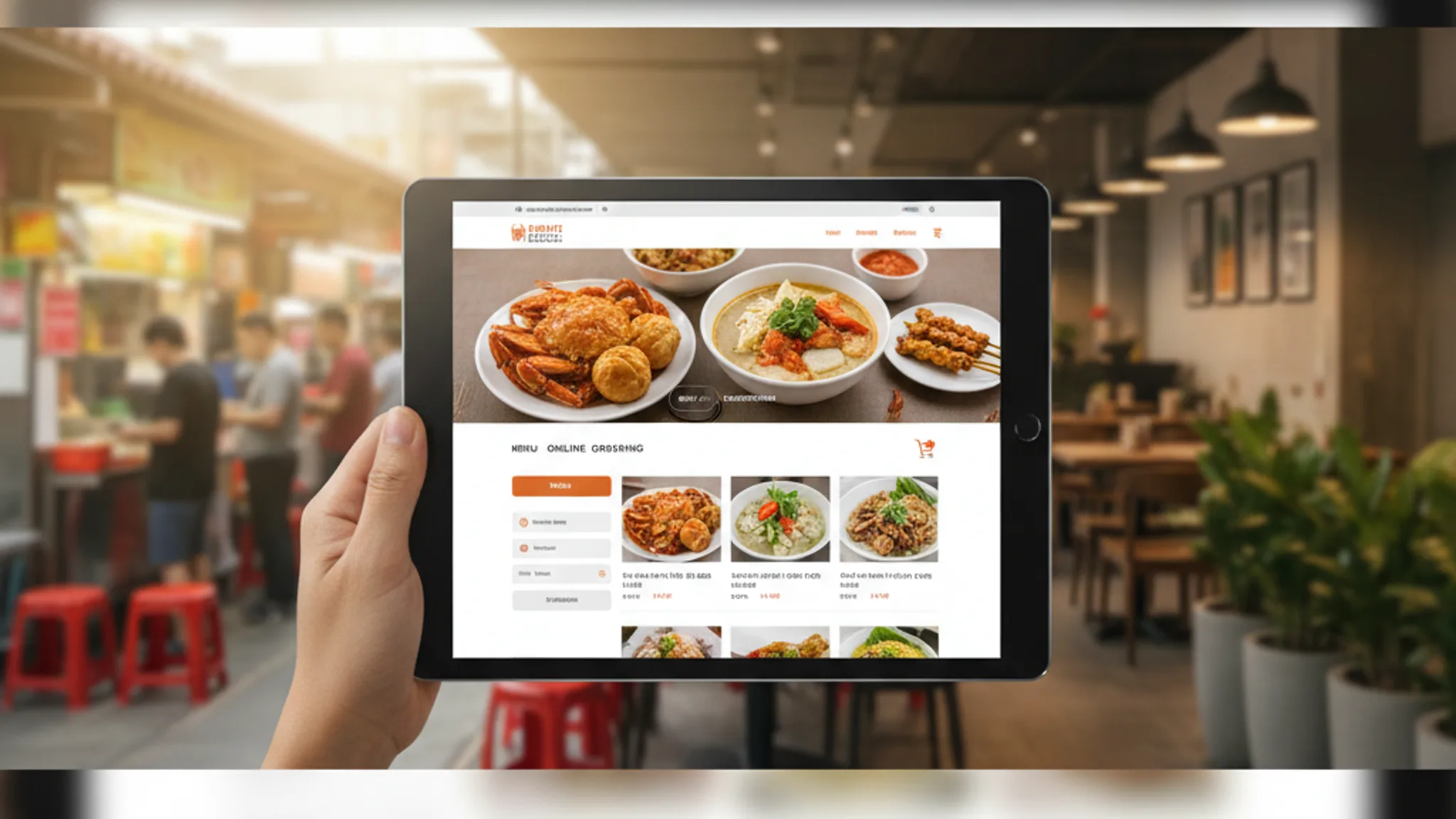
When a customer is deciding where to eat tonight, they're not standing outside your restaurant reading the menu board. They're on their phone, comparing you against GrabFood listings, Burpple reviews, and Google Maps results. Your restaurant website design in Singapore is competing in that exact moment, and if you don't have one, or it loads slowly and shows a PDF menu, you've already lost.
62% of diners discover restaurants through Google, and over 60% of those searches happen on mobile. In a market with more than 7,000 food establishments packed into a city smaller than New York, the businesses that win are the ones that make it effortless for customers to find what's on the menu, when you're open, how to get there, and how to book or order.
This guide covers what actually works: essential features, platform options, local SEO, and the mistakes we see F&B owners make over and over again.
Key Takeaways
What F&B customers actually look for on your website
Before we talk about design trends, let's start with what matters: what your customers want to find. Diners visit your site with specific questions, and they want answers fast.
- Menu and pricing: The number one reason someone visits a restaurant website. They want to see what you serve and how much it costs, not a vague description of your "culinary philosophy." If you hide your prices, customers assume you're expensive.
- Opening hours: The second most common reason for a visit. Include last-order times and public holiday variations.
- Location and directions: An embedded Google Map is the minimum. In Singapore, mention the nearest MRT station and walking distance; MRT proximity is a genuine decision factor. If you have parking, say so.
- Photos of the food and the space: 40% of people visit a restaurant after viewing food photos online. They want to see what dishes actually look like and get a feel for the ambience.
- Online ordering or reservation: Once someone decides to eat at your place, they want to act immediately. A booking widget or ordering link converts far better than a phone number, especially when 75% of local searchers convert within the day.
If your website answers these five questions within 10 seconds of landing, you're ahead of most F&B businesses in Singapore. Everything else (brand story, awards, press mentions) is secondary.
Essential features for restaurant website design in Singapore
A well-designed F&B website in Singapore doesn't need to be complex; it needs to be purposeful. Every element should serve one goal: getting a customer through your door or placing an order.
HTML menu, not a PDF
The single biggest upgrade most restaurant websites can make. PDF menus are terrible on mobile: pinching, zooming, scrolling sideways. They're also invisible to search engines. An HTML menu means Google can index phrases like "laksa" or "wagyu don" on your site, matching you to specific food searches. Structure it with clear categories, item names, descriptions, and prices.
Reservation and ordering integration
Embed your booking system directly into the site: Chope, Oddle, Quandoo, or a custom form. The customer should never leave your website to make a reservation. The same applies to online ordering: the order flow should start on your site, not redirect to a third-party app where you lose the customer's attention and pay a 30% commission.
Google Maps embed with context
Don't just drop a pin. Add text directions: "2-minute walk from Tanjong Pagar MRT, Exit A" or "2nd floor of VivoCity, above the food court." Include parking details: ERP charges, valet availability, nearby HDB carpark rates. These details matter to Singapore diners.
Mobile-first design
Over 60% of restaurant searches are on mobile. Design mobile-first, not just "responsive" as an afterthought: thumb-friendly tap targets, sticky call-to-action buttons (reserve, order, call), fast load times, no horizontal scrolling. For more on building high-performance websites, see our web design services.
Recommended reads
Online ordering and reservations: platform options
The platform you choose for ordering and reservations affects your margins, customer data ownership, and user experience. Here's a practical breakdown.
Chope
Singapore's most established reservation platform. Chope offers an embeddable booking widget, plus queue and table management tools. The trade-off: you share customer data with the platform, and diners who discover you through Chope's marketplace might book your competitor next time. Best for restaurants that rely heavily on reservations and want the credibility of a recognised platform.
Oddle
Oddle positions itself as the "own your customer" alternative. Their ordering system lets you create a branded ordering page on your own domain, accept delivery and takeaway orders, and retain full ownership of customer data. They also offer CRM and loyalty tools. Commission rates are significantly lower than GrabFood or Foodpanda. Best for F&B businesses building a direct ordering channel.
GrabFood and Foodpanda
You can link to these from your website, but you can't embed their ordering flow, and commissions run 25–35% per order. The pragmatic approach: use aggregators for discovery, but incentivise direct orders through your own site. Offer a 10% discount for ordering direct, for example.
In-house ordering system
For high-volume businesses, a custom-built ordering system can pay for itself quickly. You control menu layout, upsells, delivery zones, payment options, and all customer data. The upfront cost is higher ($5,000–$15,000+), but you eliminate ongoing commissions. If you're processing more than 200 orders per month through aggregators, it's worth running the numbers.
Food photography and design: making food look good online
No amount of clever web design compensates for bad food photos. A single compelling image of your signature dish does more to drive a booking than any amount of copywriting.
Invest in a professional shoot
Budget SGD 800–2,000 for a half-day shoot covering 20–30 dishes. A good food photographer understands lighting, plating angles, and how to make textures pop on screen. These photos serve you across your website, Google Business Profile, social media, and print materials for a year or more.
Style honestly, skip the stock
The trend in Singapore's food scene has moved toward natural, honest photography. Show the food as a customer would actually receive it: a dripping burger or a steaming bowl of bak kut teh looks more appetising than a museum-piece arrangement. And nothing erodes trust faster than a stock photo of generic pasta on a Singaporean restaurant site. If you can't afford a pro shoot yet, smartphone photos in natural light are far better than stock.
Design around the food
Your website's colour palette, typography, and layout should complement your photography, not compete with it. Dark backgrounds make vibrant food colours pop. Generous whitespace lets images breathe. The design serves the food, not the other way around. For more on how design choices affect customer behaviour, read our guide on UX design principles that drive conversions.
Local SEO for restaurants: getting found for "near me" searches
Searches for "food near me" have increased by 99% year-over-year, and "food near me open now" has surged by 875%. Here's how to make sure your restaurant shows up.
Google Business Profile is non-negotiable
Restaurants receive seven times more views on their Google Business Profile than on their website. Claim it, verify it, and complete every field: business name, address, phone, hours (including public holidays), cuisine type, price range, and attributes like "dine-in" and "takeaway." Add at least 20 high-quality photos and update them monthly. For a detailed walkthrough, see our Google Business Profile guide.
Restaurant schema markup
Schema markup is structured data that tells Google exactly what your business is. For restaurants, use the Restaurant schema type with properties for name, address, telephone, opening hours, cuisine, price range, menu URL, and geo-coordinates. This can trigger rich results, showing your hours, rating, and price range directly in search. Google's local business structured data documentation covers the full specification.
NAP consistency and reviews
Your Name, Address, and Phone number must be identical everywhere: your website, GBP, Chope listing, Burpple page, and every directory. Even small discrepancies hurt local rankings. Meanwhile, 92% of diners read reviews before choosing where to eat. Create a short review link, print it on table cards, and train staff to ask satisfied customers. Respond to every review: positive and negative. For a broader strategy, check our SEO guide for Singapore small businesses.
Common mistakes F&B websites make
After reviewing hundreds of F&B websites in Singapore, these are the mistakes we see repeatedly. Most are simple to fix, but they cost restaurants real customers every day.
PDF menus
Still the number one offender. A PDF menu on mobile means downloading a file, zooming in, scrolling around, all while trying to decide if your chicken rice is worth the trip. Convert to HTML. If your menu changes daily, even a Google Doc in an iframe beats a PDF.
Not mobile-optimised
If your site was built five-plus years ago and hasn't been updated, it probably doesn't work properly on mobile. Text too small, buttons too close together, horizontal scrolling. These are immediate bounce triggers. With 60%+ of restaurant searches on mobile, this is the difference between getting the customer and losing them.
Outdated information
Nothing frustrates a customer more than arriving to find you closed because the website listed the wrong hours. Update your site and GBP for every public holiday: Chinese New Year, Hari Raya, Christmas. If you run a seasonal menu, remove old items promptly.
No photos or stock photos
A restaurant website without food photos is like a property listing without pictures; people move on. Even basic smartphone shots in natural light are infinitely more trustworthy than generic stock imagery.
Buried contact information and slow load times
Your phone number, address, and hours should be on every page, header or footer. A sticky "Call" or "WhatsApp" button on mobile makes contact effortless. And if your image-heavy site takes more than 3 seconds to load, you're losing visitors. Compress images to WebP, use lazy loading, minimise third-party scripts. We cover performance and more in our F&B digital marketing guide.
Your restaurant website design in Singapore doesn't need to be flashy. It needs to do a handful of things exceptionally well: show your menu with prices, display your hours and location, make it easy to book or order, and look appetising on a phone screen.
The F&B businesses that get this right see measurable results: more direct orders with better margins, higher foot traffic from local search, and a professional presence that builds trust before a customer ever walks through the door.
If your current website has a PDF menu, doesn't work on mobile, or hasn't been updated in over a year, it's costing you customers right now. Start with the basics, integrate a booking or ordering platform, invest in real food photography, and make sure Google can find you. Need help? See our restaurant website design service or get a free quote.

Written by
Terris
Founder & Lead Strategist
Terris has over 8 years of experience designing high-converting websites for Singapore businesses. From hawker brands going digital to multi-outlet restaurant groups, he combines strategic thinking with design that drives real foot traffic and online orders.
Want to see these strategies in action? Browse our portfolio or get in touch to discuss your project.