




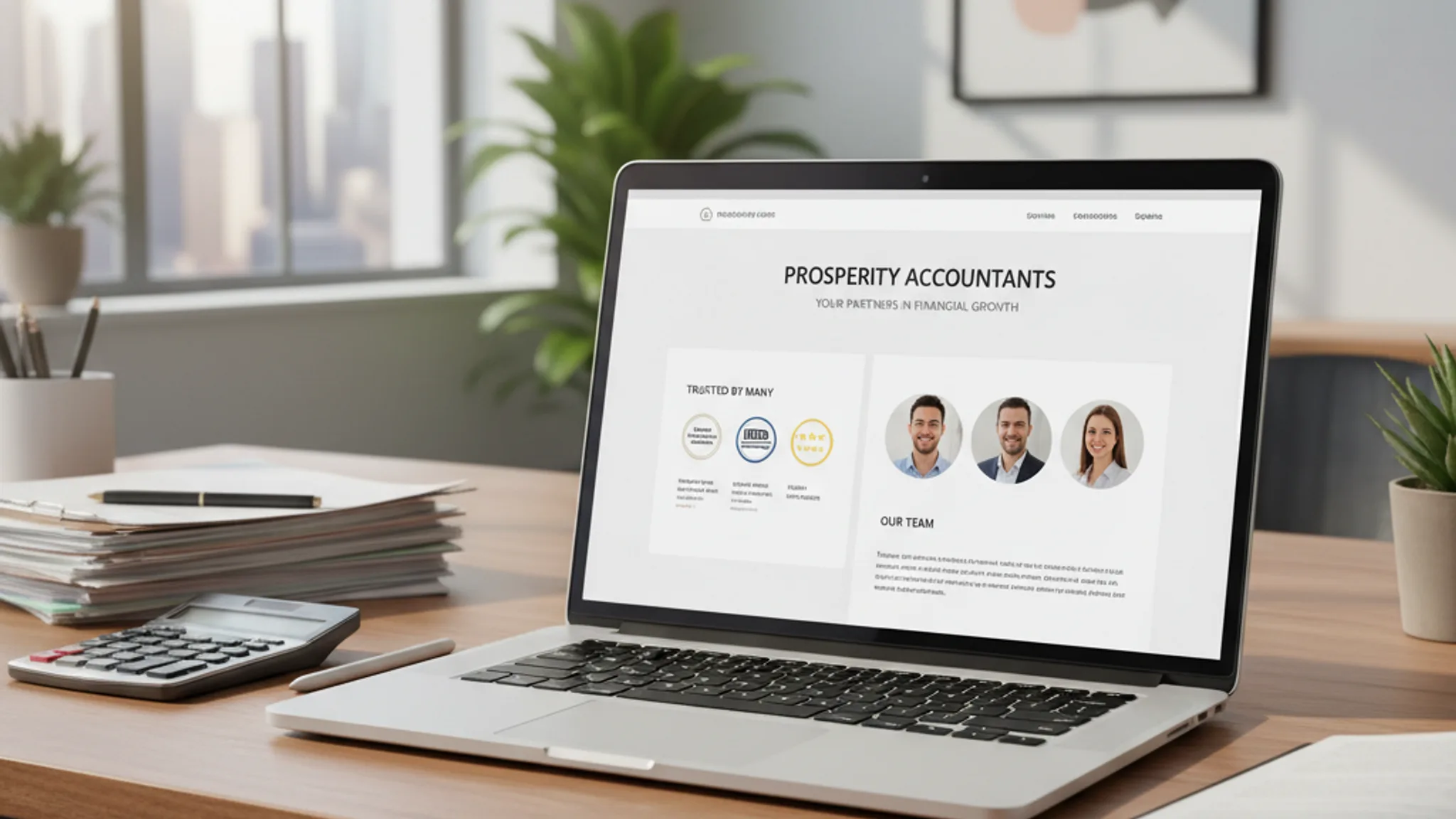
Singapore is home to more than 1,300 public accounting firms and thousands of corporate service providers, all competing for a share of one of Asia's most dynamic business environments. With over 90% of Singaporeans using the internet daily and the majority of B2B purchasing decisions beginning with an online search, your accounting firm's website is no longer optional. It is your primary client acquisition tool.
Yet most accounting firm websites in Singapore look remarkably similar: a bland template, a list of services in bullet points, a few stock photos of calculators and spreadsheets, and a generic contact form. These sites do not differentiate, they do not rank, and they do not convert. Potential clients visit, feel nothing, and move on to the next firm.
We have designed websites for professional service firms across Singapore where trust, credibility, and compliance are non-negotiable. This guide covers everything you need to know about building an accounting firm website that stands out: the essential features, compliance considerations, SEO strategy, realistic costs, and the conversion tactics that turn visitors into long-term clients.
Why accounting firms need a professional website
The accounting profession in Singapore has changed. A decade ago, most firms relied on referrals from lawyers, bankers, and existing clients. That channel still matters, but it is no longer sufficient. When a business owner needs an accountant for GST registration, audit services, or corporate tax advisory, the first thing they do is search online. They compare firms, check credentials, read about service offerings, and form an opinion about your professionalism before they ever send an enquiry.
Here is what the numbers tell us:
- Over 80% of B2B buyers research service providers online before making initial contact, including for professional services like accounting
- Singapore has more than 1,300 registered public accounting firms and thousands of corporate service providers, creating intense competition for visibility
- First impressions form in under 5 seconds. A dated, slow, or cluttered website makes business owners question your attention to detail, the very quality they need most from their accountant
- 97% of Singaporeans own a smartphone. A significant portion of initial research happens on mobile, even for B2B services. If your site does not work on a phone, you are invisible to these decision-makers
Your website is your digital office lobby. It communicates professionalism, competence, and trustworthiness before a single word is exchanged. For accounting firms, where the entire relationship is built on trust and accuracy, a poorly designed website sends exactly the wrong signal.
Beyond impressions, a well-optimised website generates leads around the clock. It ranks for searches like "corporate tax advisory Singapore" or "GST registration services," captures enquiries at midnight when your office is closed, and educates potential clients through thought leadership content. Firms still relying entirely on referrals are leaving significant revenue on the table.
What makes a great accounting firm website
Accounting firm websites need to convey two things simultaneously: expertise and approachability. Visitors are typically business owners or finance directors making a decision that will affect their company's financial health. They need to feel confident in your capabilities without feeling overwhelmed by jargon or intimidated by the site itself.
Clean, professional design. This means generous whitespace, a restrained colour palette (navy, charcoal, slate blue with selective accent colours), and typography that conveys authority without being cold. Avoid flashy animations, trendy gradients, or anything that looks more like a fintech startup than a trusted advisory firm. The design should feel precise, organised, and reliable, qualities that mirror what clients expect from their accountant.
Trust signals throughout the site. Credentials, professional memberships, and qualifications should be visible on every page, not confined to a single About section. Display your ISCA (Institute of Singapore Chartered Accountants) membership, ACRA registration details, any specialist accreditations (ACCA, CPA Australia, CA Singapore), and the number of years your firm has been operating. These details matter enormously to business owners comparing firms.
Mobile-first is essential. While many assume accounting is a desktop-only industry, the reality is different. Business owners and startup founders frequently research service providers on their phones during commutes, between meetings, or after hours. Your site must be fully responsive, fast-loading, and easy to navigate with a thumb.
Fast load times. Every second of delay costs you potential clients. Aim for a Largest Contentful Paint (LCP) under 2.5 seconds. Use modern image formats like WebP, minimise JavaScript, and choose hosting optimised for Singapore. We have audited accounting firm websites that take 7 to 8 seconds to load because of uncompressed images and bloated WordPress themes loaded with unused plugins. In 2026, that is simply unacceptable.
Clear service navigation. Accounting firms offer many services, and visitors need to find the relevant one quickly. Organise services by category (tax, audit, advisory, bookkeeping, corporate secretarial) with each category leading to dedicated pages. Avoid vague labels like "Our Solutions" or a single page listing 20 services in bullet points. Decision-makers want specificity and depth, not a laundry list.
For more on the design principles that drive conversions, read our UX design principles guide.
Essential pages and features for an accounting firm website
Every accounting firm website needs a core set of pages. These are not optional extras; they are what potential clients expect to find when evaluating your firm online.
Homepage. Your homepage is the front door. It should immediately communicate who you serve, what services you offer, and why clients choose your firm over competitors. Include a strong headline (avoid generic statements like "Your Trusted Accounting Partner"), a concise overview of core service areas, key trust signals (years in business, number of clients served, professional memberships), and a clear call to action. Do not bury your value proposition under paragraphs of company history.
Service pages by category. Each major service area deserves its own dedicated page with substantive content. At minimum, you should have individual pages for:
- Tax advisory and compliance: corporate tax, personal tax, GST registration and filing, transfer pricing, withholding tax, tax incentive applications
- Audit and assurance: statutory audit, internal audit, review engagements, agreed-upon procedures
- Advisory services: business valuations, due diligence, restructuring, IPO readiness, mergers and acquisitions support
- Bookkeeping and accounting: monthly bookkeeping, payroll processing, financial reporting, cloud accounting setup (Xero, QuickBooks)
- Corporate secretarial: company incorporation, annual returns, ACRA compliance, registered office services
Each page should explain the service in plain language, outline who needs it, describe your approach, and include a call to action. This structure also gives you a major SEO advantage, as each page targets specific keywords like "GST registration Singapore" or "corporate tax advisory Singapore."
Team profiles. People hire people, not firms. Each partner and senior staff member should have a dedicated profile page with their name, qualifications (CA, ACCA, CPA), ISCA membership details, areas of specialisation, years of experience, and a professional headshot. A brief personal note about their approach or industry focus helps humanise the firm and build connection.
Industries served. If your firm specialises in particular sectors (technology startups, F&B, healthcare, real estate, non-profits), create dedicated industry pages. A fintech startup founder searching for "accountant for tech startups Singapore" wants to know you understand their specific needs: revenue recognition for SaaS, R&D tax incentives, equity compensation accounting. Industry pages demonstrate specialisation and attract higher-value clients.
Resources and blog. A blog section serves dual purposes: demonstrating expertise and driving organic search traffic. Articles on topics like "Corporate tax filing deadlines Singapore 2026," "GST registration threshold changes," or "How to choose between Xero and QuickBooks" attract the exact audience you want. Each article positions your firm as a knowledgeable authority and creates an entry point for potential clients.
Contact page with multiple options. Make it effortless to reach you. Include a contact form, phone number (click-to-call on mobile), email address, office address with an embedded Google Map, and operating hours. Adding a WhatsApp option works well in Singapore's messaging-first business culture, especially for initial enquiries from smaller businesses and startups.
Client portal link. If your firm uses a client portal for document exchange, tax filing status, or invoice management, include a prominent link in your header or navigation. This signals to potential clients that your firm embraces technology, and it provides a practical convenience for existing clients who visit your website regularly.
Compliance considerations for accounting firm websites
While accounting firms face fewer advertising restrictions than law firms or medical practices, there are still compliance boundaries you need to respect. Getting these wrong does not just risk penalties; it damages the credibility that your entire business depends on.
ACRA requirements. If your firm is a registered public accounting firm, your website should display accurate and current registration information. Any services that require ACRA registration (such as statutory audit) should only be promoted if your firm holds the appropriate licence. Misrepresenting your firm's registration status or capabilities is a serious matter.
ISCA Code of Professional Conduct and Ethics. The Institute of Singapore Chartered Accountants sets out ethical standards that affect how you market your services. Key points include:
- No misleading claims: avoid superlatives like "best," "leading," or "number one accounting firm." Factual statements about your experience, qualifications, and client base are fine; subjective superiority claims are not
- No guaranteed outcomes: do not promise specific tax savings amounts, audit results, or financial outcomes. You can describe your approach and methodology, but implying guaranteed results crosses an ethical line
- Fee advertising: you can publish your fee structures (and in many cases, this is helpful for attracting the right clients), but avoid comparative claims about being the "cheapest" or "most affordable." Factual pricing is fine; competitive comparisons are not
- Client confidentiality: if you feature case studies or testimonials, ensure you have explicit written consent and anonymise client details where appropriate. The accountant-client relationship carries confidentiality obligations that extend to your website content
Professional disclaimers. Every accounting firm website should include a disclaimer clarifying that website content is for general information purposes and does not constitute professional advice. Blog articles on tax or regulatory topics should carry similar notes. This protects your firm from liability claims and sets appropriate expectations.
PDPA compliance. Under the Personal Data Protection Act, every form on your website collecting personal data needs a clear consent statement explaining what data you collect, why you collect it, and how it will be used. You also need a published privacy policy linked from every form and accessible from your footer. For a complete walkthrough, read our PDPA website compliance guide.
Anti-Money Laundering (AML) considerations. While this does not directly affect your website design, some firms choose to include a brief statement about their AML compliance procedures, particularly firms serving international clients or providing corporate secretarial services. This signals to sophisticated clients that you take regulatory obligations seriously.
Recommended reads
SEO for accounting firm websites in Singapore
A polished website that nobody finds is a wasted investment. Search engine optimisation is what transforms your site from a digital brochure into a consistent source of qualified leads. For accounting firms, SEO is particularly valuable because searches like "corporate tax advisory Singapore" or "audit firm Singapore" carry high commercial intent. These people are actively looking for help.
Local SEO is critical. Most accounting-related searches include location modifiers: "accountant Singapore," "tax advisory firm CBD," "bookkeeper Jurong." Optimise every service page with location-specific keywords. If your firm has offices in multiple areas, create dedicated location pages for each. Local SEO is what puts you in front of businesses searching in your immediate area. For a comprehensive strategy, read our local SEO Singapore guide.
Service-specific keywords drive qualified traffic. Each service page should target specific search terms that match what your potential clients type into Google:
- "Corporate tax filing Singapore" (consistent demand, moderate competition)
- "GST registration services Singapore" (high intent, businesses actively need this)
- "Audit firm Singapore" (competitive, but essential to target)
- "Bookkeeping services Singapore" (high volume, price-sensitive segment)
- "Xero accountant Singapore" (specific, highly qualified traffic)
- "Company incorporation Singapore" (high volume, entry point for long-term relationships)
The strategy is to rank for both broad terms and long-tail keywords. Your service pages target the broad terms while your blog content captures the longer, more specific queries that people search before they are ready to engage a firm.
Google Business Profile. This is arguably more important than your website for local search visibility. It powers the map pack (the three businesses shown with a map at the top of local search results). Claim your profile, verify your business address, add all services, upload real office photos, respond to reviews professionally, and keep your business hours current. Firms that actively manage their Google Business Profile consistently outperform those that ignore it.
Schema markup. Implement AccountingService and LocalBusiness schema for your firm's name, address, phone number, services, and operating hours. Add FAQPage schema on pages with frequently asked questions, and Person schema for individual partner profiles. Most accounting firm websites have zero structured data, so adding it gives you a genuine competitive advantage. Our schema markup guide covers the implementation details.
Content marketing through a blog. Publish articles that answer the questions your potential clients are actively searching. Topics like "When is corporate tax due in Singapore," "Do I need to register for GST," or "Xero vs QuickBooks for Singapore businesses" drive targeted organic traffic. Each article builds your authority and creates a touchpoint with people who may become clients. For a complete SEO strategy, our SEO guide for Singapore small businesses covers the fundamentals across industries.
How much does an accounting firm website cost in Singapore?
Accounting firm websites in Singapore typically cost between S$5,000 and S$15,000 for a professionally designed and developed site. The range depends on several factors, and understanding them helps you budget realistically.
What affects pricing:
- Number of pages: a sole practitioner with 6 to 10 pages will pay significantly less than a mid-sized firm needing 25+ pages covering multiple service areas, team profiles, industry pages, and a resource library
- Custom design vs templates: a fully custom design tailored to your firm's brand and positioning costs more than adapting a premium WordPress or Webflow template. For accounting firms, custom design is worth considering because it differentiates you from competitors using the same generic themes
- Content creation: if the agency writes your website copy (recommended for SEO and consistency), this adds to the cost. Accounting website copy requires accuracy and a careful balance between technical precision and accessibility for non-accountant readers
- Integrations: client portal links, booking systems, live chat, newsletter platforms, CRM integrations, and connections to accounting software (Xero, QuickBooks) add complexity and cost
- Photography: professional headshots and office photography make a measurable difference. Budget S$500 to S$1,500 separately for a professional shoot
- Ongoing maintenance: hosting, security updates, content updates, and SEO services typically run S$200 to S$800 per month depending on the scope
Typical budget tiers:
- S$5,000 to S$8,000: suitable for small firms and sole practitioners. Clean template-based design, 8 to 12 pages, basic SEO, mobile-responsive, contact form
- S$8,000 to S$12,000: mid-range for growing firms. Custom design, 15 to 25 pages, dedicated service and industry pages, professional copywriting, structured data, blog setup
- S$12,000 to S$15,000+: comprehensive build for established firms. Fully custom design, 25+ pages, client portal integration, advanced SEO, content strategy, multilingual support (English and Chinese), and ongoing content production
DIY vs professional. Website builders like Wix or Squarespace can produce a basic site for under S$500 per year. For sole practitioners just starting out, this may be acceptable as a temporary solution. However, for established firms, the DIY route carries real costs: generic design that fails to differentiate, limited SEO capability, no compliance review, and the significant opportunity cost of your time. A partner's billable hour is worth far more than what a professional web designer charges.
For a detailed breakdown of website costs across industries, read our comprehensive website cost guide.
Common mistakes accounting firm websites make
We review professional service websites regularly, and accounting firms tend to make the same mistakes. Avoiding these puts you ahead of the majority of your competitors.
- Stock photos of calculators and spreadsheets. These images appear on virtually every accounting website in Singapore. They communicate nothing about your specific firm and they actively erode trust. Potential clients recognise stock photography instantly. Invest in real photos of your office, your team, and your working environment. Authenticity builds connection; stock images build sameness.
- No clear differentiator. If your homepage could belong to any accounting firm in Singapore by simply swapping the logo, you have a positioning problem. What makes your firm different? Industry specialisation? Technology-forward approach? Multilingual team? Startup focus? Personal partner involvement? Your website should communicate this clearly within the first few seconds.
- Poor mobile experience. Tiny text, horizontal scrolling, forms that are impossible to complete on a phone, and navigation menus that break on touchscreens. Even in B2B, a growing share of initial research happens on mobile devices. A broken mobile experience means lost opportunities.
- No client testimonials or case studies. Social proof is one of the most powerful conversion tools available, yet many accounting firm websites feature none. Business owners want to see evidence that you have helped similar companies. Even brief, anonymised case studies ("Helped a 50-person tech startup reduce their effective tax rate by 15% through proper utilisation of the Productivity and Innovation Credit scheme") add enormous credibility. Ensure you have written consent and respect confidentiality obligations.
- Ignoring SEO entirely. Many accounting firm websites are built with zero consideration for search visibility. No keyword research, no optimised meta titles, no structured data, no blog content. The site may look presentable, but it generates no organic traffic because Google has no reason to surface it.
- No blog or resources section. An accounting firm website without content is a missed opportunity for both SEO and thought leadership. Tax deadlines change, GST thresholds get updated, and new incentive schemes are announced. Publishing timely, helpful content on these topics drives qualified traffic and demonstrates that your firm stays current.
- Burying contact information. If a potential client has to hunt for your phone number or navigate to a separate page to find your email address, you are creating unnecessary friction. Contact details should be visible in the header, footer, and on every service page. Make it as easy as possible for someone to reach you the moment they decide to enquire.
Converting website visitors into clients
Driving traffic to your website is only half the equation. The other half is converting those visitors into actual enquiries and, ultimately, long-term clients. Here is what works for accounting firm websites.
Trust signals on every page. Do not confine your credentials, memberships, and client logos to the About page. Display ISCA membership badges, professional qualifications, industry awards, and years of experience throughout the site. A small trust bar near the top of each page ("ISCA Member | 15+ Years Experience | 500+ Clients Served") provides instant reassurance.
Free consultation CTAs. The most effective call to action for accounting firms is the free initial consultation. Business owners want to discuss their specific situation before committing to a firm. Place "Book a Free Consultation" buttons prominently on every service page, at the end of blog articles, and in your site header. Make it clear what they will get from the consultation: a review of their current setup, identification of potential issues, and a no-obligation proposal.
Case studies and client results. Nothing converts like proof of results. Create anonymised case studies that walk through the client's challenge, your approach, and the outcome. For example: "A food and beverage chain with 12 outlets was overpaying GST by S$40,000 annually due to incorrect input tax claims. We restructured their GST filing process and recovered the overpayments." Real stories with real numbers are far more persuasive than generic service descriptions.
Thought leadership content. Publishing insightful articles on tax planning, regulatory changes, and financial strategy positions your firm as experts, not just service providers. When a CFO reads your article on "Transfer Pricing Documentation Requirements for Singapore Companies" and finds it genuinely useful, your firm is top of mind when they need advisory help.
Live chat and WhatsApp. Adding a live chat widget or WhatsApp button significantly reduces the friction of first contact. Many business owners prefer sending a quick message over filling in a formal contact form or making a phone call. In Singapore's messaging culture, WhatsApp in particular drives a high volume of initial enquiries for professional service firms.
Exit-intent and scroll-triggered offers. A subtle popup offering a free tax compliance checklist, a guide to GST registration, or a business incorporation starter pack can capture leads who might otherwise leave without engaging. The key word is subtle. Aggressive popups that block the page within three seconds drive visitors away. A well-timed, valuable offer converts them.
For a broader perspective on how design decisions affect conversions, see our web design services page or contact us for a consultation.
Choosing a web design agency for your accounting firm
Not every web designer understands the specific needs of professional service firms. When evaluating potential agencies, here is what to look for.
Experience with professional services. An agency that has built websites for accounting firms, law firms, or consultancies understands the trust-first design approach, the compliance nuances, and the conversion patterns that work for B2B professional services. Ask to see relevant portfolio examples.
SEO built in from day one. SEO should not be an afterthought or a separate "add-on" package. Every page should be built with proper heading hierarchy, meta data, structured data, mobile optimisation, and fast load times from the start. Ask how the agency approaches keyword research for service pages and whether they implement schema markup as standard.
Content capability. Will the agency write your website copy, or will you need to provide everything? Good accounting website copy requires balancing technical accuracy with readability for non-accountant audiences. If you are writing your own content, ensure the agency at least reviews it for SEO optimisation and consistency.
Ongoing support. A website is a living asset, not a one-time project. Tax regulations change, your team grows, new services are added. Ask about maintenance packages, content update processes, and how quickly the agency responds to change requests. A good agency relationship is a partnership, not a transaction.
For a comprehensive framework on evaluating agencies, read our guide on how to choose a web design agency in Singapore.
Frequently asked questions
How long does it take to build an accounting firm website?
A professional accounting firm website typically takes 6 to 10 weeks from kickoff to launch. This includes discovery and strategy (1 to 2 weeks), design (2 to 3 weeks), development (2 to 3 weeks), and content population and testing (1 to 2 weeks). The most common cause of delays is content: if your team takes weeks to provide partner bios, approve service descriptions, or finalise headshots, the timeline stretches accordingly. Firms that come prepared with content and respond to feedback promptly can launch closer to the 6-week mark.
Should I use WordPress for my accounting firm website?
WordPress is a viable option with a large ecosystem of themes and plugins. However, it requires regular maintenance (security patches, plugin updates, database optimisation) and can become slow and vulnerable if not actively managed. For accounting firms that want a hands-off, high-performance website, modern frameworks like Astro or managed platforms often deliver better results with lower maintenance overhead. The right choice depends on your budget, technical capability, and how frequently you plan to update content yourself.
Do I need a blog on my accounting firm website?
Strongly recommended. A blog is one of the most effective ways to drive organic traffic and demonstrate expertise. Articles on topics like "Singapore corporate tax filing deadlines 2026," "GST registration guide for new businesses," or "Xero vs QuickBooks: which is better for Singapore SMEs" attract business owners who are actively researching these topics. These visitors are highly qualified leads. Even publishing two to three articles per month can significantly improve your search visibility over 6 to 12 months.
Can I display client testimonials on my website?
Yes, and you should. Testimonials are one of the strongest trust signals for professional service firms. However, always get written consent from the client before publishing, and anonymise details where the client prefers privacy. Avoid fabricating or embellishing reviews. Genuine, specific testimonials ("They handled our company's GST registration and first-year tax filing seamlessly, saving us significant time") are far more persuasive than vague praise.
How do I make my accounting firm website PDPA compliant?
Every form on your website that collects personal data (contact forms, newsletter sign-ups, consultation request forms) must include a clear consent statement explaining what data you collect, why you collect it, and how it will be used. You need a published privacy policy linked from every form and accessible from your site footer. Ensure your website uses HTTPS encryption, and store form submissions securely. For a complete checklist, read our PDPA website compliance guide.
What is the ROI of a professional accounting firm website?
Consider the lifetime value of an accounting client. A typical SME client paying S$500 to S$2,000 per month for recurring bookkeeping, tax, and secretarial services generates S$6,000 to S$24,000 per year, and the average client relationship in accounting lasts 5 to 7 years. If a well-optimised website generates just two to three additional qualified enquiries per month, and you convert even a fraction of those into long-term clients, the website pays for itself many times over within the first year. Combined with ongoing SEO, the compounding returns are substantial.
An accounting firm website in Singapore needs to accomplish three things: establish trust and credibility, clearly communicate your expertise, and convert visitors into enquiries. Miss any one of these, and your website is either a missed opportunity or an expensive digital placeholder.
The accounting profession has moved online. Your potential clients are comparing firms, reading about services, and forming opinions before they pick up the phone. The firms that invest in a professional, well-optimised website are the ones filling their client rosters. The firms clinging to generic templates and zero SEO are watching their competitors capture the leads they should be getting.
What sets great accounting firm websites apart is not complexity. It is clarity, trust, and a relentless focus on making it easy for the right clients to find you and reach out. Authentic photography, specific service pages, genuine testimonials, and consistent thought leadership content. These are the building blocks.
If you are planning a new website for your accounting firm, or if your current site is not generating the enquiries it should, explore our web design services or get in touch for a free consultation. We understand the professional services landscape in Singapore, we build websites that comply with industry standards, and we deliver results that show up in your pipeline.
Sources & References (5)

Written by
Terris
Founder & Lead Strategist
Terris has designed websites for professional service firms across Singapore, combining trust-focused design with lead generation strategies that help firms attract and convert high-value clients online.
Want to see these strategies in action? Browse our portfolio or get in touch to discuss your project.