

Singapore's events industry is thriving. Between the return of large-scale MICE events, a booming wedding market, and corporate demand for experiential activations, events companies across the island are busier than ever. But here is the reality: most events company websites in Singapore do not reflect the quality of the work being delivered. We see stunning event setups, flawless execution on the ground, and then a website that looks like it was built in 2017 with a free WordPress theme.
That is a problem, because your website is where 80% of your potential clients form their first impression. A corporate HR manager sourcing a D&D planner, a bride-to-be comparing wedding coordinators, or a marketing director looking for a product launch partner: they are all Googling, scrolling through portfolios, and making shortlist decisions before they ever pick up the phone. If your events company website in Singapore does not match the calibre of your actual events, you are losing business to competitors whose online presence does.
We have built websites for visual-first businesses in Singapore, and the events industry presents a unique challenge: you need to showcase atmosphere, emotion, and scale through a screen. This guide covers exactly how to do that, from portfolio design and video integration to SEO and conversion strategy.
Why events companies need a standout website
The events industry is inherently visual. Your product is an experience, and your website needs to communicate that experience to someone who was not there. That is fundamentally different from a law firm website or an accounting practice. You are selling energy, creativity, and trust, and a text-heavy, stock-photo website simply cannot convey those qualities.
Here is why a strong website matters more for events companies than most other industries:
- First impressions are everything. If you cannot create a beautiful website, clients will question whether you can create a beautiful event. Your site is a live demonstration of your design sensibility, attention to detail, and brand standards.
- Portfolio is your strongest sales tool. Unlike service businesses that sell outcomes (higher revenue, fewer cavities), events companies sell a visual and emotional experience. Your past work is the most persuasive evidence that you can deliver. If your portfolio is buried, poorly presented, or outdated, you are undermining your own pitch.
- Competition is fierce. Singapore has hundreds of events companies, from boutique wedding planners to full-service corporate event management firms. Many of them do excellent work. The ones who win the pitch are often the ones who present themselves best online, not necessarily the ones with the most experience.
- Clients compare before they enquire. The typical client will visit three to five events company websites before reaching out. They are comparing aesthetics, portfolio quality, service range, and professionalism. If your website is the weakest of the five, you will not make the shortlist, no matter how good your actual events are.
- Google is the starting point. Whether someone searches "corporate event planner Singapore," "wedding coordinator Singapore," or "product launch events Singapore," your website needs to show up. And when it does, it needs to convert that visitor into an enquiry within 60 seconds.
In short: your website is your digital showroom. If it does not impress, nothing else gets a chance to.
What makes a great events company website
A great events company website is not just "nice-looking." It does several things simultaneously: it communicates your brand, showcases your work in its best light, loads quickly, works perfectly on mobile, and guides visitors toward making an enquiry. Here is what separates the best from the rest.
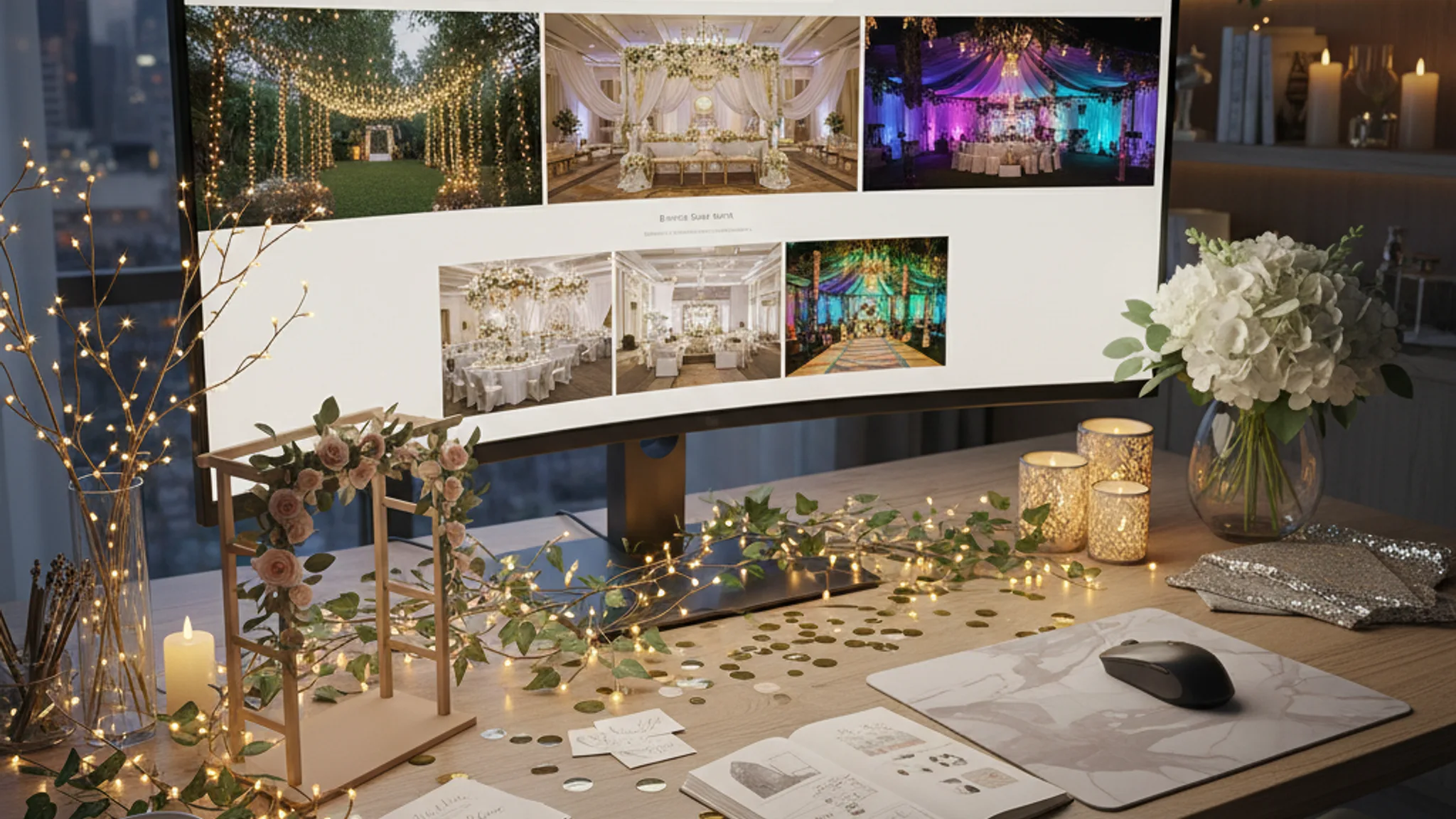
Stunning visual design that matches your brand. Your website's look and feel should mirror the calibre of events you produce. If you specialise in luxury weddings, your site should feel elegant: refined typography, muted palettes, generous whitespace. If you handle high-energy corporate activations, your site should be dynamic: bold colours, motion, and scale. Generic templates will not cut it. The design itself is a portfolio piece.
Fast-loading galleries that do not compromise quality. This is the technical challenge that trips up most events websites. High-resolution event photography is essential for showcasing your work, but unoptimised images kill page speed. The solution is modern image formats (WebP or AVIF), responsive image sizes, lazy loading for below-the-fold content, and a content delivery network (CDN) optimised for Singapore. A well-built gallery should load in under 2.5 seconds even with dozens of images. For more on why speed matters, see our guide on Core Web Vitals for Singapore businesses.
Video integration done right. Events are dynamic, and static photos cannot always capture the energy of a live experience. Highlight reels, event recaps, and behind-the-scenes footage add a dimension that photography alone cannot. But embedding raw video files directly into your site is a performance disaster. Use YouTube or Vimeo embeds with lazy loading, or host short-form clips in compressed MP4 format. A hero section with a looping background video (muted, autoplay, under 5MB) can be incredibly effective when implemented correctly.
Fully mobile-responsive. Over 70% of web traffic in Singapore comes from mobile devices. Clients will browse your portfolio on their phones during meetings, on the MRT, or in bed while planning their wedding. Every gallery, video, and contact form must work flawlessly on screens of all sizes. Touch-friendly navigation and swipeable galleries are not optional.
An immersive experience. The best events websites make visitors feel something. Subtle scroll animations, full-bleed imagery, cinematic video sections, and thoughtful typography create an emotional response that mirrors what your events deliver in person. The goal is not to overwhelm with effects, but to create a journey that keeps visitors engaged and scrolling.
Essential pages and features for events company websites
Every events company website needs a specific set of pages to cover the full client decision journey. Miss any of these, and you are leaving gaps that competitors will fill.
Homepage with hero video or imagery. Your homepage has 3 to 5 seconds to make an impression. Lead with your strongest visual asset: a cinematic hero video reel, a full-bleed photo from your best event, or a rotating gallery of highlights. Include a clear headline that states what you do and who you serve, followed by a prominent call-to-action ("View Our Work" or "Get a Quote"). Do not bury your best work below the fold.
Services pages by event type. Do not lump everything into a single "Services" page. Create dedicated pages for each category you handle:
- Corporate events: conferences, seminars, product launches, Dinner and Dance, team building, annual general meetings
- Weddings: full planning, day-of coordination, destination weddings, solemnisation ceremonies
- Private events: birthday celebrations, anniversaries, baby showers, private dining
- Live entertainment: concerts, festivals, roadshows, experiential activations
- Virtual and hybrid events: live streaming, virtual conferences, hybrid setups
Each page should describe your approach, include relevant portfolio examples, and have its own call-to-action. This structure also gives you significant SEO advantages, because each page can target a specific keyword like "corporate event planner Singapore" or "wedding coordinator Singapore."
Portfolio and gallery. This is the most important section of your entire website. We will cover best practices in detail in the next section, but the key principle is this: your portfolio should be organised, high-quality, and easy to browse. Potential clients want to see events similar to theirs.
About page and team profiles. Events are personal. Clients want to know who will be managing their event, not just the company name. Feature your key team members with professional photos, brief bios, and their specialisations. Include your company story, your values, and what differentiates your approach. If you have industry certifications (such as SACEOS membership), display them prominently.
Testimonials and social proof. Client testimonials are gold in the events industry. Feature quotes from past clients alongside the event type and (with permission) their name and company. Google Reviews integration, awards, and media mentions all reinforce credibility. If you have worked with recognisable brands, a "Past Clients" logo bar is one of the highest-converting elements you can add. For tips on writing effective copy for these sections, see our website copywriting guide.
Blog or resources section. A blog is not just an SEO tool (though it is a powerful one). It positions your company as a thought leader. Write about event trends, venue guides, planning tips, and behind-the-scenes stories. Each post creates a new entry point for organic search traffic and gives you content to share on social media.
Contact page and quote request form. Make it ridiculously easy to get in touch. Your contact page should include a form (with fields for event type, estimated date, guest count, and budget range), your phone number, email, WhatsApp link, and office location. A multi-step quote form that guides clients through key details can increase form completions by 20 to 30% compared to a single long form.
Past clients section. A dedicated section (or a logo bar on your homepage) featuring the brands and organisations you have worked with. This is particularly important for corporate event companies. When a procurement manager sees that you have handled events for companies they recognise, it immediately reduces perceived risk.
Recommended reads
Portfolio showcase best practices for events websites
Your portfolio is where visitors decide whether to contact you. It is not an afterthought or a dumping ground for every photo you have ever taken. A well-structured portfolio tells a story, demonstrates range, and makes it easy for potential clients to find events similar to what they are planning.
Invest in professional photography. This is non-negotiable. Phone snaps, dimly lit ballroom photos, and blurry crowd shots actively harm your credibility. Budget for a professional event photographer for your key events, and brief them specifically on the shots you need for your website: wide-angle setups, detail shots of decor, candid guest reactions, and behind-the-scenes moments. The cost of one professional photographer at one event will provide website content that generates enquiries for years.
Use a case study format, not just a photo grid. A gallery of beautiful photos is good. A case study that tells the full story is better. For each featured event, include:
- The client's brief and objectives
- The event type, venue, and guest count
- Your creative approach and any challenges you solved
- A curated gallery of 8 to 15 images (not 50)
- A client testimonial specific to that event
- Key metrics where relevant (guest satisfaction scores, social media reach, media coverage)
This format gives potential clients a complete picture of how you work, not just what the end result looked like.
Categorise by event type. Allow visitors to filter your portfolio by category: corporate, weddings, private events, live entertainment. Someone planning a wedding does not want to scroll past 30 corporate D&D photos to find your wedding work. Filterable galleries make your portfolio instantly relevant to each visitor.
Include video highlights. A 60 to 90 second highlight reel from your best events can be more persuasive than 50 still photos. Video captures atmosphere, scale, energy, and emotion in ways photography cannot. Embed these within relevant case studies, and consider a showreel on your homepage hero section. Keep file sizes manageable by using YouTube or Vimeo embeds rather than self-hosting large video files.
Keep it current. An events portfolio with nothing newer than 2023 raises questions. Are you still active? Have your production standards changed? Aim to add at least two to three new case studies per quarter. Remove dated or lower-quality work ruthlessly. Your portfolio should show your current capabilities, not your entire history.
Before and after, or venue transformations. If you handle decor, staging, or venue transformation, before-and-after comparisons are incredibly compelling. Interactive sliders that let visitors drag between the empty venue and the fully styled setup create engagement and demonstrate the tangible value of your work.
SEO for events companies in Singapore
Most events companies rely on referrals and word-of-mouth, which is valid but limiting. SEO gives you a channel that generates enquiries from people actively searching for event services. And in Singapore, the search volume is significant: "event planner Singapore," "corporate event company," and "wedding planner Singapore" all see consistent monthly search demand.
Target event-type keywords. Instead of trying to rank for one broad term, build pages targeting specific event types and pair them with location modifiers. For example:
- "corporate event planner Singapore"
- "wedding coordinator Singapore"
- "product launch event company Singapore"
- "dinner and dance organiser Singapore"
- "hybrid event management Singapore"
Each service page you create (as discussed in the pages section) becomes a targeted landing page for these searches. This is where having individual service pages pays off significantly. For a deeper dive into SEO strategy, see our SEO services page.
Leverage venue and partner relationships. Backlinks from venue websites, catering partners, and entertainment suppliers are some of the most natural and valuable links an events company can earn. If you are a preferred vendor at a hotel or venue, ask them to link to your website from their vendor listing. These are relevant, authoritative, and locally specific, exactly what Google values.
Plan for seasonal search patterns. Events-related searches follow predictable cycles. Wedding-related searches peak between October and February (peak wedding season in Singapore). Corporate event searches spike in Q3 and Q4 as companies plan year-end events. Christmas party and D&D searches surge from September onwards. Plan your content calendar around these patterns. Publish "Top Corporate D&D Venues 2026" in August, not December.
Optimise your Google Business Profile. For local searches like "event planner near me," your Google Business Profile is often more visible than your website. Complete every field: business category (use "Event Planner" and relevant secondary categories), services, photos of your events (upload new ones regularly), and respond to every review. Encourage satisfied clients to leave Google reviews, as the review count and rating directly influence your local ranking.
Build a content strategy. Blog posts targeting long-tail keywords drive significant organic traffic over time. Write about topics your potential clients search for: "best corporate event venues in Singapore," "how much does a wedding planner cost in Singapore," "D&D theme ideas 2026," "checklist for planning a product launch." Each post positions you as an authority and creates an additional entry point for organic traffic. For more on how good website copy drives conversions, see our copywriting tips guide.
Implement structured data. Schema markup (LocalBusiness, Service, FAQPage, and Event schemas) helps Google understand your content and can generate rich results in search. Most events company websites in Singapore have zero structured data. Adding it gives you an edge that compounds over time.
How much does an events company website cost in Singapore?
Budget is one of the first questions events company owners ask, and the answer depends on the scope of what you need. Based on what we see in the Singapore market for 2026, here is a realistic breakdown:
- S$4,000 to S$6,000: Foundation level. A clean, mobile-responsive website with 5 to 8 pages (home, about, services, portfolio gallery, contact). Suitable for smaller events companies or startups that need a professional online presence without complex features. Includes basic SEO setup and a simple contact form.
- S$6,000 to S$10,000: Professional level. Everything above, plus a structured portfolio with case studies, filterable galleries, video integration, individual service pages for each event type, testimonials section, blog setup, and advanced SEO with schema markup. This is where most established events companies should invest.
- S$10,000 to S$15,000+: Premium level. A fully custom design with immersive visual experiences, complex animations, interactive portfolio with before-and-after sliders, multi-step quote forms, CRM integration, multilingual support, and comprehensive content strategy. Suited for large events firms or agencies that want a website that doubles as a competitive differentiator.
The biggest cost factors are the number of pages, complexity of the portfolio system, level of custom design (vs. template-based), video production and integration, and whether you need ongoing content management support.
Avoid the temptation to go cheap. A S$1,500 template website with slow-loading galleries and no SEO will cost you far more in lost enquiries than the difference between that and a properly built site. For a detailed breakdown of web design pricing in Singapore, see our comprehensive cost guide.
We offer website design packages that include everything events companies need, from portfolio systems and gallery design to SEO and performance optimisation.
Common mistakes events company websites make
We audit events company websites regularly, and the same issues come up repeatedly. Avoid these, and you are already ahead of most competitors.
- Slow-loading galleries. This is the number one problem. Beautiful, high-resolution photos are essential for events websites, but unoptimised images that take 8 to 10 seconds to load are a disaster. Visitors leave. Google penalises you. The fix: compress images to WebP format, implement lazy loading, use responsive image sizes, and serve via a CDN. Your gallery should load in under 3 seconds, every time.
- No clear call-to-action. Stunning visuals mean nothing if visitors do not know what to do next. Every page needs a clear, visible CTA: "Get a Quote," "Discuss Your Event," or "Check Availability." Place CTAs above the fold, after portfolio sections, and in sticky headers or footers. Do not make visitors hunt for the contact button.
- Outdated portfolio. If your most recent case study is from 2022, potential clients will wonder if you are still operating. Worse, it suggests your design standards may have slipped. Update your portfolio quarterly and feature your best, most recent work prominently.
- Poor mobile experience. Events companies attract many enquiries from mobile users (people browsing during meetings, commuting, or in bed planning their wedding). A gallery that is gorgeous on desktop but breaks on a phone screen is a deal-breaker. Test everything on multiple devices.
- No testimonials or social proof. In an industry built on trust and reputation, the absence of client testimonials is a red flag. Even three to five strong testimonials, placed strategically alongside relevant portfolio pieces, dramatically increase credibility and conversion rates.
- Generic, template-driven design. Your website should feel like an extension of your brand, not a template that 500 other businesses also use. Events companies sell creativity and attention to detail. A cookie-cutter website contradicts that message. Invest in custom design that reflects your specific aesthetic and market position.
- Ignoring SEO entirely. Many events companies pour money into Instagram and neglect their website's search visibility. Instagram is valuable, but you do not own that audience. Google delivers high-intent traffic from people actively searching for event services. A website with zero SEO is a brochure that nobody can find.
For a broader look at website issues that hurt conversions across industries, our UX design principles guide covers the fundamentals.
Converting visitors into enquiries
A beautiful website that does not generate enquiries is an expensive portfolio that sits on the internet. Conversion is where design meets business results. Here is how to turn your events website into an enquiry-generating machine.
Smart quote request forms. A simple "Name, Email, Message" contact form is not enough for events companies. Build a structured enquiry form that captures the details you need to provide a meaningful response: event type, estimated date, guest count, venue (if decided), budget range, and specific requirements. A multi-step form that reveals questions progressively (rather than showing 12 fields at once) consistently achieves higher completion rates. We have seen 20 to 30% improvements by switching from single-page forms to multi-step flows.
Urgency and availability signals. The events industry is date-dependent, and that creates natural urgency. Consider displaying availability indicators: "December 2026: 2 slots remaining" or "Peak season (Nov-Jan) booking up fast." This is not artificial scarcity; it is practical information that motivates action. Clients who are "just browsing" become clients who enquire when they realise their preferred date might not be available.
Social proof at decision points. Do not confine testimonials to a single "Testimonials" page that nobody visits. Place them strategically throughout the site: next to your quote form, within service pages, alongside portfolio case studies. A testimonial from a satisfied corporate client next to your "Corporate Events" service description is far more persuasive than one buried on a separate page. For guidance on choosing a web design partner who understands conversion strategy, see our detailed guide.
Packages and pricing transparency. Events companies are often reluctant to publish pricing, fearing it will scare off potential clients or attract price shoppers. But in 2026, pricing transparency is an advantage. You do not need to publish exact quotes, but providing starting prices ("Wedding coordination from S$3,500") or tiered packages (Essential, Premium, Bespoke) gives visitors the confidence to enquire. They already know you are within their budget range, which means higher quality leads and fewer wasted consultations.
WhatsApp and live chat integration. In Singapore, WhatsApp is the preferred communication channel for many clients. A WhatsApp button that is always visible (floating widget in the bottom corner) lets visitors start a conversation instantly. For events planning, the conversation often starts with a quick question ("Are you available on 15 March?") that leads to a full briefing. Make that first contact as frictionless as possible.
Clear next steps after the portfolio. When a visitor finishes viewing a case study, they are at peak interest. That is the moment to present a clear CTA: "Planning something similar? Let's talk." followed by a contact button. Do not let them reach a dead end; always guide them to the next step.
Frequently asked questions
How long does it take to build an events company website?
A typical events company website takes 4 to 8 weeks from kickoff to launch. The timeline depends on the number of pages, complexity of the portfolio system, whether you have professional photography ready, and how quickly feedback and content are provided. Custom designs with video integration and interactive portfolios tend toward the 6 to 8 week range. Simpler sites with existing content can be delivered in 4 to 5 weeks.
Should I use a website builder like Wix or Squarespace?
Website builders can work for a very basic online presence, but they have significant limitations for events companies. Page speed suffers with image-heavy galleries (a critical issue for events sites), SEO capabilities are restricted, customisation options are limited, and you are locked into the platform's design constraints. If your website is your primary client acquisition tool, a custom-built site will outperform a template builder in speed, search rankings, and conversions. The ROI difference becomes obvious within the first few months.
Do I need professional photography for my website?
Yes. Professional event photography is not optional for a credible events company website. It is the single highest-impact investment you can make for your online presence. Phone photos and amateur snapshots undermine your credibility instantly, especially in an industry where visual quality is a direct proxy for your service quality. Budget for a professional photographer at your next two to three events, and you will have enough content to populate a compelling portfolio.
How do I keep my portfolio updated without rebuilding the site?
A well-built website will include a content management system (CMS) or a structured process for adding new portfolio entries without touching the underlying code. Whether it is a headless CMS, a simple admin panel, or a documented process for your developer to add new case studies, the key is building the update workflow into the project from the start. We recommend adding at least two to three new case studies per quarter to keep your portfolio fresh and your SEO growing.
What is the most important page on an events company website?
The portfolio. It is where potential clients spend the most time, and it is the page that most directly influences their decision to enquire. A beautiful homepage gets attention, but the portfolio is where trust is built. If you have budget constraints, invest disproportionately in your portfolio design and the photography that fills it.
Can my website help me rank above events listing platforms?
Yes, but it requires consistent SEO effort. Listing platforms (like event directories and wedding portals) have domain authority and aggregate content working in their favour. Your advantage is specificity: you can create deeply detailed service pages, location-specific content, and blog posts targeting long-tail keywords that listing platforms cannot match. A focused SEO strategy combined with quality content will help you rank for the keywords that matter most to your business. It takes time (typically 3 to 6 months for meaningful results), but the traffic you earn is yours, not rented from a platform that can change its terms at any time.
Your events company website should be your hardest-working salesperson: available 24/7, showcasing your best work, answering common questions, and making it easy for potential clients to take the next step. In a visual-first industry where first impressions carry enormous weight, a mediocre website is not just a missed opportunity; it is actively costing you business.
The events companies in Singapore that win the most enquiries online share a few things in common: stunning portfolio presentation, fast page speeds, clear service descriptions, strong social proof, and a frictionless path from browsing to enquiry. None of this is accidental. It is the result of deliberate website design built around how clients actually search, compare, and decide.
If your current website does not reflect the quality of events you deliver, it is time for a change. We have built websites for visual, portfolio-driven businesses across Singapore, and we understand the specific challenges events companies face online. Explore our web design services, or get in touch to discuss what a new website could do for your events business.

Written by
Terris
Founder & Lead Strategist
Terris has designed websites for events and entertainment businesses in Singapore, creating visually striking digital experiences that showcase portfolios and drive enquiries for corporate events, weddings, and live entertainment.
Want to see these strategies in action? Browse our portfolio or get in touch to discuss your project.