


Email marketing has the highest ROI of any digital marketing channel: SGD 36 returned for every SGD 1 spent. Yet most Singapore SMEs either don't use it at all, or send one generic blast per quarter and wonder why it doesn't work.
Email marketing in Singapore comes with a unique constraint: the Personal Data Protection Act (PDPA). Getting this wrong can result in fines of up to SGD 1 million.
This guide covers how to build an email marketing system that works for Singapore SMEs: legally compliant, well-automated, and actually profitable.
PDPA compliance: the non-negotiable foundation
Key requirements
- Explicit consent required: You cannot add someone to your mailing list just because they gave you their email for a transaction. You need clear, opt-in consent specifically for marketing
- Clear opt-out mechanism: Every marketing email must include an easy unsubscribe option. Process within 10 business days
- Identify yourself: Emails must clearly state who is sending them with contact information
Practical compliance checklist
- Use double opt-in for all new subscribers
- Keep records of consent: when, how, and what they agreed to
- Include business name and physical address in every email footer
- Make unsubscribe prominent, not hidden in tiny text
- Never buy email lists: PDPA violation with terrible engagement
Good news: Mailchimp, Brevo, and ConvertKit all have built-in PDPA/GDPR compliance features. Use them.
Building your email list from zero
Website opt-in strategies
- Lead magnets: Offer something valuable: a pricing guide, industry report, discount code. "Subscribe to our newsletter" isn't compelling. "Get our free 2026 Web Design Pricing Guide" is
- Exit-intent popups: Trigger when the user moves to close. Captures 2–4% of abandoning visitors
- Content upgrades: On blog posts, offer a downloadable version or bonus content for an email
- Sticky header/footer bar: Subtle, non-intrusive bar with clear value proposition
Offline collection
- QR code on receipts or table cards with a small incentive
- At events: tablet with simple signup form instead of business cards
- Post-service follow-up asking for marketing consent
Realistic expectations: 50–200 new subscribers per month. Quality over quantity: 500 engaged subscribers beat 5,000 who ignore you.
Recommended reads
Email automation sequences that drive revenue
Welcome sequence (essential)
Triggered when someone joins. 3–5 emails over 10–14 days:
- Immediately: Welcome + deliver the lead magnet
- Day 2: Your story; who you are, why you do what you do
- Day 5: Best content or most useful resource
- Day 8: Social proof: client results, case study
- Day 12: Soft CTA: book a consultation, browse services
Abandoned cart sequence (e-commerce)
Recovers 5–15% of abandoned carts:
- 1 hour after: Show cart contents with one-click return link
- 24 hours: Address objections: free shipping? Easy returns? Reviews
- 48 hours: Small incentive (5–10% off) with urgency
Re-engagement sequence
For subscribers inactive 90+ days: send a "We miss you" email, try once more with a different subject line, then remove them. A clean list improves deliverability for everyone.
Choosing the right email platform
Mailchimp
Best for: Beginners. Free tier up to 500 contacts. Easy to use, good templates. Gets expensive as you grow.
Brevo (formerly Sendinblue)
Best for: Budget-conscious SMEs. Free tier with 300 emails/day. Pricing based on emails sent, not contacts. Built-in SMS marketing.
ConvertKit
Best for: Content creators and service businesses. Free tier up to 1,000 subscribers. Best automation builder.
Klaviyo
Best for: E-commerce, especially Shopify. Free tier up to 250 contacts. Deep integrations, powerful segmentation, revenue attribution.
Our recommendation: Start with Brevo or Mailchimp free tier. Upgrade when you outgrow it.
Writing emails people actually open
Subject lines that work
- Keep under 50 characters (mobile shows less)
- Create curiosity: "The SEO mistake 90% of Singapore businesses make"
- Use numbers: "5 ways to reduce your website costs by 40%"
- Personalise with subscriber's name
- Avoid spam triggers: all caps, excessive punctuation, "FREE!!!"
Email body best practices
- One email, one purpose: Don't announce a service, share a blog post, and promote a discount in the same email
- Write like a person:"Terris at TerrisDigital" outperforms "TerrisDigital Marketing Team"
- Front-load value: Most important info in the first 2 sentences
- One clear CTA: Not three buttons to different pages
- Mobile-friendly: Single column, 16px text, large tappable buttons
Measuring email marketing ROI
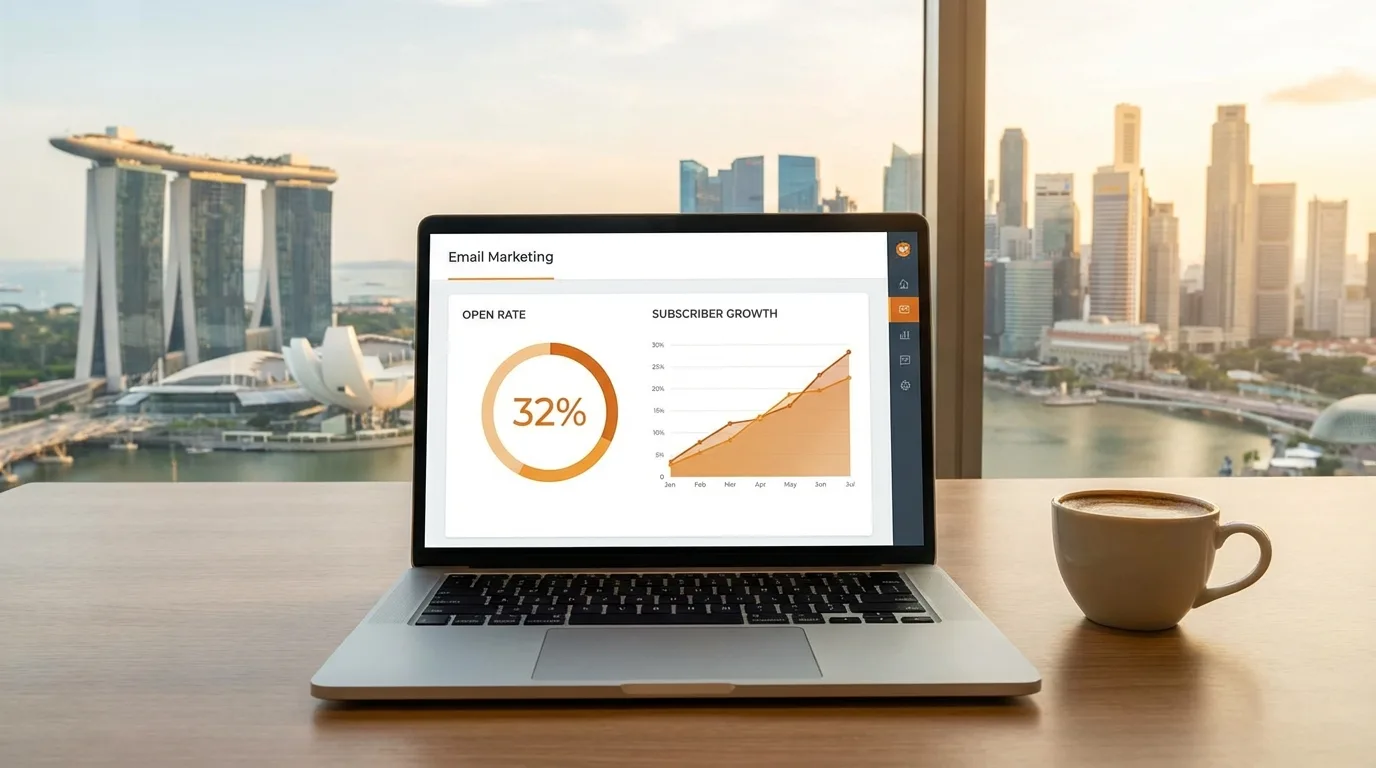
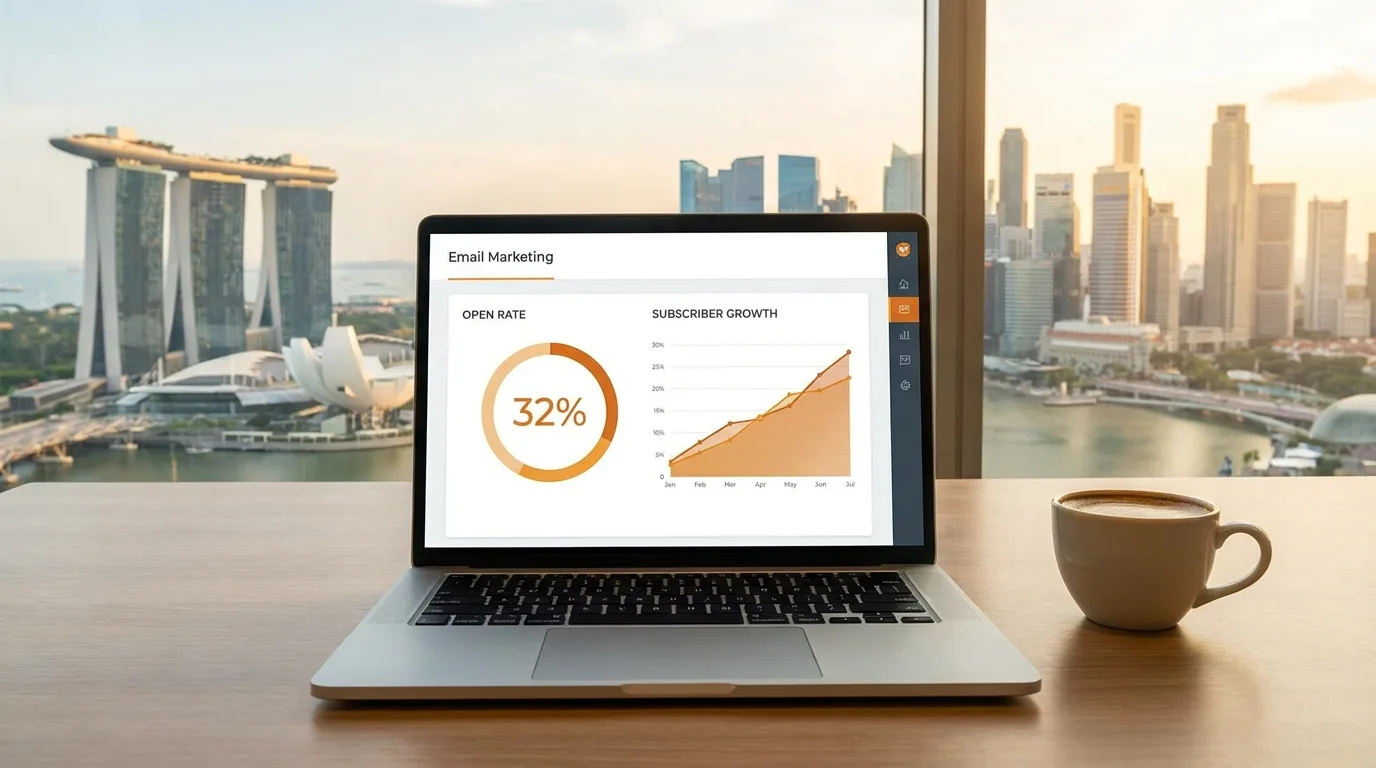
- Open rate:20–25% is average for Singapore. Below 15% signals problems
- Click-through rate:2–5% is typical
- Conversion rate: What % of recipients take your desired action
- Unsubscribe rate: Below 0.5% is healthy. Above 1% means frequency or relevance issues
- Revenue per email: For e-commerce, track revenue attributed to each campaign
- List growth rate: If losing more than gaining, something is fundamentally wrong
Benchmark: A well-run programme generates SGD 1–3 per subscriber per month. 1,000 subscribers = SGD 1,000–3,000/month from a channel costing SGD 30–50/month.
Email marketing is the most underutilised channel for Singapore SMEs. While everyone fights for attention on social media, email quietly delivers 20%+ open rates and unmatched ROI.
Start simple: build your list with a lead magnet, set up a welcome sequence, send valuable content every 1–2 weeks, stay PDPA compliant. That's enough to outperform 90% of Singapore businesses.
Email is most powerful when paired with SEO, social, and paid ads. Explore our digital marketing services to see how we connect the dots across channels for Singapore SMEs.
Need help setting up email marketing that drives revenue? Contact us, we'll help you choose the right platform, build automation sequences, and create a strategy that keeps subscribers engaged.
Sources & References (1)

Written by
Terris
Founder & Lead Strategist
Terris has implemented email marketing systems for Singapore businesses across industries: from e-commerce brands to professional services firms, focusing on strategies that drive measurable revenue.
Want to see these strategies in action? Browse our portfolio or get in touch to discuss your project.