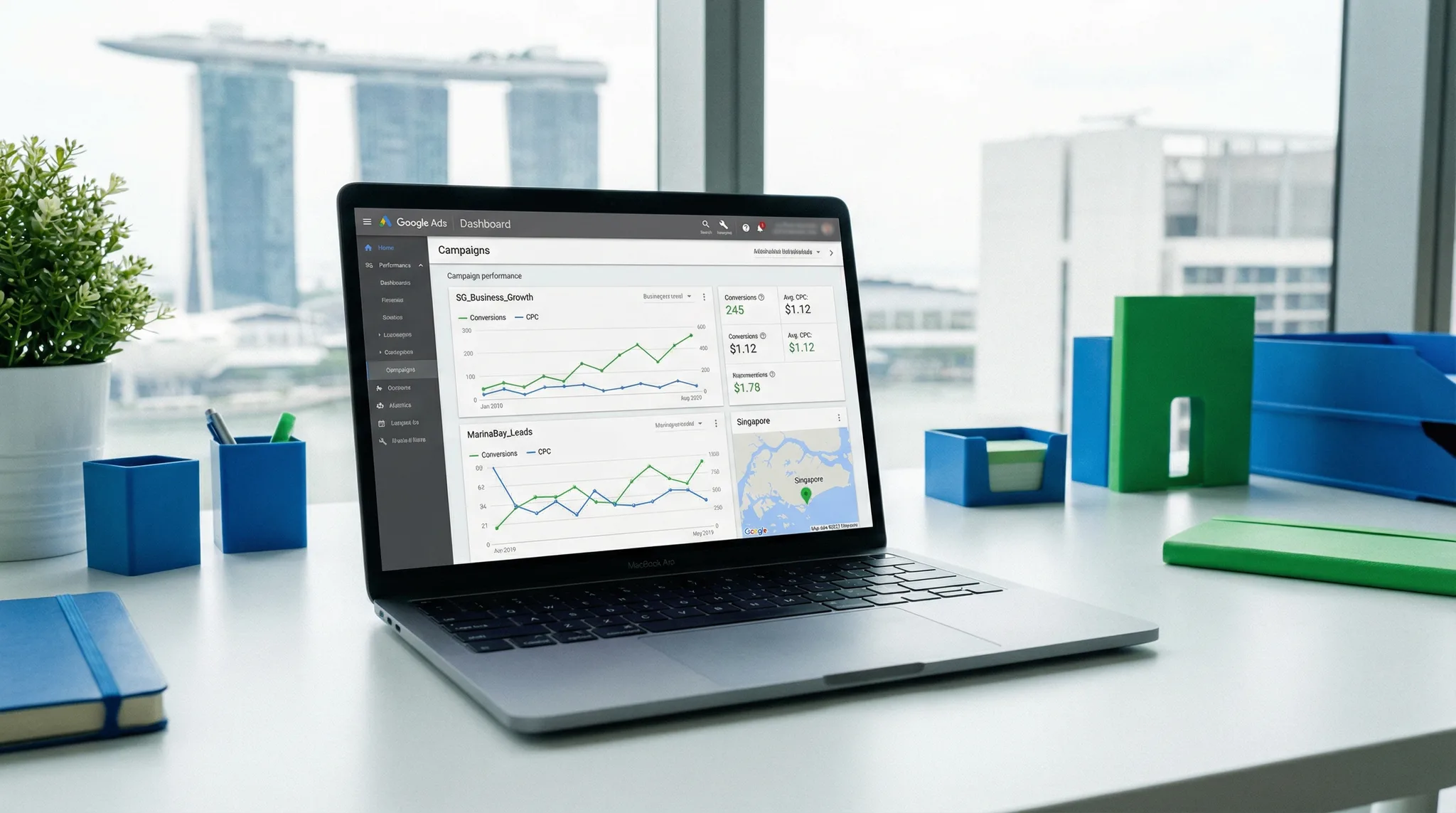






Google Ads in Singapore is getting more expensive. Average CPCs rose roughly 13% in 2024, the number of advertisers jumped from around 15,000 to 22,500, and total monthly ad spend in Singapore grew to approximately $70 million. Competition is fierce — and it's only getting fiercer.
But here's the thing: Google Ads still works. Properly managed campaigns generate an average of $8 in revenue for every $1 spent. The problem isn't the platform — it's that most Singapore SMEs set up campaigns without a strategy, waste money on broad keywords, and never track whether their ads actually generate business. This guide fixes that.
Whether you're launching your first campaign or trying to stop the bleeding on an underperforming one, here's everything you need to know about Google Ads for Singapore SMEs in 2026.
What Google Ads actually costs in Singapore
Before you spend a dollar, you need to know what you're walking into. Here are real CPC ranges for common industries in Singapore:
- Legal services: $5.50–$8.00 per click ("divorce lawyer Singapore," "employment lawyer")
- Dental / healthcare: $2.00–$4.50 per click ("dental clinic near me," "invisalign Singapore")
- Education / tuition: $3.00–$6.00 per click ("tuition centre Singapore," "PSLE tuition")
- Renovation / interior design: $1.80–$3.50 per click ("HDB renovation," "interior design Singapore")
- F&B / restaurants: $0.80–$3.00 per click ("birthday party venue," "catering Singapore")
- E-commerce / retail: $0.80–$3.00 per click ("buy furniture online Singapore")
- Finance / insurance: $3.50–$6.50 per click ("business loan Singapore")
One thing many businesses forget: Google Ads in Singapore is subject to 9% GST. A $3,000 monthly ad spend actually costs $3,270. Budget accordingly.
Worried about high CPCs? Read our Google Ads vs SEO comparison to understand when organic search might be the smarter investment. Or see our complete Google Ads cost guide for a full breakdown including agency fees, GST, and hidden costs. To model your expected return, try our free Google Ads ROI calculator.
How much to budget (realistic numbers)
Here's what we recommend for Singapore SMEs just starting out:
- Service businesses (legal, dental, renovation, web design): $1,000–$3,000/month
- E-commerce: $2,000–$5,000/month (spread across Search, Shopping, and remarketing)
- B2B companies: $2,000–$6,000/month (longer sales cycles, focus on lead quality)
- F&B / restaurants: $500–$1,500/month (lower CPCs, focus on Local campaigns)
- Education / tuition: $1,500–$3,000/month (seasonal peaks around exam periods)
A safe starting point: $35–$70 per day ($1,050–$2,100/month). That gives you enough data to identify which keywords and ads actually work before scaling up.
Don't start with $200/month. You won't get enough clicks to learn anything meaningful, and you'll conclude "Google Ads doesn't work" when the real problem was insufficient data. It's like judging a restaurant after eating only the bread.
Recommended reads
Choosing the right campaign type
Google offers several campaign types. Most Singapore SMEs only need one or two to start:
Search campaigns: text ads triggered by keywords. This is where most SMEs should start. You show up when someone actively searches for your service. A dental clinic bidding on "tooth extraction Singapore" reaches people who need a dentist right now. Average CPC: $1.50–$6.00.
Display campaigns: banner ads across millions of websites. Best for brand awareness and remarketing (showing ads to people who already visited your site). Lower CPCs ($0.20–$0.90) but lower intent, people aren't actively searching for you. Good for staying top-of-mind.
Performance Max: Google's AI-driven campaigns that run across all channels (Search, Display, YouTube, Gmail, Maps). E-commerce businesses see strong results here: roughly 39% better conversions than Search alone. But you need solid conversion tracking in place first, or the AI has nothing to optimise toward.
Shopping campaigns: product-specific ads with images and prices. Essential for e-commerce. Low CPCs ($0.20–$1.50), high purchase intent.
Our recommendation for most Singapore SMEs: Start with a Search campaign targeting 10–20 high-intent keywords. Once you have conversion data (at least 15–30 conversions), add a Performance Max campaign to expand reach. Add Display for remarketing once you have meaningful traffic (500+ monthly visitors).
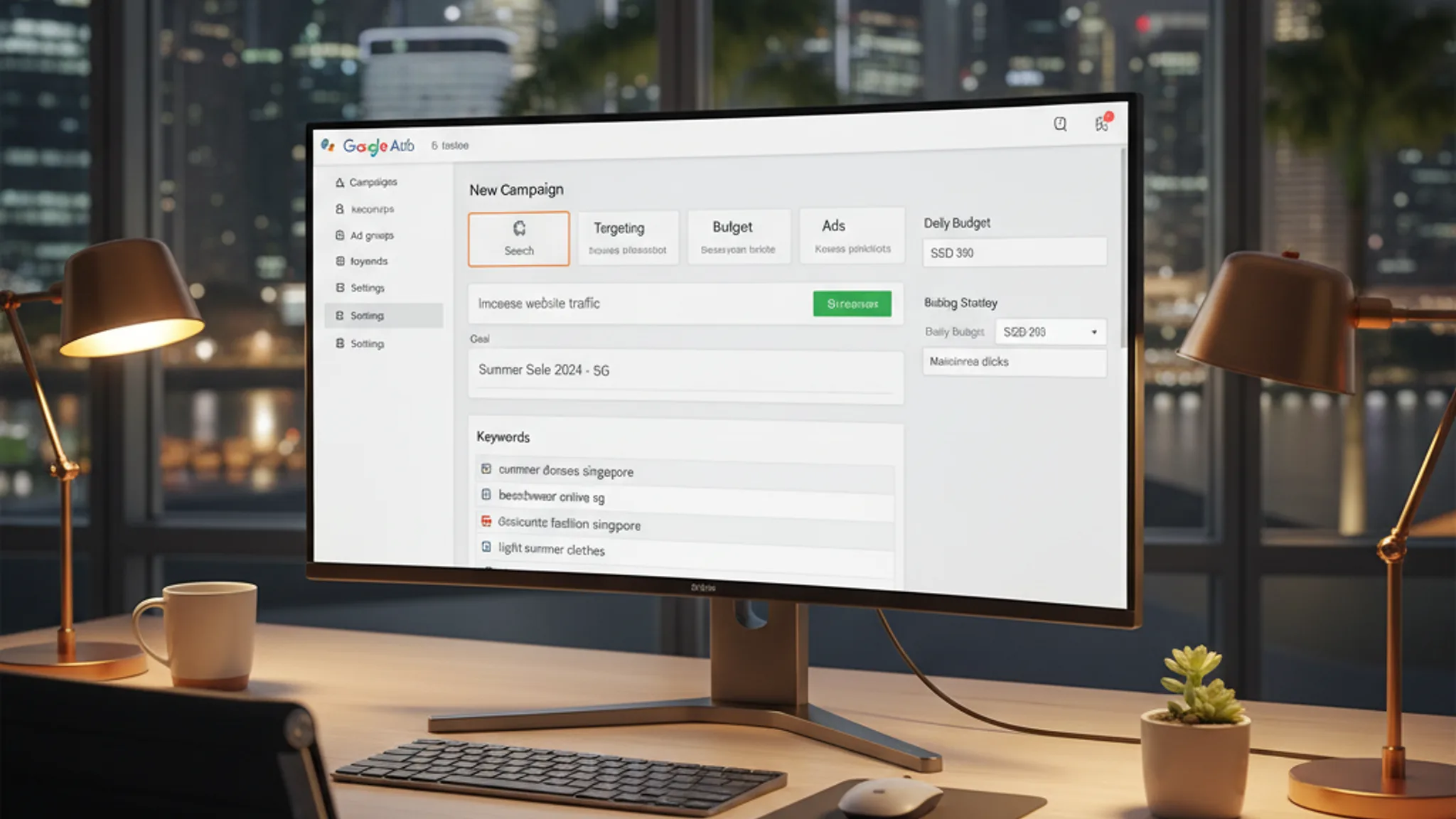
Setting up your first campaign (step by step)
Here's the setup process we follow for our clients:
- Define your conversion goal: what counts as a lead? Form submission? Phone call? WhatsApp message? Set this up first, because everything else optimises toward it
- Build keyword lists by service: group tightly related keywords into ad groups (max 10–20 keywords each). "Dental implant Singapore" and "dental crown Singapore" should be in separate ad groups, not lumped together
- Add negative keywords from day one: block irrelevant searches immediately. A law firm should add negatives like "free," "DIY," "salary," "internship." Otherwise you'll pay for clicks from people who will never hire you
- Write ads that match the search intent: if someone searches "emergency plumber Singapore," your ad headline should say "Emergency Plumbing — 24/7 Singapore" — not "Quality Plumbing Services"
- Create dedicated landing pages: never send ad traffic to your homepage. Each ad group should link to a page specifically about that service, with a clear call-to-action
- Set location targeting to Singapore: and specifically select "People IN Singapore," not "People interested in Singapore" (the default includes people overseas searching about Singapore)
- Set your daily budget and bid strategy: start with Manual CPC or Maximise Clicks for the first 2–4 weeks to gather data. Switch to Target CPA or Maximise Conversions once you have 15+ conversions
Quality Score: the hidden factor that controls your costs
Quality Score is Google's 1–10 rating of your ad quality. It directly affects how much you pay per click; and most Singapore SMEs never check it.
The impact is dramatic:
- Quality Score 10: you pay roughly 50% less than average
- Quality Score 7: you pay about 29% less
- Quality Score 5: baseline: no discount or penalty
- Quality Score 3: you pay 67% more
- Quality Score 1: you pay 400% more: five times the normal cost
Three factors determine your Quality Score:
- Expected click-through rate: how likely people are to click your ad. Write compelling, specific ad copy to improve this
- Ad relevance: how closely your ad matches the search query. Tight ad groups with closely related keywords help here
- Landing page experience: is the page relevant, fast, and mobile-friendly? This is where web design quality directly impacts your ad costs
In other words, a fast, well-designed website doesn't just convert better; it literally makes your ads cheaper. A slow, poorly designed landing page means you're paying a Google penalty on every single click.
The 7 mistakes Singapore SMEs make with Google Ads
After auditing dozens of Google Ads accounts for Singapore businesses, these are the mistakes we see over and over:
- No conversion tracking: running campaigns without knowing which clicks become customers. You're spending money blind. Set up tracking for form submissions, phone clicks, and WhatsApp messages before you launch
- Broad match keywords without negatives: bidding on "renovation" and showing up for "renovation loan calculator" or "HDB renovation grant application." Add negative keywords weekly
- Sending traffic to the homepage: your homepage isn't designed to convert ad traffic. Create dedicated landing pages for each service you advertise
- Ignoring mobile: over 90% of Singapore searches happen on mobile. If your landing page loads slowly or isn't mobile-friendly, you're wasting most of your ad spend
- Using Google's default settings: Google defaults to "Search Network with Display Select," which wastes your Search budget on low-quality Display placements. Always use Search-only for your first campaigns
- Never optimising: setting up a campaign and letting it run untouched for months. Review performance weekly: pause underperforming keywords, adjust bids, test new ad copy
- Not budgeting for GST: that 9% GST on ad spend catches many businesses off guard. A $2,000 budget actually needs $2,180 to cover the tax
Conversion tracking: the non-negotiable
If you only do one thing right with Google Ads, make it this: set up proper conversion tracking. Without it, you're gambling — not advertising.
What to track in Singapore:
- Form submissions: contact forms, quote requests, booking forms
- Phone calls: track clicks on your phone number (use Singapore +65 format)
- WhatsApp clicks: extremely common in Singapore. Track the click-to-WhatsApp button as a conversion event
- Purchases: for e-commerce, track completed transactions with revenue data
Use Google Ads' native conversion tracking (more accurate than imported GA4 goals) and enable Enhanced Conversions: this supplements tracking with hashed first-party data and typically improves data accuracy by 10–30%.
Set up Google Tag Manager to manage all your tracking tags. It lets you add, modify, and troubleshoot tags without touching your website code: a lifesaver when you need to adjust tracking mid-campaign.
Google Ads works for Singapore SMEs — but only when it's set up properly, tracked rigorously, and optimised consistently. The businesses that waste money on ads are the ones that launch campaigns without conversion tracking, target broad keywords, and send traffic to their homepage. Don't be that business.
Start with a focused Search campaign, a realistic budget ($1,000–$3,000/month), and proper conversion tracking. Give it 4–6 weeks of data before making big decisions. Once traffic is flowing, remarketing campaigns can help convert visitors who didn't enquire on their first visit. And remember: Google Ads is most powerful when combined with strong SEO; ads handle the short term while organic search builds your long-term lead engine.
Need help setting up or fixing your Google Ads campaigns? Explore our Google Ads management service, we'll audit your current setup for free and tell you exactly where your money is going.

Written by
Terris
Founder & Lead Strategist
Terris has over 8 years of experience in digital marketing strategy for Singapore businesses. From Google Ads to SEO to content marketing, he helps SMEs maximise their online presence and generate qualified leads.
Want to see these strategies in action? Browse our portfolio or get in touch to discuss your project.