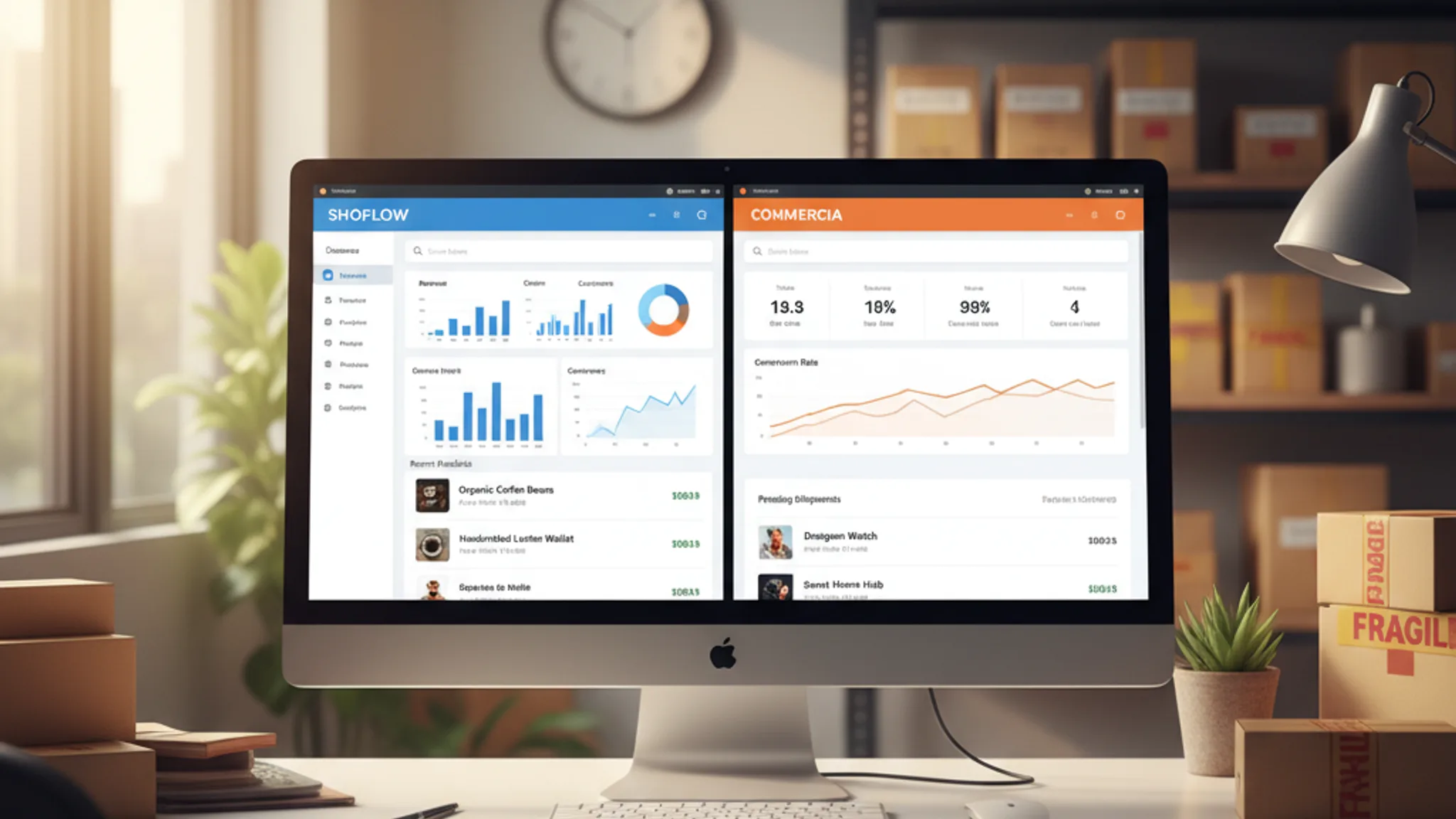






Choosing the best ecommerce platform for your Singapore business is one of the most consequential decisions you will make when launching, or relaunching, an online store. The platform you pick determines how customers pay, how orders ship, how tax is calculated, and ultimately how much friction sits between a visitor and a completed purchase.
But here is the problem: most "best ecommerce platform" articles are written for a US audience. They barely mention PayNow, ignore GrabPay entirely, gloss over 9% GST requirements, and have never heard of Ninja Van. Singapore merchants need a different lens.
We have spent the past five years building online stores for Singapore businesses of every size: from DTC skincare brands to B2B industrial suppliers. In this guide, we break down 8 platforms with Singapore-specific pricing, local payment gateway support, GST compliance, and shipping integrations so you can make a genuinely informed decision.
Whether you are a hawker selling sambal online or a retailer expanding from Orchard Road to the entire region, there is a platform on this list that fits. Let us get into it.
Key Takeaways
- 1 What Makes the Best Ecommerce Platform for Singapore Different
- 2 1. Shopify: Best All-Round Ecommerce Platform for Singapore
- 3 2. WooCommerce: Best for Control and Customisation
- 4 3. Adobe Commerce (Magento): Best for Enterprise-Scale Stores
- 5 4. BigCommerce: Best for Growing Brands That Want Built-In Features
What Makes the Best Ecommerce Platform for Singapore Different
Before we rank the best ecommerce platforms for Singapore, it is worth establishing what "Singapore-ready" actually means. A platform can have beautiful templates and slick checkout flows, but if it cannot handle these four things, it is not fit for the local market.
Local Payment Gateways
Singaporeans expect to pay with PayNow, GrabPay, NETS, and major credit cards. According to Xendit's 2026 Singapore payment guide, PayNow adoption has surged; and by late 2026, corporate cheques will be phased out entirely in favour of digital payments. Your platform must integrate with local gateways like HitPay, Xendit, or Stripe Singapore to offer these methods natively at checkout.
GST Compliance
Singapore's GST rate sits at 9% as of 2024. If your annual taxable turnover exceeds S$1 million, GST registration is compulsory. Your platform needs to apply the correct tax rate automatically, display GST-inclusive or GST-exclusive pricing (depending on your preference), and generate tax invoices that meet IRAS requirements. Some platforms handle this out of the box; others need plugins or manual configuration.
PDPA-Compliant Data Handling
The Personal Data Protection Act (PDPA) governs how you collect, store, and use customer data. Your platform should support consent banners, clear privacy policies, and, critically, store data securely with access controls. Platforms with servers in the Asia-Pacific region generally make compliance easier.
Local Shipping Integrations
Ninja Van, J&T Express, Janio, and qxpress dominate last-mile delivery in Singapore. Your platform should integrate with at least one of these carriers (ideally via a multi-carrier aggregator like EasyShip or EasyParcel) for automated waybill printing, real-time tracking, and rate calculation. If you also sell into Malaysia, Indonesia, or Thailand, cross-border logistics support is essential.
1. Shopify: Best All-Round Ecommerce Platform for Singapore
Website: shopify.com
Best for: Most Singapore businesses: from first-time sellers to scaling DTC brands.
Pricing: S$39–S$531/month (Basic to Advanced); Shopify Plus from ~S$2,500/month.
Standout strength: Largest app ecosystem with mature Singapore payment gateway integrations.
Shopify dominates Singapore's e-commerce landscape for good reason. As of January 2026, over 10,600 live websites in Singapore run on Shopify, according to BuiltWith data. The platform handles hosting, security, and PCI compliance out of the box, which means you spend less time on infrastructure and more time selling.
For Singapore-specific payments, Shopify Payments (powered by Stripe) supports Visa, Mastercard, Amex, Apple Pay, and Google Pay natively. For PayNow and GrabPay, you will need a third-party gateway, HitPay and Xendit are the two most popular options. HitPay charges no monthly fees and integrates in minutes via the Shopify App Store, giving your customers the ability to pay via PayNow QR, GrabPay, and even ShopeePay. Note that using a third-party gateway on top of Shopify Payments incurs an additional 0.5–2% transaction fee depending on your plan.
GST handling is straightforward: Shopify lets you configure tax rates per region, and you can set prices as GST-inclusive (which most Singapore B2C stores prefer) or GST-exclusive for B2B. For shipping, Shopify integrates with Ninja Van and J&T Express via apps like EasyShip and Parcel Perform, covering both local and cross-border fulfilment.
The main trade-off? Cost adds up. Between subscription fees, transaction fees (if not using Shopify Payments exclusively), premium themes (S$250–S$500), and essential apps (reviews, upsells, email marketing), a typical Singapore Shopify store costs S$100–S$300 per month to run. For a deeper comparison of costs, see our complete guide to website costs in Singapore.
2. WooCommerce: Best for Control and Customisation
Website: woocommerce.com
Best for: Businesses that want full ownership of their store and have (or can hire) technical support.
Pricing: Free plugin; hosting S$10–S$150/month; total cost S$30–S$300/month depending on extensions.
Standout strength: Unlimited customisation with no revenue caps or platform transaction fees.
WooCommerce is not a standalone platform, it is a free WordPress plugin that turns any WordPress site into a fully functional online store. That distinction matters. You own the code, the database, and the hosting. No platform takes a percentage of your sales. No arbitrary limits on products, bandwidth, or staff accounts.
For Singapore merchants, WooCommerce offers arguably the best local payment gateway coverage of any platform. The HitPay Payment Gateway plugin supports PayNow QR, GrabPay, ShopeePay, credit cards, and buy-now-pay-later options, all with zero setup fees. Alternatively, dedicated PayNow QR plugins from providers like Halfborg let customers pay directly to your bank account with zero commission, which is particularly attractive for small businesses watching margins.
GST configuration is native: WooCommerce's tax engine lets you set a 9% rate for Singapore, display prices with or without GST, and generate compliant invoices via plugins like WooCommerce PDF Invoices. For shipping, WooCommerce integrates with Ninja Van and J&T Express through plugins and multi-carrier platforms like EasyParcel.
The catch is maintenance. You are responsible for hosting, SSL, backups, plugin updates, and security patches. A poorly maintained WooCommerce store is a security risk. If you do not have an in-house developer, you will want a maintenance partner, or consider a managed WordPress host like Cloudways or Kinsta with Singapore data centres. For a detailed breakdown, read our comparison of Shopify vs WooCommerce for Singapore businesses.
3. Adobe Commerce (Magento): Best for Enterprise-Scale Stores
Website: adobe.com/magento
Best for: Large retailers and B2B operations with complex catalogues, multi-store requirements, or regional expansion.
Pricing: Magento Open Source is free; Adobe Commerce starts at ~US$22,000/year (licence only).
Standout strength: Unmatched flexibility for complex product configurations, multi-currency, and B2B workflows.
Adobe Commerce, still widely known as Magento, is the platform of choice for Singapore's larger e-commerce operations. If you are managing thousands of SKUs, operating multiple storefronts (say, one for Singapore and one for Malaysia), or running a B2B operation with tiered pricing and purchase orders, Magento handles complexity that would break simpler platforms.
The open-source edition (Magento Open Source) is free to download and self-host, making it a viable option for technically capable teams with ambitious growth plans. However, most businesses that choose Magento end up on Adobe Commerce Cloud, which bundles hosting, CDN, and support, at a starting price of roughly US$40,000 per year. Total cost of ownership, including development and extensions, typically runs 2–3x the licence fee.
Singapore payment gateways are well-supported through extensions. Stripe, 2C2P, and Adyen all offer Magento integrations that support PayNow and GrabPay. GST handling is robust, Magento's tax rules engine can handle multi-jurisdiction tax calculations, which is essential for businesses selling across ASEAN. Shipping integrations with Ninja Van, DHL eCommerce, and Janio are available through the Magento Marketplace.
The honest assessment: Magento is overkill for most SMEs. If your monthly revenue is below S$50,000, the development and maintenance costs will eat into your margins. But for established retailers processing hundreds of orders daily, it remains the gold standard for flexibility and scale.
Recommended reads
4. BigCommerce: Best for Growing Brands That Want Built-In Features
Website: bigcommerce.com
Best for: Mid-market brands that want enterprise features without enterprise complexity.
Pricing: US$39–US$399/month (Standard to Pro); Enterprise from ~US$1,000/month.
Standout strength: No transaction fees on any plan, regardless of payment gateway.
BigCommerce occupies the sweet spot between Shopify's ease of use and Magento's power. It ships with more built-in features than Shopify, customer groups, faceted search, price lists, and multi-currency, without requiring paid apps. For Singapore businesses tired of Shopify's app-dependency model, this is a compelling selling point.
The platform charges zero transaction fees regardless of which payment gateway you use. That is a meaningful difference. On Shopify, using a non-Shopify Payments gateway triggers a 0.5–2% surcharge per transaction. On BigCommerce, you can use Stripe, PayPal, or any supported gateway without penalty. Payment processing fees still apply (typically 2.89% + US$0.29 via Stripe), but there is no platform tax on top.
Singapore payment support is solid but less plug-and-play than Shopify. Stripe is the default gateway and supports credit cards, Apple Pay, and Google Pay. For PayNow and GrabPay, you will likely need to integrate via 2C2P or request a custom integration. GST can be configured manually, and BigCommerce supports tax-inclusive pricing display.
One important caveat: BigCommerce enforces annual sales thresholds. The Standard plan caps at US$50,000 in trailing 12-month sales before auto-upgrading you to Plus. The Pro plan allows up to US$400,000, with a US$150/month surcharge for every additional US$200,000. Fast-growing Singapore stores need to factor this escalation into their financial planning.
5. Wix eCommerce: Best for Small Businesses and Solopreneurs
Website: wix.com
Best for: Small businesses, solopreneurs, and service-based businesses adding a simple storefront.
Pricing: US$29–US$159/month (Core to Business Elite); Enterprise from US$500/month.
Standout strength: Drag-and-drop builder that non-technical users can genuinely master.
Wix started as a website builder and has steadily bolted on e-commerce features over the years. In 2026, Wix eCommerce is genuinely capable for small stores, you get product management, inventory tracking, abandoned cart recovery (on Business plans and above), and a surprisingly smooth checkout experience.
The drag-and-drop editor is Wix's defining advantage. If you are a solopreneur who wants to build and manage your own store without touching code, Wix is the most intuitive option on this list. Templates are polished, mobile-responsive, and can be customised extensively. The Wix App Market adds functionality for reviews, loyalty programmes, and email marketing.
For Singapore businesses, the payments picture is workable but not ideal. Wix Payments supports major credit cards and Apple Pay, but PayNow and GrabPay are not natively supported. You can work around this by integrating Stripe (which supports GrabPay in Singapore) or by adding a manual payment method with PayNow QR instructions. It is functional but not as seamless as what Shopify offers through HitPay.
The limitations become apparent as you grow. Wix's e-commerce features lag behind Shopify and BigCommerce in areas like multi-channel selling, advanced inventory management, and wholesale pricing. SEO capabilities, while improved, still trail dedicated e-commerce platforms, strong e-commerce SEO requires clean URL structures and schema markup that Wix handles less gracefully. If you expect to outgrow 100 products or need complex shipping rules, start with a platform that scales.
6. Squarespace Commerce: Best for Design-Led Brands
Website: squarespace.com
Best for: Design-conscious brands, creatives, and lifestyle businesses where aesthetics matter as much as functionality.
Pricing: US$16–US$99/month (Basic to Advanced); all plans now support commerce.
Standout strength: Award-winning templates with built-in commerce, no design skills required.
Squarespace has quietly become a legitimate e-commerce contender. With its 2026 plan restructuring, all four plans, Basic, Core, Plus, and Advanced, now support selling products, subscriptions, and digital content. The Basic plan charges a 2% transaction fee on sales, but Core and above waive it entirely.
Where Squarespace excels is visual presentation. If you sell products that need to look beautiful, artisanal food, jewellery, fashion, home decor, Squarespace's templates are hard to beat. Product pages support high-resolution image galleries, zoom, video, and rich layout options out of the box. For Singapore lifestyle brands that rely on Instagram-style visual merchandising, this is a genuine competitive advantage.
However, Singapore-specific commerce features are limited. Squarespace Payments processes credit cards at 2.5–3% + US$0.30, but PayNow, GrabPay, and NETS are not supported. You can connect Stripe or PayPal, but local wallet options remain unavailable. GST must be configured manually under tax settings, it works, but there is no automated compliance tooling. Shipping integrations lean towards US carriers; for Ninja Van or J&T Express, you will need to manage fulfilment separately or use a third-party aggregator.
Squarespace is an excellent choice for Singapore businesses selling fewer than 200 products where brand presentation is the priority. Beyond that, the platform's limited payment options and shipping integrations become friction points that hurt conversion rates.
7. PrestaShop: Best Open-Source Alternative for Budget-Conscious Stores
Website: prestashop.com
Best for: Budget-conscious businesses comfortable with self-hosting who want a dedicated e-commerce CMS.
Pricing: Free (self-hosted); hosting S$10–S$100/month; realistic total S$30–S$150/month.
Standout strength: Purpose-built for e-commerce (unlike WooCommerce, which is a WordPress add-on).
PrestaShop is the open-source e-commerce platform that most Singapore merchants have never considered; and that is a missed opportunity. Unlike WooCommerce, which layers commerce on top of a blogging CMS, PrestaShop was designed from the ground up as an online store. Product management, catalogue organisation, inventory tracking, and multi-language support are all native.
The self-hosted (Classic) edition is free to download and run on your own server. Hosting costs in Singapore range from S$10 to S$100 per month depending on your traffic and chosen provider. A realistic first-year budget: including a professional theme (~S$150), essential modules, and hosting, sits around S$500–S$800, making PrestaShop one of the most affordable options for a fully featured store.
Singapore payment support requires third-party modules. Stripe and PayPal are well-supported, and HitPay offers a PrestaShop module for PayNow and GrabPay. GST can be configured through PrestaShop's built-in tax rules, though the interface is less intuitive than Shopify's. Shipping modules for regional carriers exist but are fewer and less polished than what you find in the Shopify or WooCommerce ecosystems.
The main risk is ecosystem size. PrestaShop's community and module marketplace are significantly smaller than WordPress/WooCommerce or Shopify. Finding a PrestaShop developer in Singapore is harder, and documentation tends to skew European (the platform is French in origin). If you hit a complex customisation requirement, expect higher development costs per hour simply because of talent scarcity.
8. Ecwid: Best for Adding a Store to an Existing Website
Website: ecwid.com
Best for: Businesses that already have a website and want to add e-commerce without rebuilding.
Pricing: US$5–US$105/month (Starter to Unlimited); no transaction fees on any plan.
Standout strength: Embeds into any existing website, WordPress, Wix, Squarespace, or plain HTML.
Ecwid (now part of Lightspeed) takes a fundamentally different approach to e-commerce. Instead of replacing your website, it embeds a store widget into your existing site. If you have a WordPress blog, a Wix portfolio, or even a static HTML site, you can add Ecwid's shopping cart in minutes without a full migration. For Singapore businesses that have already invested in a website and do not want to start over, this is enormously practical.
Pricing is competitive. The Starter plan at US$5/month supports up to 10 products, enough for a small curated catalogue or a service business selling a handful of digital products. The Venture plan (US$12.50/month) scales to 100 products, and the Business plan (~US$55/month) handles 2,500 products with advanced inventory features. Importantly, Ecwid charges zero transaction fees on every plan, including Starter.
For Singapore payments, Ecwid integrates with Stripe (supporting credit cards and GrabPay in Singapore) and PayPal. PayNow is not natively supported, but you can configure a manual payment method with PayNow QR instructions. The platform supports GST configuration and automatic tax calculation. Shipping-wise, Ecwid connects with major carriers and supports real-time rate calculation, though Ninja Van and J&T Express integrations require third-party workarounds.
The trade-off is depth. Ecwid's SEO capabilities are limited compared to standalone platforms, your product pages live within an embedded widget, which can create challenges for search engine indexing. Advanced features like customer segmentation, B2B pricing, and multi-warehouse inventory are either absent or only available on the Unlimited plan. Ecwid is best understood as a lightweight commerce layer, not a full-featured e-commerce platform.
How to Choose the Best Ecommerce Platform Based on Your Business Type
Eight platforms is a lot to process. Here is a decision framework based on the types of businesses we work with most often in Singapore.
You are launching a new DTC brand
Go with Shopify. The speed to market is unbeatable, the app ecosystem covers every need, and local payment gateways are a solved problem via HitPay. You will be selling within a week.
You need maximum control and own your tech
Choose WooCommerce. You own the code, the data, and the hosting. Pair it with a managed WordPress host and a good web development partner and you have enterprise-grade flexibility at SME pricing.
You are a large retailer or B2B operation
Evaluate Adobe Commerce (Magento) or BigCommerce Enterprise. Both handle complex catalogues, multi-store setups, and regional expansion. Magento offers more customisation; BigCommerce offers a faster path to launch.
You are a solopreneur or small service business
Wix eCommerce or Ecwid are your best bets. Wix if you are building from scratch; Ecwid if you already have a website. Both are affordable and manageable without technical help.
You are a design-led lifestyle brand
Squarespace Commerce delivers the most beautiful storefronts with the least effort. Just be aware of the payment gateway limitations for Singapore customers.
You want open-source without WordPress
PrestaShop gives you a purpose-built e-commerce CMS without the WordPress overhead. Best if you have access to a developer who knows the platform.
Best Ecommerce Platforms for Singapore: Quick Comparison Table
| Platform | Starting Price | PayNow | GrabPay | GST Built-In | Transaction Fees | Best For |
|---|---|---|---|---|---|---|
| Shopify | S$39/mo | Via HitPay/Xendit | Via HitPay/Xendit | Yes | 0.5–2% (non-Shopify Payments) | Most businesses |
| WooCommerce | Free + hosting | Via HitPay/plugin | Via HitPay/Stripe | Yes | None (platform) | Full control |
| Adobe Commerce | Free / US$22k+/yr | Via 2C2P/Stripe | Via 2C2P/Stripe | Yes | None (platform) | Enterprise |
| BigCommerce | US$39/mo | Via 2C2P | Via 2C2P | Manual config | None | Mid-market growth |
| Wix eCommerce | US$29/mo | Manual QR | Via Stripe | Manual config | None | Small businesses |
| Squarespace | US$16/mo | No | No | Manual config | 2% on Basic plan | Design-led brands |
| PrestaShop | Free + hosting | Via HitPay | Via HitPay | Yes | None (platform) | Budget open-source |
| Ecwid | US$5/mo | Manual QR | Via Stripe | Yes | None | Add to existing site |
There is no single best ecommerce platform, only the best platform for your business. The right choice depends on your technical resources, budget, product complexity, and how important Singapore-specific payment methods are to your customers.
If you are a typical Singapore SME launching your first online store, Shopify offers the fastest, lowest-risk path to revenue. If you value ownership and flexibility, WooCommerce gives you more control at a lower ongoing cost. And if you are scaling to enterprise, Adobe Commerce and BigCommerce both have the muscle to support complex operations.
Whatever you choose, make sure your platform supports the payment methods your customers actually use (PayNow adoption in Singapore is enormous), handles GST correctly, and integrates with local couriers. These are not nice-to-haves, they directly affect your conversion rate and operational efficiency.
Need Help Setting Up Your Online Store?
We build e-commerce websites on Shopify, WooCommerce, and custom platforms: designed to convert. From payment gateway integration and GST configuration to custom product page design and local shipping setup, we handle the technical details so you can focus on selling.
Every store we build includes PayNow and GrabPay support, mobile-optimised checkout, and SEO foundations that help you rank for product searches in Singapore. Check out our web development services or see examples of stores we have built in our e-commerce website guide.
Sources & References (6)
- https://www.shopify.com/sg/pricing
- https://www.bigcommerce.com/essentials/pricing/
- https://www.squarespace.com/pricing
- https://www.ecwid.com/pricing
- https://www.iras.gov.sg/taxes/goods-services-tax-(gst)/specific-business-sectors/e-commerce
- https://www.xendit.co/en-sg/blog/singapore-payment-gateway-guide-2026/

Written by
Terris
Founder & Lead Strategist
Terris has built over 60 e-commerce stores for Singapore businesses: from boutique fashion labels to industrial suppliers. He specialises in Shopify and WooCommerce builds that are optimised for local payment gateways, GST compliance, and Southeast Asian logistics.
Want to see these strategies in action? Browse our portfolio or get in touch to discuss your project.