

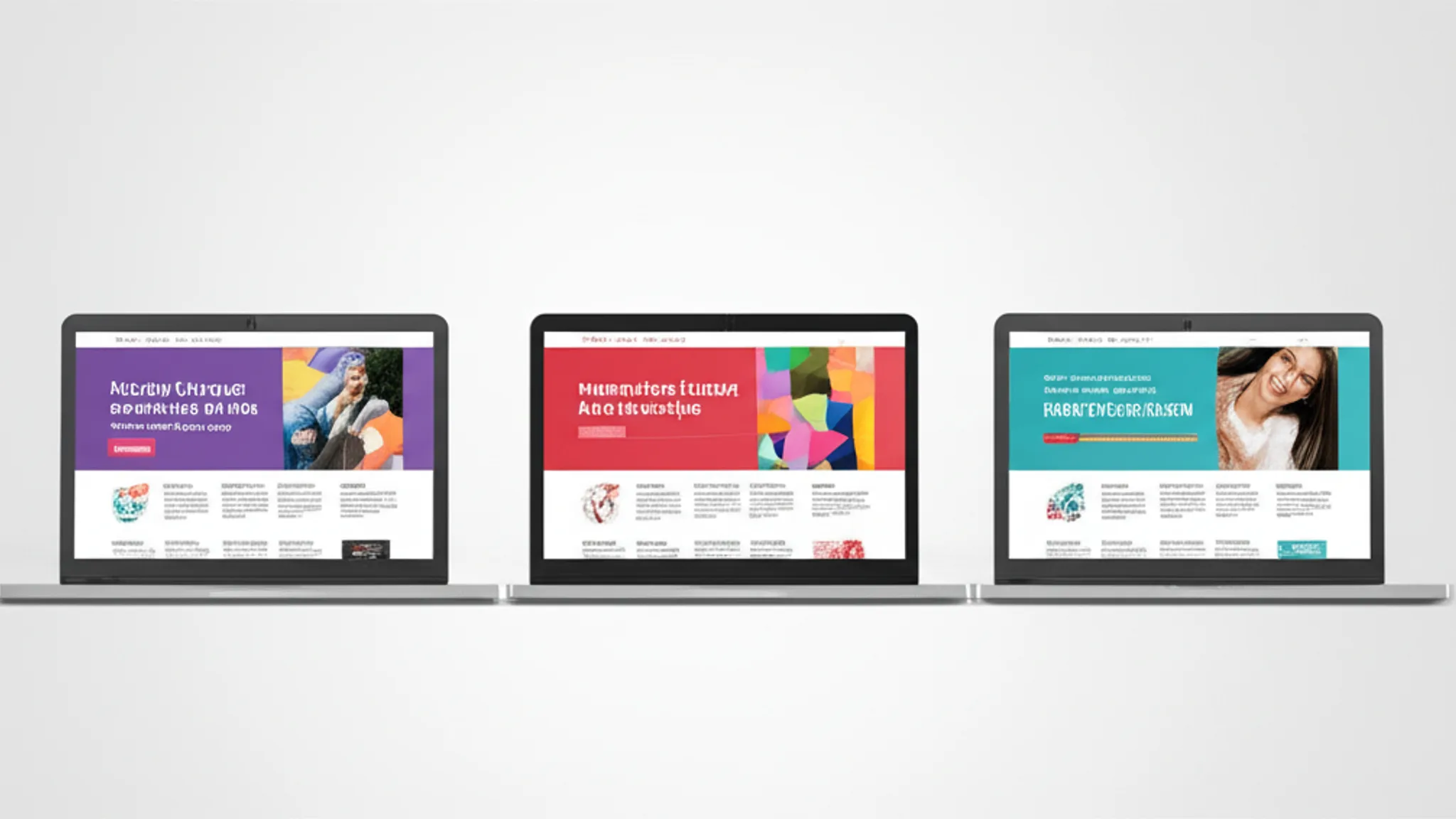
A designer recently tested three popular AI website builders with the same prompt. All three produced essentially the same site: soft beige background, teal-green accent colour, curved friendly font, hero section with a stock photo, three-column feature grid, testimonial slider. Different tools. Same output.
This isn't a flaw in any single platform, it's how AI design works. These tools are trained on existing websites, so they optimise for "average good." The result is a clean, inoffensive design that looks professional and looks exactly like everyone else's.
The question for your business isn't whether AI designs are ugly (they're not). It's whether looking identical to your competitors costs you something. For the full AI vs agency comparison, see our pillar post.
Why AI designs converge on the same look
AI website builders use preprogrammed design systems trained on thousands of existing sites. They learn what "works"; and by "works," the algorithm means "what most websites already look like."
The result is predictable: the same hero layout, the same feature grid, the same colour combinations, the same section flow. One analysis described it as "you're not building a brand, you're renting one." When every business in your category uses the same AI tool, the websites become interchangeable.
This isn't because AI can't produce variation. It's because the tools are designed to produce safe, template-level outputs that work for the broadest possible audience. Distinctive design requires understanding your specific brand, your market position, and what makes you different, context that a one-line prompt can't provide.
The numbers: does design actually affect trust and sales?
This is where opinion meets data:
- 48% of users say website design is the number one factor in deciding whether they trust a business
- Users form opinions about your site in 50 milliseconds: before they read a single word
- 38% of people stop engaging if the content or layout is unattractive (Adobe)
- Brands with consistent presentation across channels are 3.5x more visible
- Consistent branding leads to revenue growth of up to 23%
- Well-designed landing pages can improve conversions by 120%
Design isn't decoration. It's the first signal of whether someone should trust you with their money. And if your design is indistinguishable from every other business in your space, that trust signal defaults to "average."
Recommended reads
When "good enough" is genuinely fine
Not every business needs a distinctive website. Here's when a generic AI design is the pragmatic choice:
- Internal tools and platforms. If your website is for internal use or a limited audience, design differentiation is irrelevant.
- MVPs and test launches. Validating a business idea doesn't require a polished brand. Speed matters more than aesthetics when you're testing demand.
- Commodity services where price decides. If customers choose you purely on price (e.g., printing services, basic cleaning), a clean functional site that loads fast and shows your rates is enough.
- Businesses with strong offline brands. If your reputation comes from referrals, your physical location, or your personal network, your website is a digital business card, not a sales tool. A template is fine.
For these cases, spending $5,000+ on custom design is genuinely wasteful. Spend that money on marketing, inventory, or hiring instead.
When brand differentiation is a business requirement
For other businesses, looking identical to competitors is an active liability:
- Luxury and premium services. An interior design firm, a high-end salon, or a premium F&B brand can't afford to look like a template. Your website is your first impression; and for premium businesses, it needs to reflect the quality of your work. That's why we built G&K Couture's site as a custom experience, not a template.
- Competitive markets with many similar providers. If ten physiotherapists serve the same area, the ones with distinctive, professional websites will capture more of the "I'm comparing options" traffic. Generic sites blur together.
- Professional services. Law firms, consultancies, and financial advisors are selling trust and competence. A template website undercuts that message before you've said a word.
- Businesses spending on advertising. If you're paying for Google Ads or social media ads that drive people to your website, your conversion rate determines your ROI. The difference between a generic landing page and a conversion-optimised one can be 120%. That's not a design preference, it's money.
The calculation is simple: if users can't tell you apart from competitors in three seconds, you pay for it later in higher ad spend, steeper discounts, and longer sales cycles.
Singapore-specific trust signals AI misses
41% of Singapore online shoppers prioritise trust as their primary decision factor, above price, above convenience. That's a market where trust signals on your website directly affect revenue.
AI builders miss several Singapore-specific trust signals:
- Local contact details. A Singapore phone number and address reduces the "fly-by-night" perception that plagues online businesses here. AI templates often bury contact info or use generic layouts that don't emphasise local presence.
- Regional payment badges. Displaying PayNow, GrabPay, and NETS logos signals "we're a real Singapore business." AI builders using Stripe/PayPal only miss this trust marker.
- Cultural design cues. Bilingual content, design aesthetics that resonate with local audiences, and imagery featuring diverse Singaporean faces, these aren't just nice-to-haves. They signal "we understand you." AI tools trained primarily on Western design patterns don't produce these naturally.
- Regulatory compliance badges. BizSafe, ACRA registration, industry certifications, showing these prominently builds trust. Generic templates don't allocate space for them effectively.
For more on building a strong brand identity, our branding guide for Singapore SMEs covers the fundamentals.
The real cost of looking generic
Here's the part most comparison articles miss: the cost of a generic website isn't what you paid for it. It's what you lose because of it.
If your conversion rate drops from 3% to 1.5% because your site doesn't stand out, and you get 1,000 visitors per month, that's 15 lost enquiries per month. If each enquiry is worth $500, you're leaving $7,500 on the table every month, $90,000 per year. The $5,000 you "saved" on web design cost you 18x more in lost revenue.
Obviously, these numbers vary wildly by business. But the principle holds: for businesses where the website drives revenue, design quality has a measurable ROI that far exceeds the cost of getting it right.
When we redesigned Perfect Style Salon's website, online enquiries increased 180%, not because we used fancier technology, but because the design was built around how their specific customers make decisions. That's the difference between a template and a strategy.
AI websites aren't ugly, they're average. And for some businesses, average is fine. But if your revenue depends on standing out, building trust, or converting visitors into customers, "average" has a cost you can calculate. The question isn't whether you can afford custom design. It's whether you can afford to look like everyone else.
Curious what a distinctive website could look like for your business? See what we do, or talk to us about your specific situation.

Written by
Terris
Founder & Lead Strategist
Terris has over 8 years of experience designing high-converting websites for Singapore businesses. From luxury brands to SMEs, he combines aesthetic design with strategic thinking to deliver websites that drive real business growth.
Want to see these strategies in action? Browse our portfolio or get in touch to discuss your project.