
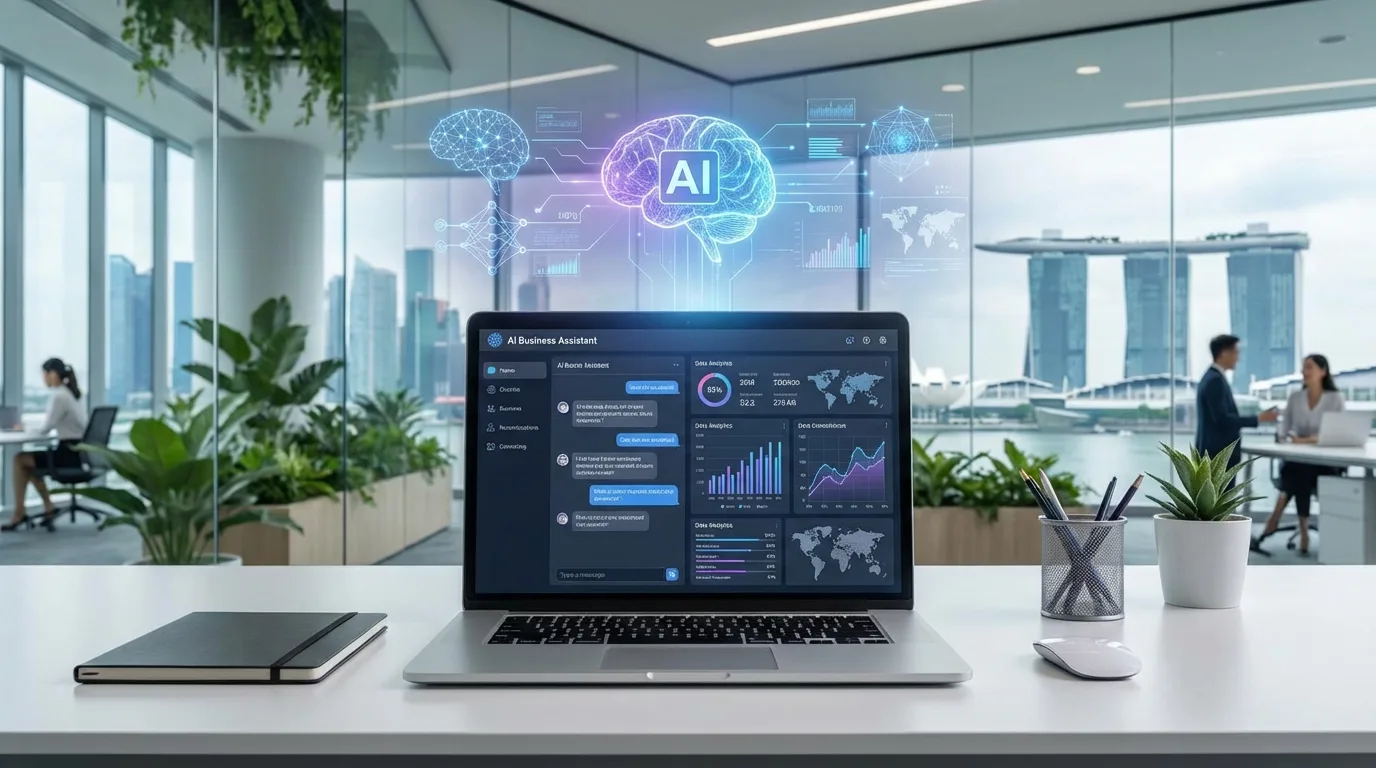
AI is the most overhyped and underapplied technology for small businesses right now. Every conference talks about it, every vendor claims to use it, and most business owners are either overwhelmed or sceptical; both are reasonable reactions.
Here's the reality: AI won't replace your business or your team. But it can save you 5–15 hours per week on repetitive tasks, improve response times, and help you compete with bigger companies. The key is knowing which AI tools are actually useful today.
This guide focuses on practical, proven AI applications for Singapore SMEs. No science fiction; just tools and strategies that work right now.
AI for content creation: the realistic assessment
What AI does well
- First drafts: Blog posts, social captions, emails, product descriptions in minutes instead of hours
- Repurposing: Turn a blog post into 10 social posts, an email, and a script
- Research summaries: Summarise industry reports, competitor sites, customer reviews
- Brainstorming: Generate 20 blog topics, 50 subject lines, or 10 campaign angles in seconds
What AI does poorly
- Original thought: AI combines existing information. Your unique perspective is what makes content stand out
- Accuracy: AI confidently states incorrect facts. Every piece needs human fact-checking, especially for Singapore-specific data
- Brand voice: Without careful prompting, AI content sounds generic
- SEO at scale: Google is increasingly good at detecting low-effort AI content. Mass-producing without editing is risky
Our approach: Use AI as a research assistant and first-draft generator. Then add your expertise, local examples, and genuine opinions. Half the time, authentically yours.
AI chatbots for customer service
What modern chatbots handle
- Answering FAQs (pricing, hours, services, policies) 24/7
- Qualifying leads with initial questions
- Booking appointments and reservations
- Order status updates
Practical implementation
Tidio: Free tier, easy setup, AI-powered responses. Good for small businesses.
WhatsApp Business API + AI: Platforms like Respond.io or WATI add automated responses to WhatsApp; where your Singapore customers already are.
Custom chatbots: Trained on your own FAQs, product info, and policies. Can handle 60–80% of queries accurately.
Important rule: Always provide a clear path to a human. Nothing frustrates customers more than being trapped in a chatbot loop. For a detailed comparison of the top platforms with Singapore pricing, see our guide to the best AI chatbot tools for Singapore businesses.
Recommended reads
AI for marketing automation
Email personalisation
Modern platforms use AI to predict the best send time per subscriber, suggest high-performing subject lines, segment audiences by behaviour, and recommend products from browsing history.
Ad campaign optimisation
- Performance Max (Google): AI distributes budget across Search, Display, YouTube based on what converts
- Advantage+ (Meta): AI finds likely converters, often outperforming manual audience selection
- Smart bidding: Real-time bid adjustments based on device, location, time, and user behaviour
Tip: Don't fight the AI. Give it enough data (30–50 conversions) and clear goals. Your job shifts from bid management to creative strategy and landing page optimisation.
AI search: the channel most Singapore SMEs are missing
AI is not just a tool you use; it is also becoming the primary way customers find you. ChatGPT, Google AI Overviews, and Perplexity now answer business queries directly, citing specific companies in their responses. When someone asks "best accountant in Tanjong Pagar" or "affordable web design Singapore," AI engines synthesise an answer from the web and name businesses. If yours is not mentioned, you are invisible in a channel that 37% of consumers now use to start product searches.
This shift has created an entirely new discipline called generative engine optimisation (GEO). Where traditional SEO focuses on ranking in a list of links, GEO focuses on getting your business cited inside AI-generated answers. The tactics overlap with good SEO practices: specific content, structured formatting, FAQ sections, and fresh data. But GEO also requires building your off-site presence (reviews, directory listings, social mentions) because 85% of AI citations come from third-party sources.
The opportunity for Singapore SMEs is significant. AI search visitors convert at 14.2% compared to 2.8% from traditional Google organic, making this traffic roughly 5x more valuable per visitor. And because most Singapore businesses have not started optimising for AI search, the early-mover advantage is wide open right now.
Practical first steps you can take this week:
- Search your target keywords in ChatGPT and Perplexity. Does your business appear? Note which competitors do.
- Check that your robots.txt does not block AI crawlers (GPTBot, ClaudeBot, PerplexityBot)
- Add FAQ sections to your key service pages with specific, data-backed answers
- Encourage Google reviews; AI engines use review data to assess business quality
For a complete walkthrough of GEO strategies, costs, and measurement, read our generative engine optimisation guide for Singapore businesses.
AI tools for daily operations
Document processing
- Invoice/receipt processing: Xero and QuickBooks scan receipts, extract data, auto-categorise expenses
- Contract review: AI highlights key clauses and flags unusual terms. Not a legal replacement, but useful for initial review
Meetings and communication
- Transcription: Otter.ai or Fireflies transcribe meetings and generate action items automatically
- Email drafting: AI in Gmail/Outlook drafts replies and summarises threads
Design and creative
- Canva AI: Generate social graphics and presentations with AI assistance
- AI image generation: Midjourney and DALL-E create custom illustrations and mockups
- Video editing: CapCut auto-captions, removes backgrounds, and suggests edits
What's hype vs reality in 2026
Works well right now
- Content drafting and brainstorming (with human editing)
- Customer service chatbots for routine queries
- Ad campaign optimisation through platform AI
- Meeting transcription and summarisation
- Email personalisation and send-time optimisation
Getting better but not fully reliable
- AI-generated images (quality varies, needs refinement)
- Autonomous customer service (handles 60–70%, needs backup)
- AI SEO content (quality debate ongoing)
Overhyped for SMEs
- "AI agents" running entire business processes: not ready for most SME use cases
- Fully AI-generated converting websites: technology isn't there for bespoke design
- "Replace your marketing team with AI": oversimplified and risky
Getting started: a practical AI roadmap
Phase 1: Quick wins (this week)
- Sign up for ChatGPT or Claude (free tiers). Use for email drafting, brainstorming, summarising documents
- Enable smart bidding on Google Ads if you have 30+ monthly conversions
- Set up AI send-time optimisation in your email platform
Phase 2: Automation (month 1–2)
- Implement a chatbot on your website (Tidio free tier)
- Set up email sequences with AI personalisation
- Use AI for social media planning and caption drafting
Phase 3: Integration (month 3+)
- Connect AI tools with your CRM for lead scoring
- Implement AI customer support on WhatsApp
- Use AI analytics to identify marketing patterns
Budget: Most tools have free tiers. A Singapore SME can start for SGD 50–200/month. The real investment is 2–4 hours per week learning and implementing.
AI isn't a magic wand and it's not coming for your job — but it is the most significant productivity multiplier available to Singapore SMEs right now. The businesses that learn to use it effectively will do more with less, respond faster, and make better decisions.
Start with one or two practical applications, measure the time saved, and expand from there. The goal isn't to be "an AI company" — it's to be a more efficient company that uses AI where it makes sense.
Want help integrating AI into your digital strategy? Talk to us: we help Singapore SMEs adopt practical AI solutions that drive real results, not just buzzwords.
Sources & References (1)

Written by
Terris
Founder & Lead Strategist
Terris integrates AI tools into workflows for Singapore businesses, not as a trend, but where they genuinely save time and improve outcomes. He focuses on practical applications over hype.
Want to see these strategies in action? Browse our portfolio or get in touch to discuss your project.