



Your engineering company website in Singapore is a credential: whether you treat it like one or not. Procurement teams, project managers, and main contractors Google you before they shortlist you. Yet most M&E contractors, civil engineering firms, and specialist subcontractors on the island still have websites stuck in 2012, if they have one at all.
Singapore's construction demand hit S$47–53 billion in 2026, with BCA forecasting S$39–46 billion annually through 2029. Changi Terminal 5, Cross Island Line, Marina Bay Sands expansion. The pipeline is enormous. We are talking about companies that deliver multi-million-dollar projects but present themselves online with a broken WordPress theme and a PDF brochure link. It is a strange disconnect, and it is costing them contracts they never even know about.
This guide covers what engineering firms actually need from their website, what most get wrong, and how to build a site that earns trust from the people who sign off on tenders.
Why engineering companies need a professional website
Engineering firms have traditionally relied on relationships, word of mouth, and the BCA registry to win work. That still matters. Nobody awards a S$5 million M&E contract because of a pretty homepage. But your website has become a checkpoint in the decision-making process, and failing that checkpoint quietly removes you from consideration.
Here is how it actually plays out in B2B procurement:
- Post-referral research: a project manager gets your name from a colleague, then checks your website to verify scope, size, and legitimacy before making a call
- Tender pre-qualification: procurement teams reviewing RFQ submissions will look up every shortlisted contractor. A broken or outdated site raises immediate doubts about operational standards
- Government and statutory board projects: public-sector procurement under the BCA Contractors Registration System involves due diligence where online presence is part of the picture
- Talent acquisition: experienced engineers research prospective employers online. A dated website signals a company that does not invest in itself
The maths is simple. If preserving even one contract worth S$500,000 justifies a website investment of S$5,000–15,000, the return is obvious. Your website does not create the opportunity, but it directly influences whether that opportunity moves forward.
Essential features for an engineering company website
A contractor website in Singapore is not an e-commerce store. Visitors are not impulse-buying structural steel. They are conducting due diligence, often under time pressure, with a shortlist of three to five firms to evaluate. Your site needs to answer their questions fast.
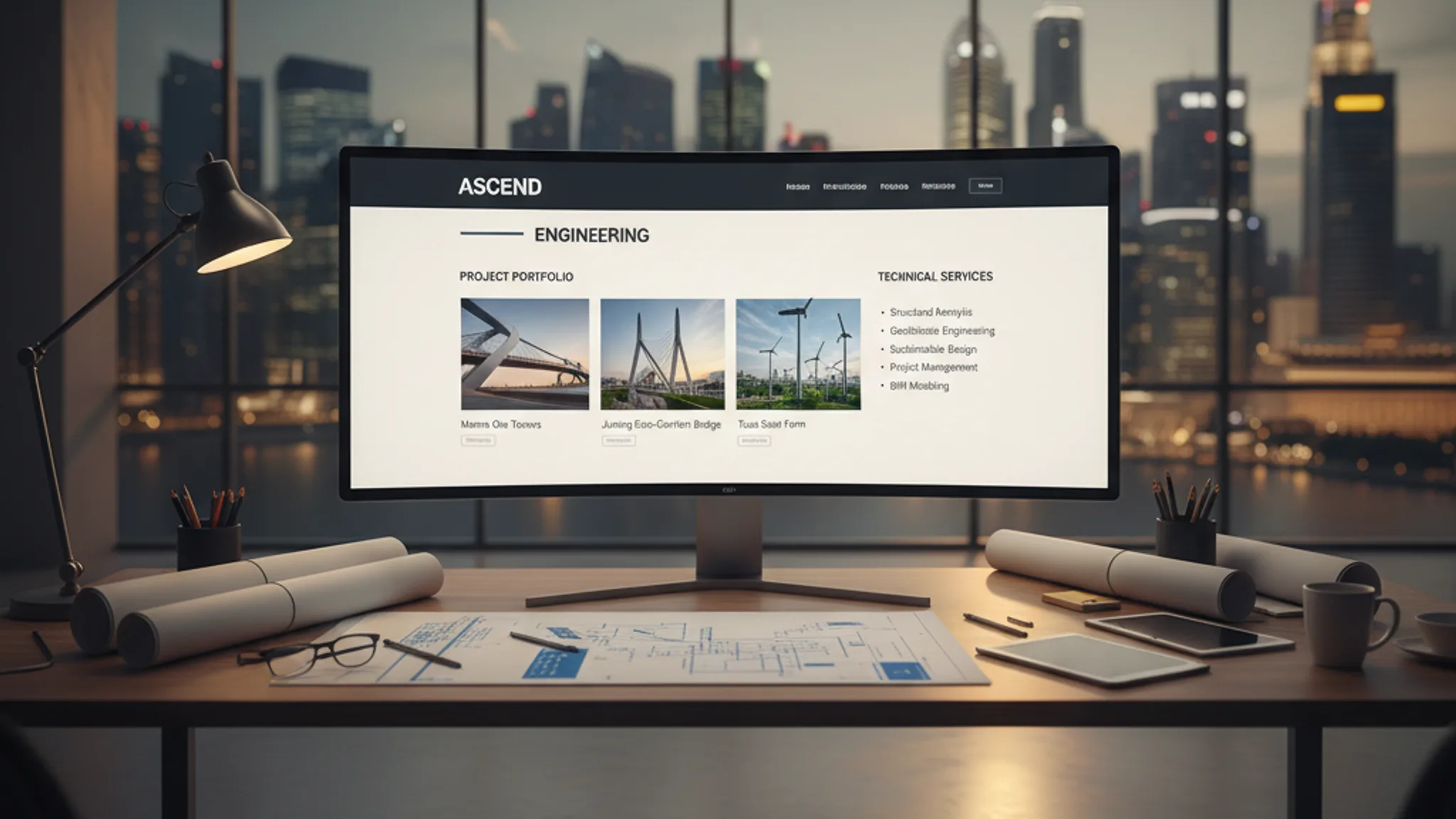
Project portfolio with real detail. This is the single most important section. Procurement teams want projects similar to theirs: same industry, similar scope, comparable scale. Each listing should include project type, client industry (if permitted), scope of work, and completion date. Photos of completed work carry more weight than any amount of marketing copy.
Services breakdown by workhead. If you hold BCA registrations across CW, CR, or ME workheads, structure your services to match. An M&E contractor should clearly list electrical installation, ACMV, fire protection, and plumbing, not bury them in a single paragraph. Quantity surveyors scanning your site need to confirm your scope in seconds.
Certifications and accreditations. Non-negotiable for engineering website design in Singapore. Display your BCA grading, ISO certifications (9001, 14001, 45001), and bizSAFE level prominently, not tucked away on an about page. When we rebuilt the website for J Tech Eng Services, their ISO 45001:2018 badge went right on the hero section. It is the first thing procurement managers see.
Team profiles. Include professional engineer (PE) registrations, relevant degrees, and years of experience. Decision-makers want to know who will actually be running their project.
Contact with RFQ capability. A basic contact form is the minimum. Better: a structured request-for-quotation form that captures project type, scope, and timeline. This saves time on both sides and signals professionalism.
Recommended reads
Design principles that build B2B trust
Engineering firms do not need flashy, animation-heavy websites. That approach actively works against you. When a procurement manager lands on your site between reviewing tender documents and site inspections, they want clarity and speed, not a parallax scrolling showcase.
The design principles that work for B2B website design in Singapore are straightforward:
- Clean, professional layout: structured grid, generous whitespace, consistent typography. Think boardroom presentation, not nightclub flyer
- Fast loading times: enterprise visitors often access sites from office networks or site offices with variable connectivity. A site that takes 5 seconds to load loses credibility before it displays content
- Case studies with measurable outcomes: "completed 3 months ahead of schedule," "zero LTI across 18-month project," "delivered S$4.2M scope under budget." Numbers speak louder than adjectives
- Client logos: if your NDAs allow it, displaying logos of recognised clients or main contractors immediately establishes your tier. Even listing industry sectors you have served helps
- Certifications above the fold: ISO badges, BCA grading, bizSAFE level. These are trust accelerators in B2B engineering procurement. Do not make visitors hunt for them
For J Tech's site, we used a teal and dark colour palette: professional, industrial, calm. Stats counters showing 20+ years of experience, 100+ projects, and 50+ clients sit below the hero. The entire above-the-fold experience answers one question: "Are these people serious?" The answer should be obvious within two seconds.
SEO for engineering companies: low competition, high contract value
Most engineering firms do not realise the SEO landscape for their industry is wide open. Consumer keywords like "web design Singapore" have dozens of agencies fighting over them. But terms like "M&E contractor Singapore" or "civil engineering company Singapore" have far fewer competitors, and the people searching are procurement professionals with real budgets.
Keywords worth targeting for an engineering company website in Singapore:
- Service-specific terms: "ACMV contractor Singapore," "structural steel fabrication Singapore," "clean room installation Singapore"
- Industry-specific terms: "semiconductor facility contractor," "pharmaceutical plant engineering Singapore"
- Certification-related terms: "BCA registered contractor Singapore," "bizSAFE Star contractor"
- Location-based terms: "M&E contractor Jurong," "civil engineering Tuas"
The contract values behind these searches are enormous. A single first-page ranking for "M&E contractor Singapore" could generate enquiries worth millions over a year. Compare that to the cost of proper SEO for a Singapore business. The return is difficult to ignore.
Technical SEO matters too. Structured data markup (Organization, LocalBusiness, Service schemas) helps Google understand what your firm does. A proper SEO foundation ensures your site does not just look professional but actually gets found by the people who matter.
Content strategy that positions you as an authority
Most engineering company websites are static brochures: built once, never updated. Regular content improves your search rankings and positions your firm as a knowledgeable authority.
Content that works for engineering firms:
- Project case studies: detailed write-ups of completed projects with scope, challenges, and outcomes. Every completed project is a potential case study that demonstrates capability to future clients
- Technical insights: articles on industry developments, new building codes, or construction methodologies. A post explaining implications of new BCA CRS requirements shows you are current and engaged
- Industry certifications explained: many procurement staff are not engineers. Content explaining what your ISO 45001 certification or BCA grading signifies helps non-technical decision-makers understand your value
- Tender and procurement guides: practical content about the public-sector tendering process or pre-qualification requirements. This attracts exactly the audience you want
You do not need to publish weekly. One case study per quarter and one industry insight piece every couple of months is enough to keep Google interested. The key is consistency, not volume.
Common mistakes engineering websites make
We see the same mistakes repeatedly across engineering and contracting firms. If any sound familiar, it might be time for a website redesign.
Outdated project lists. Nothing damages credibility faster than a "Latest Projects" section where the newest entry is from 2019. Procurement teams assume you have either stopped winning work or stopped caring. Neither conclusion helps.
No mobile version. Engineers and project managers increasingly access websites from phones and tablets, on site, in meetings, during commutes. A site that requires pinching and zooming on a phone screen signals a company behind the curve.
PDF-only brochures. We still encounter firms whose entire "website" is a homepage with a link to download a company profile PDF. Search engines cannot index PDF content effectively, mobile users struggle with large downloads, and every extra click is a chance for prospects to move on to the next contractor.
No clear call to action. Many engineering websites present information without ever telling the visitor what to do next. Every page should guide visitors toward a next step: request a quote, download your capability statement, call your business development team. Make it obvious and easy.
Missing certifications. You paid for bizSAFE Star and invested in ISO audits, but none of it is visible on your website. These credentials exist to differentiate you from uncertified competitors. Hiding them defeats the purpose.
Generic stock photography. A procurement manager who has spent twenty years on construction sites can spot stock photos immediately. Use real images of your actual projects, your team, your equipment. Authenticity matters in B2B far more than polish.
WordPress or custom build? Choosing the right platform
Engineering firms tend to have straightforward website requirements: no e-commerce, no user accounts, no complex integrations. That actually gives you more flexibility in choosing a platform.
WordPress remains a solid option for firms that want their team to update content without touching code. It works well for project portfolio updates, blog posts, and team changes. The trade-off is ongoing maintenance: WordPress sites need regular updates, security patches, and plugin management. For a deeper comparison, see our breakdown of WordPress versus custom websites.
Custom static builds using frameworks like Astro or Next.js deliver exceptional performance: sub-second load times, perfect Lighthouse scores, and virtually zero maintenance overhead. For J Tech, we chose Astro with Tailwind CSS and delivered a fully functional site in 4 weeks that loads nearly instantly.
The right choice depends on how often you update content and who will be doing it. If you publish project updates monthly, WordPress with a quality theme makes sense. If your site is updated quarterly at most and performance matters, a custom static build is hard to beat. Either way, the platform matters less than the content. A well-organised WordPress site with genuine project photos will outperform a beautifully coded custom site with placeholder text every time.
Singapore's construction pipeline is massive, competition for contracts is fierce, and procurement teams are doing more due diligence online than ever before. Your engineering company website is no longer a nice-to-have digital brochure: it is a working business tool that either supports your tendering efforts or undermines them.
The firms that treat their website as a credential (keeping portfolios current, certifications visible, and content fresh) will have an edge over competitors still relying on a broken site and a PDF company profile. The barrier to entry is surprisingly low.
If your website is not pulling its weight, we can help. We have built sites for engineering and contracting firms that need to communicate technical credibility to procurement teams and enterprise clients. See our web development services or get in touch for a quote. We will tell you honestly what your site needs.
Sources & References (3)
- https://www1.bca.gov.sg/procurement/pre-tender-stage/contractors-registration-system-crs
- https://www1.bca.gov.sg/about-us/news-and-publications/media-releases/2025/01/23/construction-demand-to-remain-strong-for-2025
- https://www.anologix.com/is-your-engineering-firms-website-costing-you-opportunities/

Written by
Terris
Founder & Lead Strategist
Terris has over 8 years of experience building fast, reliable websites for Singapore businesses. From Astro and React to WordPress and custom solutions, he engineers web experiences that perform as well as they look.
Want to see these strategies in action? Browse our portfolio or get in touch to discuss your project.